
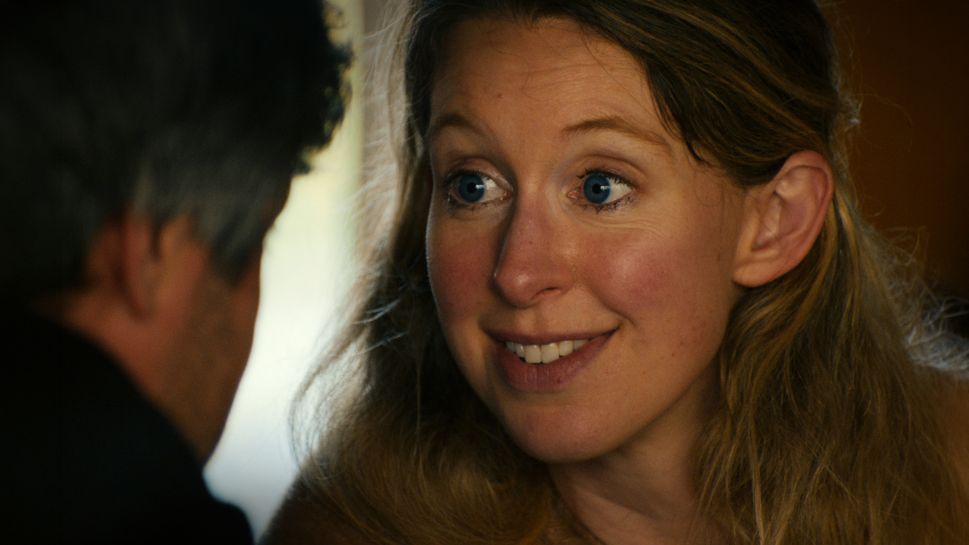
Elizabeth Holmes, deep in conversation with Nathan Fielder. ” width=”970″ height=”546″ data-caption=”Elizabeth Holmes asks Nathan Fielder, “Why would I deceive you?” in You Can See Everything. The exchange became a viral meme before the documentary reached theaters, giving the convicted Theranos founder yet another turn in the spotlight.”>
Mark Zuckerberg is back on the big screen. Sam Altman is getting the Luca Guadagnino treatment. Elizabeth Holmes and Elon Musk are the subjects of new documentaries. Hollywood has found plenty to work with in Big Tech’s scandals. Whether audiences want to watch is another matter.
Sony Pictures’ The Social Reckoning, directed by Aaron Sorkin and starring Jeremy Allen White, Jeremy Strong and Mikey Madison, follows the 2021 Facebook whistleblower scandal. Madison plays Frances Haugen, the former Facebook employee who provided internal company documents to Wall Street Journal reporter Jeff Horwitz (White), exposing what the company knew about the harmful effects of its platforms. Strong plays Zuckerberg.
Luca Guadagnino’s Artificial, a satirical drama starring Andrew Garfield as Altman, dives into OpenAI’s history, including the chaotic five-day firing and rapid rehiring of its chief executive in 2023. The movie had a buzzy premiere at the New York Film Festival on Oct. 5 and is set to hit theaters Dec. 25.
Meanwhile, audiences are gearing up for Nathan Fielder and Lance Oppenheim’s You Can See Everything. The documentary, which opens Oct. 16, follows a skeptical film crew tracking disgraced Theranos founder Elizabeth Holmes, beginning 34 days before she heads to prison. What starts as a portrait of Holmes and her family becomes a three-year examination of her life and attempts to control her public image.
On the documentary front, Alex Gibney’s nearly four-hour Musk, released Oct. 9, examines the billionaire’s business empire, personal life and growing political influence.
You don’t even have to look up at a theater marquee to see that many of these tech figures are in the cultural zeitgeist right now. Altman appears on the digital cover of Vanity Fair’s October New Establishment issue, photographed by Annie Leibovitz. He’s also at the top of the magazine’s annual power list, which includes Anthropic CEO Dario Amodei, Musk and Nvidia CEO Jensen Huang.
Hollywood’s Meme Treatment
But back on the film front, there’s A24’s Primetime, also directed by Oppenheim, which came out last month. Its subject, former Dateline NBC correspondent and To Catch a Predator host Chris Hansen (played by Robert Pattinson), falls more under traditional investigative media than Silicon Valley. Still, the film fits into Hollywood’s growing appetite for turning prominent and sometimes controversial figures into entertainment—and, increasingly, memes. Hansen has also added entrepreneur to his résumé, having co-founded the true-crime streaming service TruBlu.
A24 heavily marketed Primetime, dropping merchandise and rolling out camera tests of Pattinson perfecting Hansen’s voice and famous lines, sparking a wave of memes and fan edits on TikTok. Similarly, clips featuring Fielder and Holmes from the You Can See Everything trailer have gone viral ahead of its release.
Oppenheim has acknowledged how much internet culture influenced Primetime. In a September essay for A24, he recalled receiving a personalized Cameo video from Hansen, who used the message to promote his newer streaming projects. Watching Hansen’s transformation from investigative reporter to online personality helped inspire the movie.
Of course, this isn’t Hollywood’s first merry-go-round with movies about controversial tech titans. The Social Reckoning serves as a companion piece to David Fincher’s 2010 hit The Social Network, also written by Sorkin, which won three Academy Awards and chronicled the creation of Facebook while Zuckerberg was still a student at Harvard. But while Fincher’s original film captured the ambition, rivalries and nascent startup culture of the early internet days, these new movies are more interested in what happened after their subjects became powerful—and the controversies that followed.
Big Tech’s Growing Reputation Problem
Public sentiment surrounding tech founders has shifted from the enthusiasm of the early social media boom to today’s fatigue and distrust. According to Gallup research, just 20 percent of Americans say they have a great deal or quite a lot of confidence in large tech companies, down from 24 percent last year and 27 percent in 2024.
According to Navigator Research data, nearly two-thirds of likely voters surveyed in competitive congressional districts agreed with a description of Big Tech, social media and A.I. CEOs as a corrupt elite who profit from harmful, addictive products and use their money to manipulate politics. Just 22 percent agreed with a more favorable description of those executives as successful entrepreneurs who create jobs and drive innovation.
Meanwhile, an August CNBC/Generation Lab survey found that roughly 70 percent of respondents ages 18 to 34 distrusted Zuckerberg, Altman, Huang and Musk.
But as a BBC review of The Social Reckoning points out, there hasn’t been much of a reckoning for Meta itself. Zuckerberg remains at the helm, and despite years of public criticism and regulatory scrutiny, the company’s advertising business continues to thrive.
The film also struggled to find an audience. The Social Reckoning debuted to just $5.5 million at the domestic box office during its opening weekend, falling short of expectations. Maybe audiences are tired of Facebook scandals. Or maybe they just don’t want to pay to see one they’ve already spent years reading about.
Meta, meanwhile, continues to face fines, lawsuits and regulatory scrutiny, but its advertising business remains remarkably lucrative. The company reported about $59.4 billion in advertising revenue during the three months ended June 30, up 27 percent from a year earlier. OpenAI has also continued to expand since Altman’s brief ouster in 2023, with Altman firmly back in charge.
Even when real accountability happens—as in the rare case of Holmes serving a prison sentence for defrauding investors—there’s still the possibility that these figures will be recycled into viral clips and TikTok memes. That kind of attention risks turning their misconduct, or the controversies surrounding them, into just another piece of consumable content.
So are these films a genuine cultural reckoning, or just another way for the tech world to hide behind a layer of irony?