
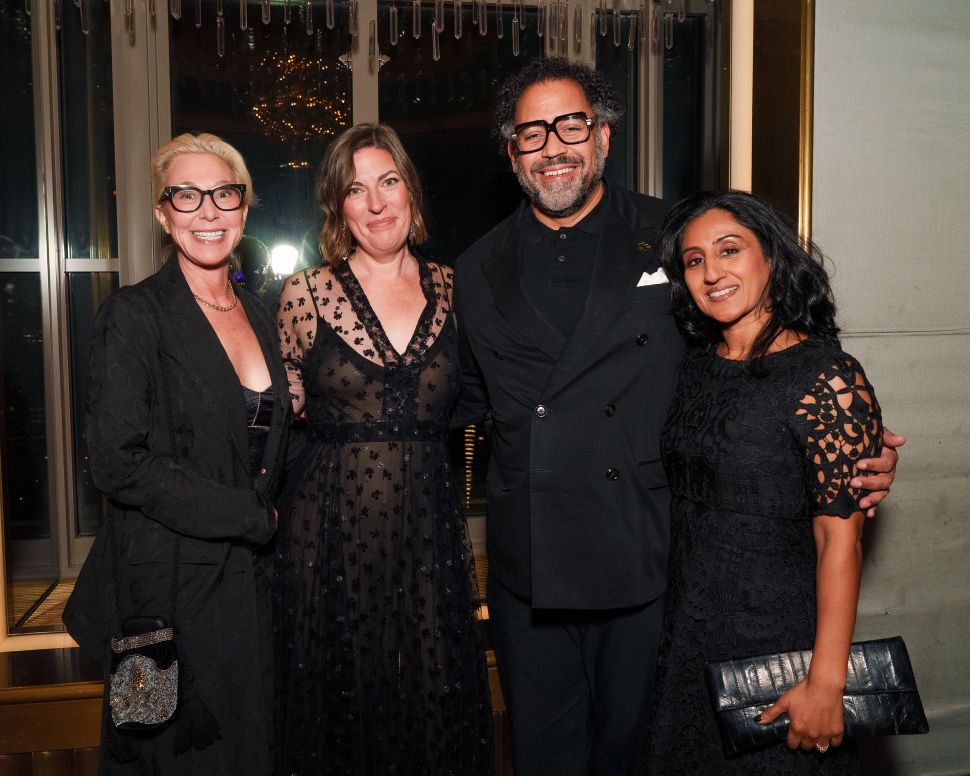
Last week, Storm King Art Center’s 2026 gala dazzled at the Rainbow Room atop Rockefeller Center. The horizon glowed a mesmerizing tangerine and yellow, and the skyscrapers’ windows turned opalescent in the waning sun; drinks and ornate hors d’oeuvres were served in Bar SixtyFive, with its wraparound terrace. There were gusts of wind and a palpable thrill as artists, trustees, gallerists and supporters of Storm King gathered to honor the artist Alicja Kwade and Cathy and Peter Halstead, founders of Tippet Rise Art Center in Montana. Funds raised that night, including via a benefit auction of works by Storm King artists, will support Storm King’s collection, exhibition, education and landscape programs.
The sharp city skyline and the vast expanse of Storm King’s 500 acres inspire different kinds of awe. Founded in 1960, the open-air museum near New Windsor, New York, is an oasis where sculpture converses with the sheer beauty of nature. With its undulating hills, woodlands, wetlands and meadows, it sits between Schunnemunk Mountain and the Hudson Highlands.
Storm King often works with artists, and in some cases their estates, to find the right spot for a sculpture. Artists have been known to walk the grounds for weeks in search of a site. They might ask for a piece to be placed in the woods or under open sky, or request a particular planting. “We really think about artwork at Storm King as being something collaborative with the landscape,” executive director Nora Lawrence told Observer. “It’s not passive.”
Experiencing the grounds is visceral. Chakaia Booker, whose work is in Storm King’s permanent collection and who wore a standout black-and-white headpiece of her own making, said that “for each person looking at the work, feeling the environment, smelling the environment, it’s spectacular.” Her favorite time of day there, she said, varies. “You get there at that moment and you either catch a rainbow or you look at the change in season, maybe it’s raining a little.”
Artist Arlene Shechet, whose artwork is also in the collection, felt similarly. Asked whether she had a favorite season, she said each was special. “I actually love even the winter, when things get covered with white crystals.”
The Empire State Building’s spire glowed azure, and the room overlooking Manhattan was packed. We spotted board member Lisa Stern, granddaughter of Storm King co-founder Ralph E. Ogden and founder of the museum’s education program, in a bright jacket that looked as if it had been painted with colorful squiggles. Storm King was “tiny in the beginning,” she told Observer, “just a few acres and a few artists.” Her grandfather, whom she described as “a lot of fun,” was a committed land conservationist. When a friend died and left him a large estate, Ogden wanted to use the land for the public good but didn’t know how, until he saw the outdoor sculpture collection at the Kröller-Müller Museum in the Netherlands. “That’s it,” she recalled him saying. “We’re going to do outdoor sculpture.” In 1967, he bought 13 works by David Smith, “because they were affordable.” He lived on the grounds and drove around to watch the progress, “totally obsessed.”
It runs in the family. After Ralph E. Ogden passed, Stern’s father ran Storm King, adding the trams and the café. Her brother took over next and recently retired, though he remains on the board. As we talked, Stern was joined by her sister-in-law, Sarah Lawrence, in an olive lace blouse. “You don’t need to speak to me, just family members,” Lawrence joked. “I’m just like a tagalong.” (She also happens to be the curator in charge of the Robert Lehman Collection at the Metropolitan Museum of Art.)
Praising Storm King, Lawrence noted that in earlier generations, much of artists’ outdoor work was confined to urban plazas. “To have the opportunity, with this vast landscape, to fill the space, interact completely differently with the public—I think Storm King is one of the greatest philanthropic achievements.”
“It’s exemplified by my father,” Stern added. He once gave a tour to her son’s second-grade class and asked the children where the museum’s walls were. The kids looked around. “It’s the woods, it’s the landscape.” And the ceiling, he asked? “The sky.” He told them it was all open to their imagination.
Board member Hume Steyer, in a striped Charvet bow tie, helps ensure that the view from this museum without walls or ceilings stays protected. He is also a trustee of the Open Space Institute, a nonprofit that conserves thousands of acres surrounding Storm King. “If anyone ever wants to build a house up there,” he quipped, “they want us to spring into action and kill them.” Had he ever done that? “I have never killed anybody,” he deadpanned.
The dinner bell rang, and guests lined up in the bottleneck between the bar and the Rainbow Room. Waiting in line, Observer caught up with gallerist Erica Weiss and conceptual artist Josephine Meckseper. Asked about the Rainbow Room’s allure, Weiss said, “I feel like New York puts you through a lot, and it’s nice to have reminders why you do it. And then you have this room. You’re like, oh yeah, I get it.”
Meckseper will present an installation at Storm King in the spring of 2027. She loves that she can experience art in nature there, “almost like a utopian idea.” Her project takes its cue from a specific aspect of the landscape and becomes a kind of mapping exercise. “I’m almost creating a star constellation that is based on the nature of Storm King and then translating it into a conceptual sculpture.” It is also, she added, “a comment on male-dominated, vertical sculpture… kind of playing with the idea of doing it almost like an inverted monument.”
At the center of the Rainbow Room is its famous revolving dance floor, set beneath a recessed domed ceiling. Art Deco chandeliers cascaded overhead, crystal sconces glowed and the windows, hung with dangling cut crystals, sparkled like rain on glass. Each table held an arrangement of orange and pink dahlias accented with burning bush from Heart and Soil (pun intended).
As guests dined on local burrata with beet purée, arugula and marjoram pesto, Storm King board chair Nicholas Polsky, who first visited Storm King 50 years ago, welcomed attendees and said the place “still feels mind-expanding and will never grow old.” Nora Lawrence then made opening remarks and introduced Kwade, who she said “is pushing the boundaries of sculpture.” Kwade admitted that sculpture is not an easy field: it’s heavy, hard to ship and annoying at times. She thanked the room, telling the audience that art needs supporters like them. “But you also need us,” she added coyly, to laughter and applause.
Over a choice of Atlantic salmon or the 1934 Rainbow Room filet mignon, Pritzker Prize-winning architect and Storm King trustee Francis Kéré introduced Cathy and Peter Halstead. “Art is not just to collect and put it somewhere,” he said. “It is to make it accessible to many people.” Peter, who is also a poet and musician, took the stage in a ski hat, “because it’s a chilly night,” while Cathy, a painter and Storm King trustee, wore an ocean-print dress. Each spoke about how meaningful Storm King has been in their lives.
After a dessert trio of cheesecake, Key lime and caramel crémeux, Observer spoke with Kwade. She said that although she had visited Storm King, made maps and plans and knew exactly where her piece LinienLand would go, seeing it installed for the first time was a surprise. “It was beautiful. I was super excited, because it’s like a theater play with no rehearsal.” She was also touched to finally meet the Halsteads, who own one of her works. They were, she said, “surprisingly normal, beautiful people.”
For Peter Halstead, the night was “the thrill of a lifetime.” He told Observer that Storm King had “structured our life since 1978,” when he and Cathy first got together. The institution befriended them long before Tippet Rise existed, introducing them to artists like Mark di Suvero (they now own four of his sculptures). “On di Suvero’s 90th birthday, when he could have gone anywhere, he came to Tippet Rise,” Halstead said. He added that they had imagined Tippet Rise as “a little mom-and-pop thing in the middle of nowhere where we could just do our thing. But bit by bit, it builds, year by year, until now it is a bigger thing.”
As departing guests congratulated her, Cathy Halstead told Observer she was “a little overexcited. It was our dream in so many ways.” As for why she chose an ocean-print dress for the occasion, she said, “It’s one of those incredible natural forces that fills us with beauty. And Storm King fills us with beauty, with the land, the trees, all the different greens, the sky. It’s another element.” She was bursting, she said, with joy, love and every other emotion. “Storm King, in so many ways, was the inspiration for Tippet Rise. It is such a place that has filled us with yearning for what the world can be.”
Marc Glimcher and Melissa Chiu
Peter Halstead and Cathy Halstead
Essye Klempner and Chakaia Booker
Kevin Beasley and Golnaz Esmaili
Diébédo Francis Kéré
Maya Lin and Nick Polsky
Nicelle Beauchene, Nora Lawrence, Patrick Resing and Victoria Lichtendorf
Kellie Honeycutt and Miguel Hennessy
Neil Bender and Marika Bender
Victoria Tigipko
Peter Halstead, Nora Lawrence and David Nolan
Adela Goldsmith, Karen Zukowski, Jean Shin and Brian Ripel
Noa Khamallah
Jennifer Field and Luke Smith-Stevens
More