
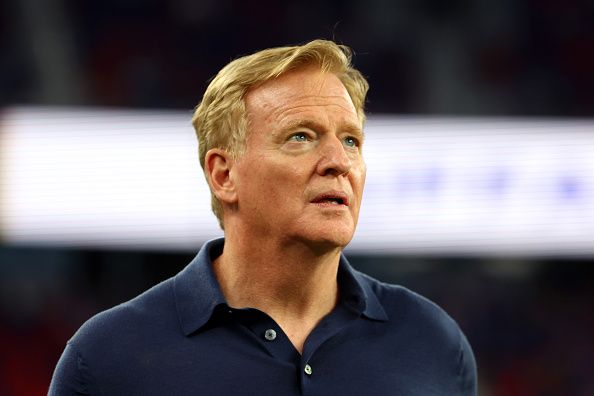
NFL Commissioner Roger Goodell looks on prior to the game between the Buffalo Bills and the Detroit Lions at Highmark Stadium on September 17, 2026 in Orchard Park, New York.” width=”594″ height=”396″ data-caption=’NFL Commissioner Roger Goodell has helped turn the league into a $23 billion annual business. As the NFL seeks more money from broadcasters and expands its streaming and international footprint, questions are emerging about how much more fans and media partners are willing to pay. <span class=”lazyload media-credit”>Photo by Timothy T Ludwig/Getty Images</span>’>
No empire lasts forever. That’s especially true in sports, where audience preferences shift alongside changes in how people watch. As television expanded in the 1970s, American football’s weekly schedule, high-octane violence and start-and-stop nature made it a near-perfect fit for the medium. Before long, it was the nation’s most popular sport.
Fifty years later, the NFL remains atop the American sports hierarchy. Commissioner Roger Goodell’s aggressive expansion strategy has grown annual league revenue from roughly $6 billion when he took over in 2006 to more than $23 billion today. But that growth has raised longer-term questions. The NFL is still firmly in its peak era. What’s less certain is whether its business model can keep maximizing revenue without alienating the fans who make it so valuable in the first place.
America’s Monoculture
The NFL is the most popular programming in the U.S. by far. Bigger than Game of Thrones, Stranger Things and Yellowstone. NFL games accounted for 83 of the 100 most-watched U.S. telecasts in 2025, according to Sportico, and 25 of the top 50 so far in 2026, according to Samba TV data provided to Observer. Football remains America’s favorite sport to watch at 31 percent, per Gallup, although that’s its lowest share since 2001. There’s a reason why every major media partner uses NFL games as powerful lead-ins for its other programming.
“In an increasingly fragmented media landscape, the NFL is the last vestige of monoculture we have,” Alyson Sprague, Samba TV’s vice president of measurement science, tells Observer.
That dominance enables Goodell and company to command the largest media rights deals of any North American sport. The league’s agreements with its major broadcast and streaming partners, beginning in 2023 and collectively worth approximately $110 billion, bring in upward of $10 billion annually. That’s comfortably ahead of the NBA’s approximately $6.9 billion in annual domestic media rights revenue and far more than other major U.S. sports leagues collect.
Yet the NFL’s leverage may finally be approaching its limits.
When the Networks Push Back
In September 2025, Goodell told CNBC that the league could begin renegotiating its media rights agreements this year, well before its contractual opportunity to exit most of those deals after the 2029 season.
“I think our partners would want to sit down and talk to us at any time, and we continue to dialogue with them. I like that opportunity,” Goodell said.
The message was widely interpreted as the NFL flexing its muscles: Deal with us now or pay the price later.
But some question whether Goodell overplayed his hand. The league was reportedly seeking as much as a 100 percent increase in media rights fees, while television executives were more comfortable with a 25 percent bump.
That Grand Canyon-sized gap has produced some resistance. In August, FOX CEO Lachlan Murdoch publicly announced that the network would not renegotiate its existing NFL deal ahead of schedule. Fox intends to continue under its current agreement through the 2029 season before revisiting the terms closer to 2030.
The tensions extend beyond contract negotiations. The Wall Street Journal reported that Rupert Murdoch raised concerns with President Donald Trump about the NFL moving more games to streaming services, fearing the damage that could do to traditional broadcasters.
Paramount-owned CBS hasn’t reached a new agreement, either. Negotiations were put on hold in August, while Paramount dealt with legal challenges to its proposed merger with Warner Bros. Discovery. That merger has since closed, but there’s little sign CBS is in a hurry to resume negotiations. At an October industry event, Paramount board member Gerry Cardinale suggested the network would be better off renegotiating “in a few years when the contract comes up,” according to Sports Media Watch.
Even with all that friction, fans haven’t abandoned the NFL. Early-season viewership was briefly down from a year earlier, prompting complaints from the league about Nielsen’s measurement changes. But by Oct. 9, average viewership had rebounded to 20.2 million through Week 4, up 4 percent from the comparable period in 2025.
“The NFL is still well-positioned to substantially grow its next major rights deal, but there are limits, as the league just found out the hard way,” Wade Payson-Denney, founder of WPD Communications, which advises media companies on communications strategy, tells Observer.
He also notes that Amazon and Alphabet, two of the league’s major streaming partners, are spending enormous amounts on A.I. infrastructure. That competition for capital could affect how much either company wants to commit to additional football rights.
Okay, so the NFL and its broadcast partners aren’t exactly on the same page about the economics. But is there any tangible evidence that the league’s empire is showing signs of structural weakness?
Audience Reality
Reach versus revenue is the balancing act every major sports league is fighting. Making the most money possible and remaining accessible to the greatest number of people don’t always go hand in hand.
As I’ve previously covered, fans who want to watch every NFL game need some combination of CBS or Paramount+, Fox, NBC or Peacock, ESPN or ABC, Amazon Prime Video, YouTube’s NFL Sunday Ticket and Netflix. Unsurprisingly, some fans have grown increasingly frustrated.
The NFL says more than 87 percent of its games are carried on free, over-the-air television in at least one market, and every game is available on local broadcast television in the participating teams’ home markets. But fans relying solely on an antenna can’t watch every game, particularly when following teams outside their home markets. Nationally exclusive streaming games also require subscriptions for viewers outside those local markets.
According to the same Gallup study, just 20 percent of Americans ages 18 to 34 name football as their favorite sport to watch, compared with 38 percent of those 55 and older. Younger millennials and Gen Z are the NFL’s softest demographic groups by that measure. Yet Samba TV reports that the NFL reaches 41.2 percent of households with adults ages 18 to 34, broadly consistent with national averages.
“The NFL bringing its games to streaming hasn’t increased reach, which is essentially flat for the first four NFL games from last year,” Sprague says. “But streaming has increased engagement among existing football fans.”
The distinction matters. Gallup asks Americans to name their favorite sport to watch. Samba measures who actually watches NFL games. The latter remains envy-inducing, even if the former suggests the league’s hold on younger generations is less secure.
The Cost of Fandom
The trend points to the NFL’s major long-term threat: Extracting more money from existing fans may be making it harder to cultivate future ones.
The share of NFL-viewing households using streaming to watch games rose from 20 percent to 26 percent from a year earlier, according to Samba. In-person attendance was down slightly in 2025. And the league’s newer stadiums offer another example of how the economics are changing.
Buffalo’s new Highmark Stadium, which opened this year, holds about 60,000 fans, roughly 11,000 fewer than its predecessor. Nashville’s new stadium, expected to open in 2027, will also have a smaller capacity than its predecessor while offering more premium seating and hospitality options.
“Sports fandom is largely passed down from one generation to the next via communal live experiences,” Payson-Denney says. “If the current generation of middle-class Americans get priced out of attending games, they’re going to be less likely to develop a passion and love for the game that gets passed down to their children.”
Ryan Schreiber, founder of Streamline, an aggregator that helps sports fans navigate the growing number of subscriptions and platforms carrying their favorite teams, shares that concern.
“The NFL is best positioned to get away with maximizing revenue, but there’s a breaking point from a cost perspective for fans, and while we maybe we haven’t reached it yet, it’s on the horizon,” Schreiber tells Observer.
Exclusive games on Amazon Prime Video, ESPN+, Netflix and Peacock require paid subscriptions to access nationally, even as local broadcast arrangements preserve free access in participating teams’ home markets. Luxury seating allows teams to charge more per ticket while reducing the number of less expensive seats available.
In the short term, the strategy funnels more money into the NFL ecosystem. In the long term, it risks making the league less accessible to potential new fans.
What’s Next for the NFL?
Scattering its broadcast rights across the television map may be frustrating for fans, but they’re still following the games for now. Schreiber argues that new platforms, game windows and formats can expand the league’s audience rather than merely divide it.
And Goodell’s emphasis on cultivating international fans has been paying off. The NFL scheduled nine international games across seven countries this year and continues to explore ways to monetize its growing overseas audience. A separate package of international media rights could eventually generate more than $1 billion annually, according to reporting from Front Office Sports, although the league has not announced such a deal.
A potential move to an 18-game regular season would create even more inventory to sell. But it would also risk watering down the do-or-die weekly stakes that football’s limited schedule has traditionally guaranteed, to say nothing of the physical toll on players. Any expansion would require negotiations with the players’ union.
Changes abound, and most of the people making these decisions today may not be around to deal with their long-term consequences.
“Today’s executives are going to be collecting lucrative MBA lecture gigs by the time any of this negatively impacts the value of the league,” Payson-Denney says. “Their successors are the ones who will be holding the bag when football just doesn’t matter as much to fans two or three generations down the road.”
The NFL is in no immediate danger of losing its throne as America’s most valuable media property. No other sports league has emerged as a true challenger. Goodell’s insatiable hunger for growth has helped build an extraordinarily lucrative business, one that looks increasingly insulated from its competitors.
Whether that same ambition can preserve the NFL’s power for another 50 years is a different question.