
In The Devil Wears Prada 2, Anne Hathaway’s Andy Sachs borrows a flowing, multicolored patchwork Gabriela Hearst dress from the closet of the fictional Runway magazine to wear to the Hamptons. An investigative journalist by training and a dilettante in the fashion world, Hathaway’s heroine promises Stanley Tucci’s Nigel that the dress will stay spotless. In short order, she spills an hors d’oeuvre on it and runs to the kitchen to scrub off the growing stain.
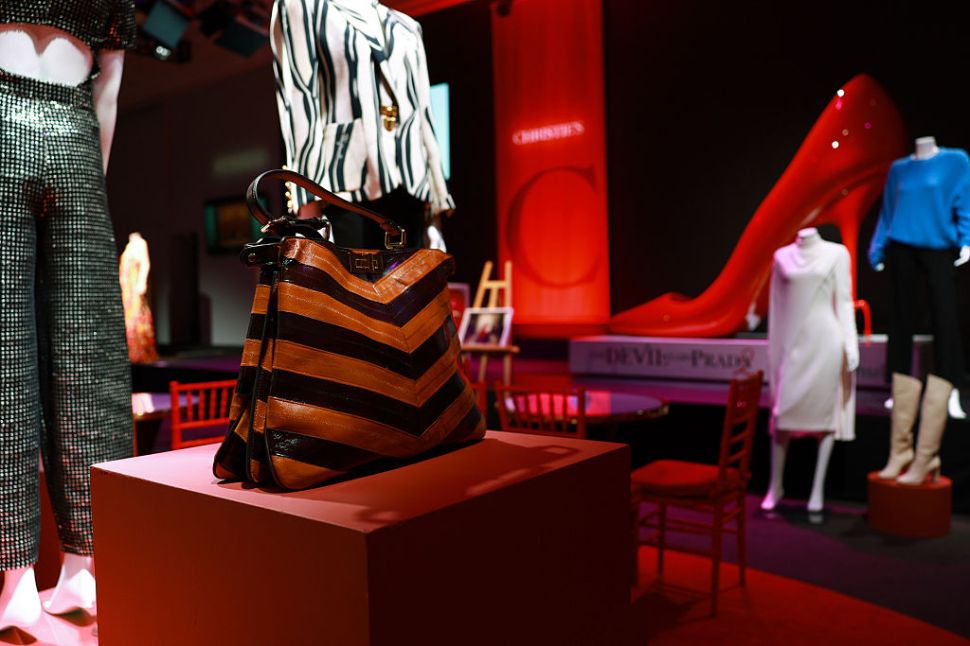
Knockoffs of the tainted frock have since proliferated online, promising the look without the $7,900 price tag, but they can’t beat the real thing. Hearst’s hand-painted linen maxi dress is based on a vibrant geometric drawing and took a team of 40 artisans to bring to life. Last month, it went on the block at Christie’s, part of a dedicated online sale of apparel and accessories from The Devil Wears Prada 2, where it achieved $12,160 over a $4,000 high estimate. The sale was an homage to the summer blockbuster with proceeds going in part to the Committee to Protect Journalists, in keeping with Andy and Miranda’s fight to defend fashion journalism amid corporate mergers.
“This is really Meryl Streep’s brainchild,” Nathalie Ferneau, 30, an associate specialist for Private and Iconic Collections at Christie’s, told Observer. “We have costumes that were worn on screen, we have some pieces that were ready to be worn on screen but may not have actually made it in the film, we have couture pieces in the press tour. One of my favorite pieces is this incredible custom Balenciaga look worn by Emily Blunt. It is a red strapless top with an extensive train and then matching red cigarette pants and red heels, a monochromatic look with dramatic taffeta behind it. . . it’s really a showstopper.”
While that particular look failed to hit its low estimate, it nonetheless sold, along with everything else in the auction—perhaps unsurprisingly, as fashion collecting is on the rise alongside a secondary market that hit $55.5 billion in 2025. Younger Millennial and Gen Z buyers are entering the auction market, but where older generations might have splashed out on art or fine wine, these bidders are raising their paddles for signature couture and archival accessories. (Forty-one percent of all new bidders and buyers entered Christie’s through luxury auctions, and 44 percent of participants in 2025 were in those generational cohorts.) “I think people are maybe a bit fatigued with modern or contemporary clothes that are made because of the reduction in quality,” said Keesean Moore, 37, a former stylist and the owner of Philadelphia-based Moore Vintage Archive. “When things are so mass-produced, it’s difficult to have an individualized look.”
Fashion collecting has always existed, of course. Azzedine Alaïa was renowned for his collection of beautiful, statuesque Dior gowns, and the journalist Alexander Fury has assembled an archive of more than 3,000 pieces, including John Galliano’s fantastical creations and a coat Alaïa fitted on Fury himself. Fashion historian Sandy Schreier has amassed one of the largest private couture and 20th-century fashion collections in the world, featuring works by designers like Balenciaga and Valentino. Designer and socialite Daphne Guinness collects rare Alexander McQueen and acquired the entire personal archive of late stylist Isabella Blow.
Fashion’s rise as an asset class is arguably new, yet even as prices have skyrocketed, so has the zeal of fashion aficionados, many of whom skew younger. Gen Z consumers notably lead the resale market, making up 54 percent of shoppers. (Millennials made up 43 percent of bidders in the auction of the maximalist icon Iris Apfel’s wardrobe at Christie’s; the sale prompted the creation of 1,000 new accounts.) Kate Mao, who founded the appointment-only Manhattan showroom Into Archive, pointed to Fendi Baguette handbags, once an entry-level staple. “If you go to Fendi, the minimum entry has become $10,000,” she told Observer. “And that’s the same price as a Birkin, which is quite wild. Back in the day you could easily pick one up for $2,000 or even $1,000.”
Mouna Ayoub Haute Couture Collection Is Displayed At Le Bristol Prior To Its Auction On January 29th” width=”970″ height=”647″ data-caption=’Couture collector Mouna Ayoub. <span class=”lazyload media-credit”>Photo by Luc Castel/Getty Images</span>’>
That said, neither ‘vintage’ nor ‘secondhand’ implies inexpensive in this context. Iconic luxury handbags and historic runway pieces now routinely break auction records. Jane Birkin’s original Hermès Birkin sold for a record-breaking $10.1 million at Sotheby’s in 2025, becoming the most expensive handbag ever sold on the secondary market. Mouna Ayoub’s collection of Dior masterpieces achieved €6.19 million at Kerry Taylor Auctions in January 2026, setting multiple records. What generally ends up on the block are the kinds of pieces that savvy shoppers have been educated to regard as investments.
“We are increasingly seeing participation from the youngest generations as they are introduced to the world of collecting through social media channels,” Rachel Koffsky, international head of handbags and accessories at Christie’s, told Observer. Online communities on X (formerly Twitter), Instagram and TikTok have opened up what was once an exclusive industry to anyone with a passion for fashion. And the impact of virality can’t be ignored. This past summer, photos of Bella Hadid and Tyla in Roberto Cavalli’s unmistakably sensual silk dresses gained traction on social media, fueling sales of the Cavalli dresses Mao had assembled for Into Archive.
Diana’s Revenge Dress On Display In London For Final Time Ahead Of Auction” width=”970″ height=”647″ data-caption=’The infamous Christina Stambolian Revenge Dress worn by Diana, Princess of Wales on the final day of its public display at Sotheby’s in London. It will go on the block in New York in December. <span class=”lazyload media-credit”>Photo by Ben Montgomery/Getty Images</span>’>
A connection to a mythic figure like Princess Diana, Audrey Hepburn or Carolyn Bessette-Kennedy can also drive demand, sending a piece’s price at auction soaring and making it largely unattainable for new collectors. But nostalgia for a time before fast fashion went mainstream, when clothes felt better crafted and more authentic, is rampant, and there’s plenty of less buzzy but still pedigreed collectible fashion going on the block.
Lately, Moore has been collecting pieces from the archive of Anna Bayle, often hailed as the first Asian supermodel, focusing on clothes Azzedine Alaïa personally gave to the willowy, doe-eyed muse. “It’s a mixed bag like a lot of the Alaïa pieces are skirt suits in separates, bomber jackets, blazers, some dresses. I don’t do a ton of bags, that’s not my specialty. But for me it’s like the clothing,” he said. “I’ve always just been naturally more drawn to clothes because of the styling element of it. You can just throw the bag on anything, it doesn’t necessarily require a lot of personal style. I just like clothes better.”