
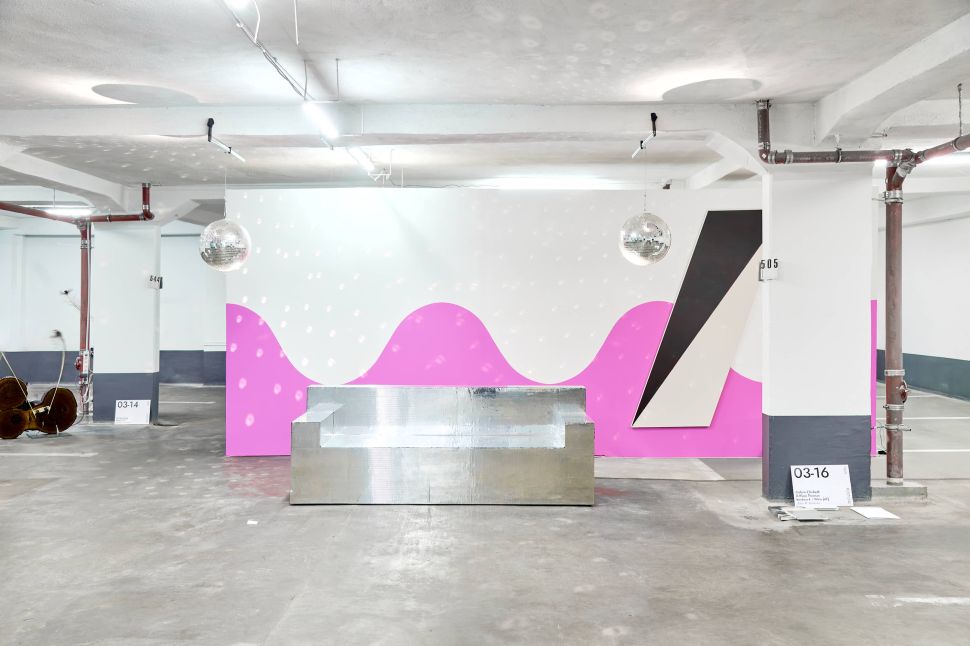
Among the highlights at the spacious, multistory Astoria Garage in Vienna this past September was FS 272 (1992), a mirrored sofa by the celebrated Swiss artist John M. Armleder made of furniture, reflective surfaces, lights and rotating disco balls. The work was presented at Vienna’s newest art fair, Astoria Artshow, by Galerie Elisabeth & Klaus Thoman, a member of Vienna Art United, a group of 35 Viennese galleries that organized the fair. It was the first time the garage had been used for a major art event. Built in 1923 in the center of Vienna and said to be Europe’s first and largest tower garage, the space was designed for the fair by the Berlin-based architecture firm Kuehn Malvezzi, whose credits include documenta 11, the Belvedere and the Hamburger Bahnhof in Berlin.
The nonprofit Vienna Art United was founded in April 2026 to launch what the organizers call “a new, central, international art fair” in Vienna, following the cancellation this year of the city’s two main fairs, Vienna Contemporary and Spark Art Fair Vienna. “Gallerists in Vienna saw the urgency to act collectively and to communicate with each other to create this new art fair, [an] internationally recognizable art fair that is run by the city’s galleries,” Maximilian Thoman of Galerie Elisabeth & Klaus Thoman told Observer, adding that this year’s presentations signal ambitious plans for future editions of Astoria Artshow.
Astoria Garage. Photo: Stefan Gergely
The fact that the fair is organized by the city’s own galleries “is kind of unique,” said Vienna-based sculptor and filmmaker Julia Haugeneder, adding that “everyone [was] very much looking forward to and coming together” after the announcement in July. That enthusiasm was reflected in the response from artists, collectors, gallerists and art lovers, as well as from supporting partners like the Austrian Federal Ministry for Housing, Art, Culture, Media and Sport, the City of Vienna’s Department of Culture, the Museum of Applied Arts (MAK) and the Academy of Fine Arts Vienna.
Astoria Artshow’s organizers adopted what they called a “solidarity-participation model,” in which participation fees were based on each gallery’s revenue and size rather than the size of the booth. Around 80 Austrian and international galleries opted into the inaugural edition, including art spaces from Romania, Italy, Belgium, the U.K., Norway, Germany, Switzerland, Slovenia and the Netherlands. Main Positions, devoted to contemporary solo presentations, included Christine König Galerie, CFA Contemporary Fine Arts, Galerie Krinzinger, City Galerie Wien, Smolka Contemporary, Crone Berlin, Nicolas Krupp and Rhomberg Gallery. New Positions – Zone 1, curated by Casandra Hermann and dedicated to young emerging artists from Austria, included presentations by galleries such as AG18, Exile, Shore, Mountains and Charim. The Editions, Publications, Projects & Institutions section hosted academies, art publishers and art spaces including the University of Applied Arts Vienna, the Academy of Fine Arts Vienna, Art Association Garden House, Gallery by Garage Show and Monopoly.
Amsterdam-based Galerie Ron Mandos presented a solo booth of work by the Cuban American artist Anthony Goicolea, including large-scale paintings and Untitled Sleep, a mixed-media installation. “The work depicts the passage from childhood to adulthood, and the precarious existence of refugees, many of them children and teenagers, adrift between worlds,” the artist said in a statement. “For them, the journey into the unknown often marks an abrupt end to childhood or even life itself.”
Another highlight was Austrian gallery Lisi Hämmerle’s presentation of works from the Still Life 3000 series by Vienna-based artist and filmmaker Claudia Larcher. A contemporary reinterpretation of the traditional still life inspired by the renowned Dutch painter Rachel Ruysch, the series features motifs such as a techno-aesthetic bird skull, a shattered smartphone and a bee-like drone, speaking to the fragility of life and the interplay between nature and technology. (Larcher is also the subject of a major solo show, “No applause. no life. no pain,” curated by Eva Fischer at the Francisco Carolinum museum in Linz, Austria.)
Elisabeth Kihlström, L’oro del mare. Video installation, BEK Forum Vienna 2026. Photo by Manuel Carreon Lopez. Courtesy BEK Forum Vienna
Astoria Artshow is “a very important” and “very innovative” addition to Vienna’s art scene, according to Bärbel Vischer, curator of contemporary art at the city’s Museum of Applied Arts, pointing to the choice of the Astoria Garage as a venue and the collective effort of the gallerists who developed the fair’s concept.
When Observer visited, the museum was hosting “Rooms That Dream of the Past,” a solo show by the renowned Berlin-based artist Thomas Demand that draws on the visual power of theater and opera. Curated by Vischer, the show is on view through Jan. 24, 2027. (The museum is also presenting “Wien 1900,” named for the era when Vienna became one of the most important centers of modernism. Described as a redesign of the museum’s permanent collection, which spans furniture, glass, porcelain, silver and textiles from the Middle Ages to the present day, the show was created in collaboration with the contemporary Austrian artist Markus Schinwald and aims to build a bridge between past and present. It is on view through Aug. 31, 2030.)
Nearby, the Franz-Josefs-Kai Contemporary Art Space was showing “Passants parmi les pierres,” a group show curated by Demand featuring work by Carrie Mae Weems, Mohamed Bourouissa, Esther Hovers, Jens Franke, Thomas Struth and Cai Dongdong, among others.
Galerie Ron Mandos presenting Anthony Goicolea Photo: Robert Puteanu, courtesy Galerie Ron Mandos Amsterdam
Held concurrently with the Astoria Artshow were Parallel Vienna, an alternative art fair and hybrid festival, and Curated By, a gallery festival that brings together 24 Vienna-based galleries and invites international curators to respond to an annual theme with exhibitions addressing social issues. This year’s 17th edition is themed “LOVE” and runs through Oct. 17, 2026.
Several museums, galleries and independent, alternative and artist-run spaces concurrently hosted solo and group exhibitions, including the Secession, Wien Museum, Kunstraum Niederoesterreich, Neuer Kunstverein Wien, Kunsthalle Exnergasse, Can, Mumok, PART Residency, BEK Forum Vienna, AG18 Gallery, Bonartes Photo Institute and Belvedere 21, which is presenting the first solo museum exhibition in Europe of the Chinese contemporary artist Miao Ying. Foto Arsenal Wien, meanwhile, is showing solo exhibitions by the South African visual activist Zanele Muholi and the Ghanaian Austrian photographer Eric Asamoah, both running through Jan. 10, 2027.
“I think that Vienna has one of the most dense art scenes in Europe in relation to the size of the city [and] the size of the country. We have an incredible number of museums, artist-run spaces, and art galleries,” said Vischer. The city, she added, “has a very lively contemporary art scene. We have many very active galleries that work with artists across all generations, and they have a strong experimental and conceptual focus. We have two art schools in Vienna, which also contribute a lot. And there’s a long tradition of institutions such as the Secession.” (Her own museum belongs to that tradition: founded in 1863 by Emperor Franz Joseph I, it is dedicated to collecting, preserving and exhibiting applied arts, design, architecture and contemporary art from historical periods to the present.)
Mark Dion’s work presented by Lombardi-Kargl in Main Positions at Astoria Artshow 2026. Photo: Stefan Gergely
“The public art museums and the historic ones have been doing an amazing job in having a consistent structure and a very comprehensive curatorial and research team working on each project. And they do put in a lot of effort into presenting the shows properly,” said Li Yizhuo, a Vienna-based art historian, curator and collector. “And especially in the past year or two, there is this new wave of exhibitions focused on Vienna 1900 from all kinds of perspectives, design and crafts, intellectual media, art, philosophy, everything. So in terms of institutional presentations, you can see the consistent focus, the kind of scale [and] the kind of quality they can deliver.”
Li hopes Vienna will continue “this current trend of being more open” to other voices. Through BEK Forum, which describes itself on its website as a “production platform for art and scholarship, with a focus on project collaboration with artists and imaginative forms of exhibition and performance,” she aims to strengthen connections between collectors in the city and artists, especially new artistic voices.
Vienna’s relative affordability compared with other cities has drawn artists from across Europe, Haugeneder said. Rents that aren’t “super expensive,” along with initiatives by the Austrian government and the City of Vienna to support artists, have also been instrumental in the consistency and growth of the city’s art scene, she added.