
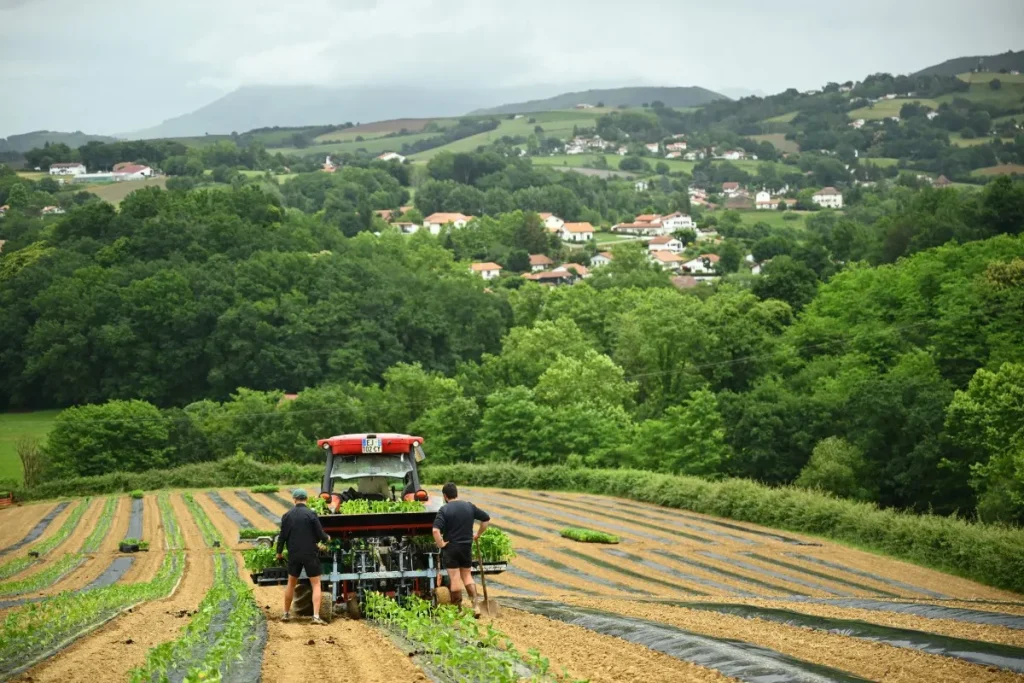
With one third of the country’s population and specific challenges including transport and access to healthcare, rural France forms an important battleground in the 2027 presidential election. Here’s a look at the policies.
The regular surveys of life in rural France revealed that rural residents are more likely to rely on their own cars for work, shopping, and medical visits. They’re likely to be less well off than people living in towns and cities. And public services that many urbanites take for granted – including healthcare – are reduced or much more difficult to access.
In a 2025 Ipsos study, 84 percent of rural respondents felt national media ignore rural life and 81 percent felt rural France is treated as a zone in decline, abandoned by Paris.
Listen to the team at The Local discuss the politics of rural France in the latest episode of the Talking France podcast – download here
This is something the populist candidates tap into, with campaigns framed around defending la France oubliée – “forgotten France”, which is home to 22 million people (out of a total population of 67 million) many of whom are of voting age.
The issue of rural life is therefore likely to play a central role in the 2027 presidential campaign – so here’s a look at some of the candidates’ policies.
There were, at the last count, 38 declared candidates in the election – many of whom have not got as far as announcing detailed policies. We’ve therefore focused on the six candidates who are currently topping the polls, arranged roughly in order of their polling scores.
The policies listed here are only those specifically aimed at rural residents, who will naturally also be affected by policies on issues like the economy, defence and immigration.
READ ALSO: Compared: The French presidential candidates’ policies for foreigners in France
Marine Le Pen
Le Pen’s Rassemblement National party is strong on a local level in rural France, with rural and small-town France electing many RN local mayors and councils. In fact, a study from 2018 found that the distance that a person lived from the nearest train station to be the single biggest indicator of a vote for Le Pen.
Although her 2027 campaign largely focuses on security and immigration, Le Pen’s party’s policies include measures aimed directly at rural residents and farmers.
She proposed a requirement for public schools, hospitals and administrative canteens to source at least 80 percent French agricultural products – the idea being to guarantee steady income for domestic farms.
Her long-standing opposition to wind farms continues, with a pledge to stop the installation of wind turbines and solar panels on rural land.
However she also proposed a programme to help livestock farmers manage the increasingly severe heatwaves that France is facing.
On the economic side, she proposes excluding agriculture from international free-trade agreements (such as the Mercosur treaty, which is extremely unpopular with many French farmers) and banning non-EU food imports produced with methods prohibited in France.
Jean-Luc Mélenchon
Jean-Luc Mélenchon’s far-left La France Insoumise – traditionally stronger in the cities – has published a series of documents in addition to the main party manifesto and one of them is a 32-page A5 booklet dedicated to ‘ruralité’.
They propose a law to guarantee that every citizen can reach essential public services and emergency medical care in under 30 minutes by car, essentially a rural version of ‘the 15-minute city‘.
The manifesto sets a target of insulating 700,000 rural homes every year – since research shows that rural residents are more likely to have poorly insulated homes, and to rely on inefficient or expensive heating methods such as wood-burners or oil-fired boilers, giving them expensive energy bills.
When it comes to farming, Mélenchon supports “a widescale transition toward agroecology”, meaning more ecological farming methods.
The party proposes abolishing administrative super-structures, such as métropoles and intercommunalités, and returning decision-making power and budgets directly to local mayors and communes. There are also promises to rebalance municipal funding.
Fully renationalising the SNCF rail network is also in there – something that might get the attention of the 48 percent of rural residents who work in an urban area.
Édouard Philippe
The centre-right candidate Philippe’s main focus is on making things simpler and more profitable for farmers, especially by streamlining regulations and paperwork.
His key policy for the agriculture industry – confirmed on a visit to Metz-Magny in September – is water. Specifically the need to facilitate water storage and reuse to combat the increasingly severe summer droughts.
On healthcare, he proposes building maisons de santé pluridisciplinaires (multi-disciplinary health centres) in rural areas that have a shortage of doctors, saying that shared facilities would reduce waiting times.
Like Mélenchon, he advocates giving local mayors a bigger say in housing, transport and administrative decisions rather than centralising rules in Paris.
Raphaël Glucksmann
Centre-left candidate Glucksmann wants to spend €200 billion on a ‘Grand Adaptation Plan’ for agriculture – he says farmers are on the frontline of both climate change and climate resilience.
The MEP put his green credentials in policies early, visiting a community windfarm on his first official outing after declaring his candidacy, and seeking to link ecological transition with agricultural concerns, land-use planning, and adaptation to extreme weather events.
For rural households, he proposes an energy voucher (chèque énergie) to help cover costs, and a tax-free savings account to help finance home insulation.
Gabriel Attal
Centrist Attal also targets farmers, but he’s more focused on economic competitiveness and reducing red tape – things like permanently reducing employer payroll taxes for seasonal farm workers and protecting agricultural fuel tax relief.
On the economic front, Attal advocates a recovery policy focused on ecological transition and support for innovative business.
He proposes incentives to encourage investment in renewable energy and green technologies, through tax incentives and subsidies, and also wants to strengthen support for low-income households in order to reduce economic and social inequalities.
This approach aims to create sustainable economic growth in rural – and urban – areas while addressing pressing environmental challenges.
Bruno Retailleau
The right-wing Retailleau is proposing the creation of a Ministry of Rural Affairs to address the challenges facing rural areas in France.
Retailleau argues that creating a dedicated ministry would allow for better coordination of public policies that support these areas, rather than current ‘centralised’ policies that do not sufficiently take into account local specificities. By creating a Ministry of Rural Affairs, he hopes to give rural areas a stronger voice in government.
He also proposes measures to support agriculture, notably by increasing aid to small farms.
He says that developing digital infrastructure is also crucial to improving connectivity in rural areas, and a focus on economic sovereignty, reindustrialisation, and reducing regulations burdening businesses.