
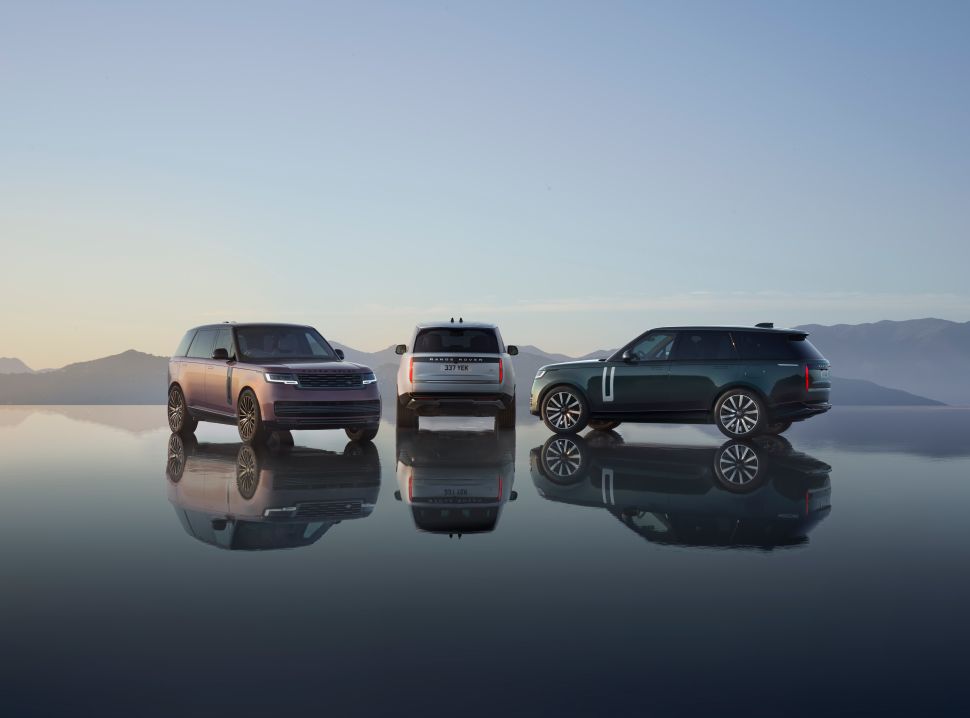
Range Rover is such a well-established, trusted luxury brand that its customers settle comfortably into the seasonal rhythm of its annual releases. Every fall brings updated models, and fans of the U.K.’s most established SUV brand happily rub their hands together in anticipation of their next potential purchase, one destined to carry them comfortably across town or through the wilds.
This model year brought those fans special excitement with the unveiling of an entirely new, eagerly awaited model: the Range Rover Electric (or Range Rover Battery Electric Vehicle, if technicalities are on the menu). The automaker’s first fully electric SUV, the BEV arrives with one assignment: Do everything the dinosaur-burning Range Rovers do, without compromise.
Right out of the charger, the Range Rover Electric, which starts at about $138,000, outperforms the latest gas version. Its two 260-kilowatt motors, one over each axle, produce 542 horsepower and 627 lb-ft of torque, the highest figures in both categories of any Range Rover to date.
However, the vehicle’s pedigree isn’t built on straight-line speed. A Range Rover is supposed to venture across hill and dale with confidence, perhaps towing a few extra goodies, while keeping its driver and passengers secure and comfortable. Owners of previous Range Rovers considering a jump to the BEV would balk if its electric cousin couldn’t handle water up to its doors or a rocky hill climb.
During media testing near Jaguar Land Rover’s engineering and design facility in Gaydon, U.K., the company’s engineers set out to prove that there’s nothing a gas-powered Rover can do that this electric upstart can’t. Through streams and mud, over gravel and grass, the BEV powers through its day’s work thanks to a new traction management system that can respond in as little as 50 milliseconds. In simpler terms, the onboard intelligence senses which wheel has the best grip on any surface at any moment and sends power to that wheel 100 times faster than any current combustion model, according to Range Rover.
Off-roading fans wouldn’t doubt for a moment that a gas-powered Range Rover can handle wet conditions, but adding electricity to the mix might raise a few questions. In answer, the BEV is rated to wade through up to 35 inches of water. To put would-be buyers at ease, Range Rover engineers had test drivers run the electric prototypes the equivalent of 38 times around the world, both on the road and in extreme environments.
The BEV’s motors are powered by a 118.5-kilowatt-hour battery pack with 800-volt technology and split charging. At a high-performance DC charger, the battery charges from 10 to 80 percent in 22 minutes. But for an EV like a Range Rover, which is expected to do more than shuttle back and forth to the store, the most important statistic is range. Whether in grand touring mode or far afield where charging is impossible, the Range Rover Electric needs enough legs to get out into the world. The new SUV has an EPA-certified range of 333 miles, with some give and take for driving conditions.
Beyond surviving rough terrain, every member of the Land Rover and Range Rover family has to deliver maximum comfort to driver and passengers. To that end, the 2027 BEV takes an already quiet electric SUV and adds advanced drivetrain isolation for an exceptionally hushed cabin. Active noise cancellation creates individual quiet zones for each occupant, and even the Meridian Signature Audio system is tuned specifically to fill an EV’s quieter interior.
Unlike other automakers that uglify their EVs so owners can advertise how they’re saving the planet by driving unattractive cars, Range Rover made minimal changes to its first electric model. It adapted the grille, since an EV has no radiator to cool, and altered the underbody to protect the battery pack. Otherwise, even the most trained eye couldn’t tell the BEV from its gas-powered siblings.
Traditionalist gearheads frown on every EV, and single-minded environmentalists believe nothing with four wheels should have an engine anymore. The reality is that an EV isn’t right for every purpose, but it’s very right for some. Electric driving fits the luxury owner like a tailor-made shoe. That buyer can likely afford to install the companion home charging unit, ensuring a fully charged battery every morning.
As with all EVs, the Range Rover Electric faces range and charging challenges away from home. Its extended range allows for plenty of urban and regional travel, but the availability of charging stations out on the highway and in the wilderness will determine how far the BEV can go and how long it has to wait before going farther.
Range Rover can bring an electric SUV to market, but it can’t make governments invest in charging infrastructure. It’s up to buyers to decide whether their surroundings and driving habits make an EV workable. If they don’t, there’s no sign Range Rover plans to retire its gas or hybrid models anytime soon.