
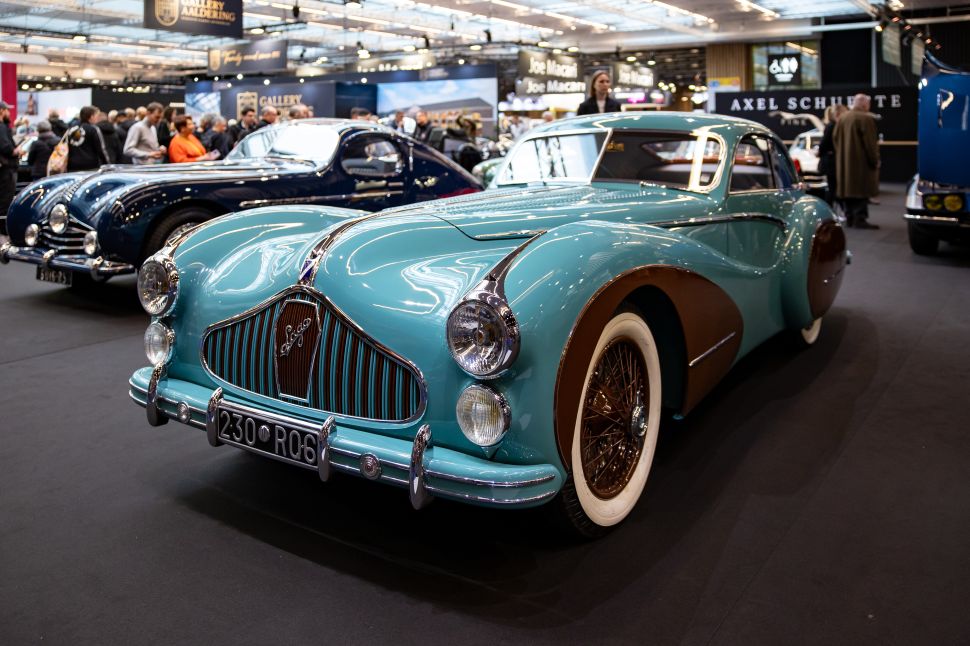
For half a century, Rétromobile belonged exclusively to Paris. Neither a conventional auto show nor a concours d’élégance, but something sitting comfortably between the two, it has long been a fixture of the international car collector calendar. “It was born in Paris; it grew up in Paris,” Rétromobile CEO Gérard Neveu told Observer. “This event has never traveled.” Until now, that is. Rétromobile New York opens at the Javits Center for a four-day run next week—the first U.S. edition in the show’s history—with a roster of 200 exhibitors that includes international dealers and brokers, manufacturer heritage divisions, restorers, classic car clubs and museums.
More than 300 storied vehicles will be on display, among them not only exceptional privately owned vintage automobiles but also cars from the Fast & Furious films, Batman and Ghostbusters franchises on loan from the Petersen Automotive Museum in L.A. and a survey of what Neveu calls “youngtimers” from the 1980s to 2000. Alongside these will be galleries of legendary motorcycles and, to court collectors across categories, books, watches and art.
The cross-category component isn’t exclusive to the U.S. edition. Rétromobile integrated the TIME ON SHOW watch parlor into the Paris salon in 2023, and its Artists’ Gallery brings dozens of international painters, sculptors and illustrators to each edition. But Neveu was quick to point out that he and his team spent months studying the American landscape before committing to specific programming because they didn’t want to simply ship the European show across the Atlantic. “You can be the best restaurant in Paris with the best chef, but if you open the same restaurant in America with exactly the same menu, the same service, the same schedule—it’s wrong,” he said. “We needed to create a Rétromobile New York with its own signature.”
Earlier this year, for its 50th-anniversary edition in Paris, Rétromobile featured a historic reunion of all seven Le Mans-racing BMW Art Cars, from Alexander Calder’s 1975 BMW 3.0 CSL to Julie Mehretu’s 2024 BMW M Hybrid V8. Rétromobile New York will have its own gallery of art cars featuring the work of Daniel Arsham, Esther Mahlangu, Damien Hirst, Olafur Eliasson, Jeff Koons, Barbara Kruger and others, all owned by one man: collector Larry Warsh.
Keith Haring’s signature dancing figures, flying saucers, and radiant motifs inside a museum gallery” width=”970″ height=”608″ data-caption=’Haring’s 1971 Series III Land Rover Defender. <span class=”lazyload media-credit”>Courtesy CART DEPARTMENT</span>’>
Warsh came of age as a collector in the downtown scene of the 1980s, living at Astor Place and acquiring works by Keith Haring and Jean-Michel Basquiat before either was a household name. “There was nothing ‘traditional’ about my early life as a collector—it was, and still is, a wild ride to collect art,” he told Observer. “When I look back to that downtown moment and fast-forward to the art car collection now, the straight line has been my motivation to be parallel with the relevant art of the time.” He sees his art cars as a continuation of the instinct that drove him to take risks and collect with passion.
Neveu admits he was skeptical about this particular intersection of automobiles and art, even as he went looking for “somebody who had the right kind of knowledge and the right collection.” But when Warsh drove him to a garage in New Jersey to see the cars in person, he “was like a kid in a toy store… It was exactly aligned with the New York DNA, which is what we were looking for.”
Notably, Warsh—who recently launched CART X, an exhibition platform that “brings together cars, art and culture on a heightened scale”—once shared that skepticism. In interviews, he has described his first art cars as things he bought and then simply put away, but seeing them in Adam Lindemann’s 2013 art-car show “Piston Heads” changed his thinking. “When I saw the other art cars in that show, I had a transformational feeling about the car as canvas, and it all started there,” he said. “One of the most compelling aspects of the art cars is their capacity for storytelling. Each vehicle embodies a narrative: the artist’s personal story, a cultural commentary or explorations in form and color. Selecting the precise vehicle is a personal journey for the artist and allows them to express their singular vision onto their car of choice.”
Much of what will be on view at Rétromobile New York will be for sale (though not Warsh’s cars), and Neveu sees this as a reflection of how serious collectors now think about their vehicles. “The classic car collector uses cars also as a value refuge, like art,” he said. It’s a market that, according to him, has only lately come into its own, which contributed to the decision to bring the salon to North America. “The American collectors who have been going to Paris for years are very happy to have it coming to New York, but that is a very limited number relative to the total volume of car collectors in the northeast… If all goes well, in two or three years New York will be especially impressive because you have an amazing stage, an amazing community of car collectors and amazing stories.”
For Warsh, those stories are a way of reaching people who might never set foot in an art gallery. “Cars are often associated with significant life experiences: road trips, speed, freedom,” he said. “By transforming these vehicles into art, artists of our generation are tapping into a collective memory… We are excited for audiences to encounter these cars for the first time and get an expanded vision of how they reflect our shared human experience in distinct ways.”
Asked to name a favorite from his art car collection, he demurred, but then pointed to the Kruger. “Every time I see her School Bus, I feel a great sense of pride that I can promote her messaging as an artist,” he said. “Kruger is one of the most important feminist artists of her generation, and her bold text-based artworks are fundamental to our understanding of cutting-edge contemporary art.” Thinking past Rétromobile and even past CART X, he hopes the collection will one day find a permanent museum home. “My purpose for bringing together an important art car collection is to preserve these unique artistic objects for the future. I imagine in 50 to 100 years, someone will understand these incredible artists of our time as represented by cars—and cars will be dinosaurs.”
But for now, particularly in the United States, they remain as of-the-moment as ever. In the months leading up to next week’s opening, Rétromobile has made teaser appearances at Pebble Beach, Monterey Car Week, Amelia Island and Cavallino. At The Bridge in the Hamptons, Neveu said, several guests told him they’d spent decades frustrated that Manhattan had no dedicated classic car event of its own. Neveu is happy to be able to quell that particular frustration, and his goal for the inaugural edition of Rétromobile New York is simple: “We need to inspire emotion. It is not only about money; it is not only about knowledge. It’s like when you visit a museum, you don’t have to know everything by heart. The most important thing is just to sit down and look and say wow. If we can provide that, we’ll have been successful.”