
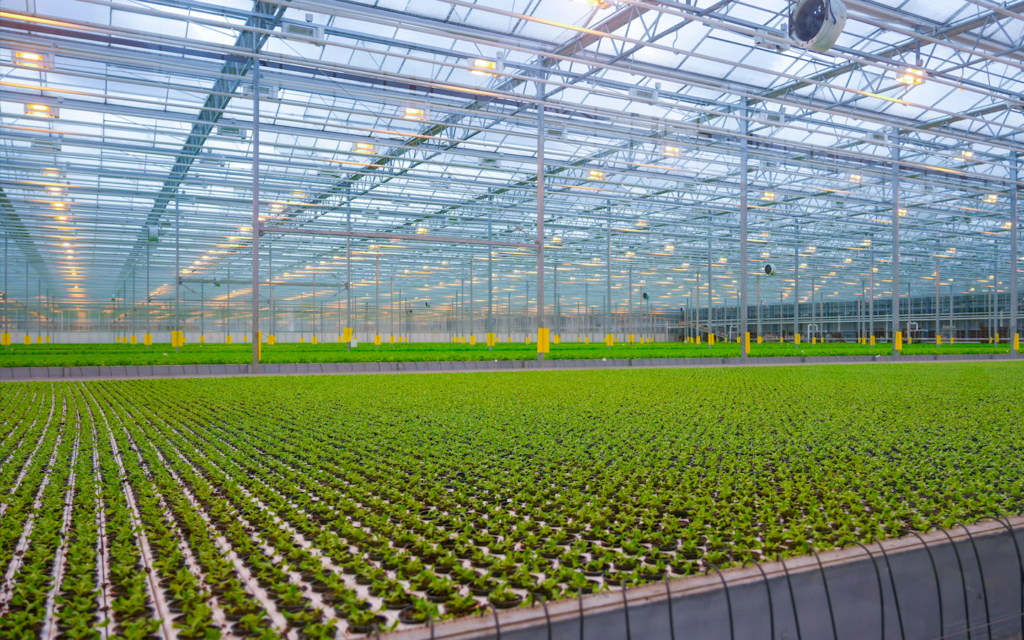
The supermarket has also been designed to reduce its use of resources. Photo credit: aapsky/Shutterstock
If you buy bagged salad at the supermarket, you probably don’t give much thought to where it was grown or how far it travelled to reach the shelf. But one German supermarket is changing that by growing its own lettuce on the roof, with enough space to produce up to 900,000 salad mixes a year. The REWE Green Farming supermarket in Berlin’s Lankwitz district opened on 21 May 2026, combining a conventional food shop with a 2,760-square-metre rooftop farm.
The lettuce is grown above the store, harvested and packed on site, with supplies also destined for other REWE branches across the Berlin region. The project brings food production into an urban setting and gives the retailer a way to shorten the journey between growing and selling fresh produce.
Lettuce grown in just 23 days
The farm is run by Berlin-based ECF Farmsystems, which specialises in urban food production. It uses hydroponics, a method of growing plants with little or no soil. The lettuce sits on specially designed trays and receives a nutrient solution several times a day. The growing cycle takes around 23 days. After harvesting, the lettuce is taken directly downstairs for processing and packing, ready to be sold in the supermarket or sent to other branches.
Most Read on Euro Weekly News
The first harvest took place in August, and the salad is already being sold. The varieties include Batavia, green romaine, Lollo Rosso and dark green Easy Leaf lettuce. The greenhouse is designed to operate throughout the year, rather than depending on the growing seasons of outdoor farms. REWE expects the farm to produce up to 900,000 salad mixes annually. Its produce is distributed to around 500 supermarkets in the Berlin region, although the rooftop farm itself is located at just one store.
Could it reduce food miles?
Growing lettuce above the shop means it does not need to make the same journey as produce brought in from farms further away. REWE estimates that its rooftop operation could save around 500,000 transport kilometres a year compared with imported lettuce from southern Europe. That is the retailer’s estimate, rather than an independently verified figure. The supermarket has also been designed to reduce its use of resources. Its main structure uses timber, while around 200 solar panels contribute to its energy supply.
The building uses renewable electricity and recovers waste heat from its refrigeration equipment to help heat the premises and greenhouse. Rainwater is collected in a large underground cistern, with a capacity of 200 cubic metres, and used by the store and farm. REWE says the building requires around 50 per cent less energy than a standard supermarket.
Could other supermarkets follow?
The Berlin store is not REWE’s first experiment with growing food above a supermarket. Its first Green Farming store opened in Wiesbaden-Erbenheim in 2021, although that project uses a different approach, combining fish farming and plant cultivation. The newer Berlin site is Germany’s largest rooftop farm, according to REWE. The company says its modular store design allows rooftop space to be adapted for different uses, and it plans to build more timber-based supermarkets.
Rooftop farming will not replace traditional agriculture, and a single greenhouse cannot supply every fresh product a supermarket needs. But the Berlin project demonstrates how an otherwise unused roof can produce food for local shops, with less distance between harvesting and sale. For customers, the difference is straightforward: the lettuce in the bag may have grown just metres above the supermarket where they buy it.