
A Los Angeles outreach worker has revealed the sickening depths swindlers will sink to in order to lure homeless addicts to California detox centers, after a pair of accused fraudsters were charged by federal authorities in a $1.6 billion drug rehab scheme.
Federal prosecutors busted David Young, 71, and his son Nathan Young, 39, who are accused of using “body brokers” to recruit at least 6,000 junkies — many from out of state — to enter Golden State rehabilitation clinics as part of an alleged insurance scam.
LA-based homeless advocate and outreach worker Lang Martinez said the sickening scam the Youngs are accused of is all too commonplace on Skid Row, while revealing more of the disgusting tricks that fraudsters employ to maximize their profits.
David and Nathan Young. Carlin Stiehl for CA Post
Homeless tents stand on 5th and Central Avenue in Skid Row. Andy Johnstone for CA Post
“Los Angeles is definitely a hot spot for this sort of thing,” said Martinez, who lived homeless on Skid Row before getting sober in 2018 and turning his life around. “First, they’ll find someone caught up in addiction. Then, they’ll give you a little bit of money.”
Next, said Martinez, body broker cons will obtain an ID from a victim, and get them insurance, so that they can be admitted to a rehab center on the insurer’s dime, about a week later.
“They have insiders with the insurance companies, your top insurance companies,” said Martinez of such cons. “They’ll grease their palms, and then what they’ll do is they’ll backdate homeboy’s insurance.”
Lang Martinez. Courtesy of Lang Patrick Martinez
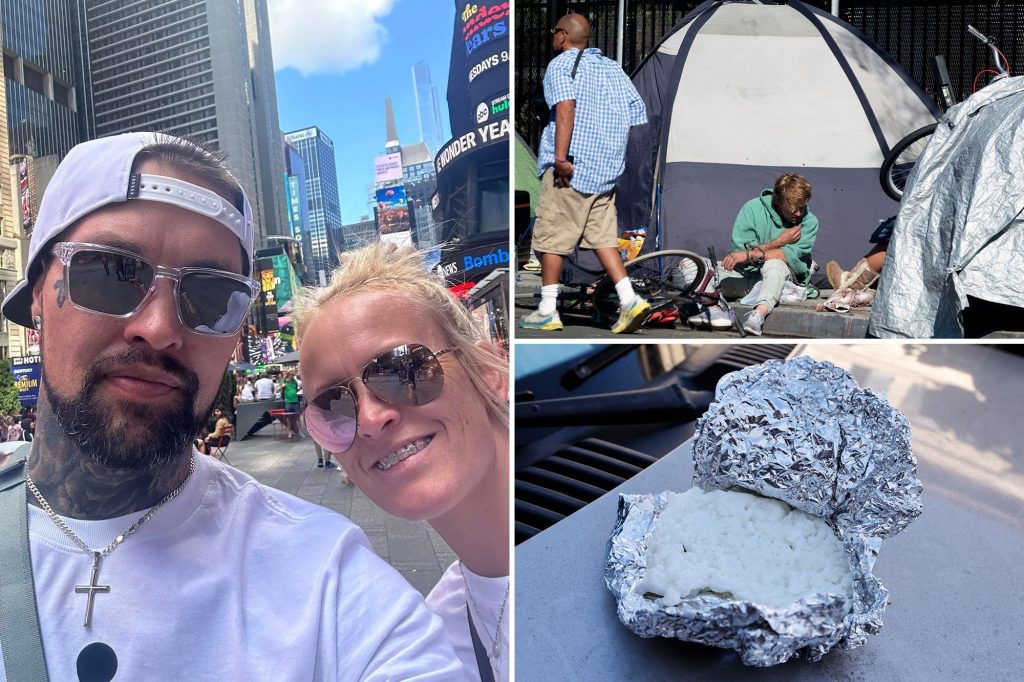
Cody and Honey Phipps. Facebook/@codynhoney.phipps
The body brokers’ spiel next goes something like this: “’Got you a spot, man. I’m gonna put you on a plane, and I’m gonna fly you out to this place,’” Martinez said
“It happens all over the country,” he added. “Get you in the car. Put you on a plane.”
But once there, addicts may realize they’re not getting help at all, but just ripoffs like those alleged to have occurred at the Youngs’ bogus rehabs, such as Zoom meetings with hundreds of attendees and no treatment, or trips to the movies disguised as group therapy.
Cops handle cash and dope at a Skid Row drug bust. Carlin Stiehl for CA Post
Thousands of homeless live in Skid Row. Ringo Chiu for NY Post
Worse, said Martinez, body brokers often pull sobers addicts out of rehab, ply them with cash and drugs, and encourage a relapse. Then, they’ll readmit them at another rehabilitation front, collecting another placement fee to drive up their profits.
“A lot of these people die,” said Martinez of addicts victimized in this way.
“They relapse you again, and then I put you in another program,” he said. “That’s how the brokering works.”
Body brokers lure addicts to California, prosecutors say, and dump them on the street. Andy Johnstone for California Post
Dope is big money in Skid Row. Carlin Stiehl for CA Post
Martinez said hundreds of homeless addicts wandering Skid Row probably landed there under such schemes.
“When you turn human suffering into a business, you’ve lost your humanity,” he added. “What is happening to our unhoused and our most vulnerable individuals through body brokering is not recovery – it’s exploitation.”
The practice grabbed headlines this week in the case of the Youngs, who are accused of using body brokers including accused Greenville, Texas couple Honey and Cody Phipps, to mercilessly target homeless addicts and recycle them through their drug facilities.
Cody and Honey Phipps. Facebook/@codynhoney.phipps
Bill Essayli in Skid Row. Carlin Stiehl for CA Post
Justice Department prosecutors say the defendants pocketed more than $210 million in the six-year scheme that Assistant Attorney General Colin M. McDonald called “the largest the largest sober home fraud scheme the Department has ever prosecuted.”
Both Youngs and both Phipps were arrested in a sweeping anti-healthcare fraud investigation in California that federal authorities unveiled in Los Angeles Thursday.
To execute the complex con, the Youngs ordered the Phipps and other body brokers to travel to various states to find homeless addicts, get them insured and enroll them at the Youngs’ rehabs in LA, San Diego, the Bay Area and elsewhere, court papers say.
Download The California Post App, follow us on social, and subscribe to our newsletters
California Post News: Facebook, Instagram, TikTok, X, YouTube, WhatsApp, LinkedIn
California Post Sports Facebook, Instagram, TikTok, YouTube, X
California Post Opinion
California Post Newsletters: Sign up here!
California Post App: Download here!
Home delivery: Sign up here!
Page Six Hollywood: Sign up here!
David Young. Carlin Stiehl for CA Post
Addicts in Skid Row have it rough. Ringo Chiu for NY Post
Credit card records showed that victims were flown in from Las Vegas, Cleveland, and Birmingham, Ala., according to court papers.
The body brokers offered addicts kickbacks to enroll at the Youngs’ rehabs, “including money, drugs, free airline flights, free or nearly-free accommodations at highly desirable locations, including luxury apartments and houses in” Los Angeles, prosecutors say.
Sometimes, victims were coached “to fabricate and exaggerate their symptoms and substance addictions during intake,” or encouraged to use drugs or alcohol so that they would not pass a urine drug test,” and would be eligible for rehab, court papers state.
Violence is also part of life on Skid Row. Carlin Stiehl for CA Post
The area has no shortage of homeless. Jonathan Alcorn for NY Post
Once inside the Youngs’ network of rehab homes, the patients were cycled through different types of treatment centers that corresponded to different levels of sobriety, so the fraudsters could maximize their profits, prosecutors charge.
To keep their victims as long as possible, the Youngs had such addicts “drugged with medication, cut off from communication with family members, prevented from accessing their belongings, and physically blocked from leaving,” according to court papers.
First Assistant US Attorney Bill Essayli said the scheme was particularly distressing in light of California’s homelessness problem.
“These body brokers brought vulnerable people here with false promises of treatment, worsening California’s drug-addicted homelessness crisis,” he said. “We will hold accountable those who turn addiction and human suffering into a business.”