
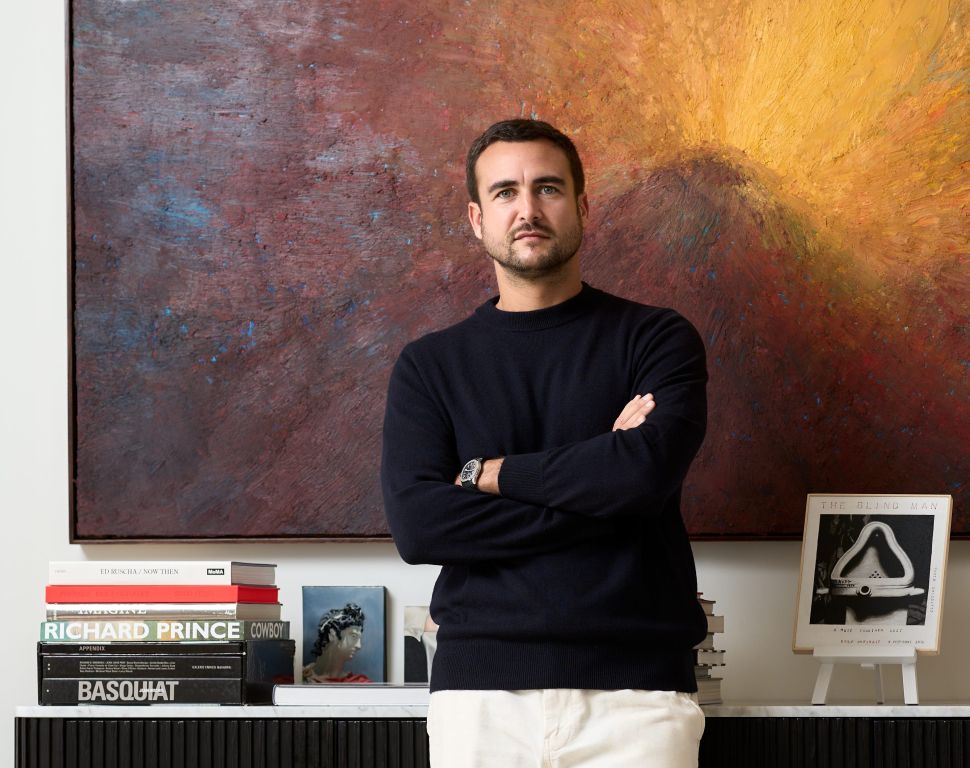
After 11 years at Sotheby’s in Paris, London and New York, Michael Bouhanna has hung his shingle in Miami, with Bouhanna Art Advisory, an independent modern and contemporary art advisory serving private collectors, family offices and estates. Until now, Bouhanna’s career has run along two tracks that rarely met. In Paris, he headed Contemporary Art sales and worked on major single-owner collections, including those of Daniel Cordier and Marianne and Pierre Nahon. After moving to London in 2017, he joined the Contemporary Art Day auction team with a focus on emerging artists. He’s probably best known, though, for what came next. In 2021, he moved to New York to lead Sotheby’s foray into digital art and NFTs, building the department from scratch.
His first curated NFT sale, Natively Digital, achieved $17.1 million in June 2021, headlined by CryptoPunk #7523, which sold for $11.8 million. In June 2023, with the crypto market in a slump, he led the Grails sales of the seized collection of the bankrupt hedge fund Three Arrows Capital (what was then the largest-ever live sale of digital art). Dmitri Cherniak’s Ringers #879 (“The Goose”) hammered at $5.4 million, and total Grails sales passed $17 million. By the time Bouhanna left, Sotheby’s digital art and NFT offerings had surpassed $250 million in total sales since the department’s launch and drawn a client base that averaged 15 years younger than the house’s traditional buyers. While the fervor around NFTs eventually died down, those younger buyers found their way into other collecting categories, and today, Millennials and Gen Z account for roughly 50 percent of the auction house’s new clients each year.
Bouhanna’s advisory covers the broader modern, postwar and contemporary markets, placing works by Pablo Picasso, Andy Warhol, Jean-Michel Basquiat and Yayoi Kusama, among others, alongside those of digital pioneers like Vera Molnár (and he’s more than happy to introduce collectors to the long and nuanced history of digital art). With Art Basel Miami Beach around the corner, Observer spoke with Bouhanna about why he chose Miami, what new collectors really need and where the market is headed in 2027.
This interview has been edited for length and clarity.
What inspired you to open your own advisory?
I spent 15 years in the art market, almost all of them at Sotheby’s. It was incredible, and I think it’s one of the last places among the auction houses where you can really develop your own expertise in your segment. But I always wanted to be more independent and closer to collectors and clients. So I launched my own advisory firm for modern and contemporary art that acts for private collectors, family offices and estates across acquisitions, sales and valuation.
And what are you bringing with you from Sotheby’s in terms of how you engage with collectors?
Expertise, obviously. There are a tremendous number of galleries and artworks out there. The problem is not getting in front of art. It’s making the right decisions. I always advise my clients to take their time before making a first purchase, because every purchase is very important when you’re building a collection. And the transactions themselves have become very complex when you take into account guarantees and all the financial infrastructure that can be part of a deal. It’s very important for any collector entering the space to have expert advice, someone on their side. I work exclusively for the client. I’m not paid by a gallery or an auction house, so I really defend the interests of the collector.
But there’s another part that I’m personally passionate about, which is getting people into collecting. With young collectors, I can explain how the market works and who the different players are. Then I help them shape their eye for quality.
Why Miami?
Miami, I think, is becoming a very interesting city in terms of the market. There is a lot of growing demand for expert advice on modern and contemporary art, and the number of collectors has increased over the past 10 years. It’s the city in the United States that has had the biggest growth in millionaires, in terms of wealth that has moved there. So I see two groups. There are collectors who have already built strong collections, and there are new collectors, people in finance who are just starting to collect. It’s also a younger generation of collectors, which is in line with what we see across the market. Every report says buyer profiles are getting younger, and Miami is one of the cities where you see that most clearly.
There’s this perception among some collectors that Miami is only about Art Basel. What’s behind that misunderstanding?
Yes, it’s really a misunderstanding of the scene that is here year-round. It’s not comparable to New York, Paris or London yet, but it is growing faster than any other U.S. city. I would put Paris aside, because I find what’s happening there after Brexit very interesting. But in the U.S., Miami is where we see a lot of investment on the institutional side. You have the Pérez Art Museum, the Bass, the Rubell and the Institute of Contemporary Art, which wasn’t very prominent five or 10 years ago. The ICA is adding a second building, and the Bass is getting a new pavilion.
Some cities build by bringing in the market first and the institutions second. I think the right way is education first, and then the appetite for collecting comes after. That’s what I see happening in Miami, and it’s very much supported by Palm Beach, where the number of millionaires has doubled in 10 years. Compare that to cities like New York and L.A., where the wealthy are moving away. That dynamic is very real.
People are talking about a “great taste transfer” happening alongside the “great wealth transfer,” with younger collectors prioritizing relationships with artists and cultural experiences. Are you seeing that in your younger clients?
Yes. They see collecting as something that looks closed off and very difficult to enter. The role of an advisor for collectors who want to start is to show them the ecosystem and get them learning about the history of art. And at that stage, it’s really about saying no to almost everything they think they want to buy. It’s important to be extremely selective. But opening the door to meet artists, giving them that kind of experience and showing them a lot of works means they very quickly start to form an opinion on what is good. That’s where the best discussions can happen about which works are right for them.
How else have you seen the market change over the past 10 years?
There have been some interesting trends. In 2022, there was a surge of interest in young, emerging artists. Galleries benefited enormously—it became much easier for them to sell out their shows—and we saw some very young artists getting stunning prices early in their careers. A lot of collectors came into the market during that period, and then they lived through the correction, because many of those artists lost literally 80 percent of their value. I think collectors learned more from that than they could have learned from the whole decade prior.
Overall, the market has become a lot more selective. What I’m seeing now is a doubling down on modern artists who were avant-garde, with works from the 1920s through the 1950s. They may not be the biggest household names, but they had very good careers and are in every major museum. Their work is more approachable in terms of pricing and really interesting aesthetically and in terms of scholarship. The market has been shifting toward established modern and post-war artists. At the higher end, the selectivity is even more pronounced, and provenance and freshness to the market are increasingly important. That’s where it’s even more important to be advised, because there is a lot of due diligence to be done.
What can we expect from Art Basel Miami Beach this year?
I think it will be a good edition. The floor plan is more compact, and less is more. It lets collectors see fewer works but spend more time in front of each one. Since Paris, London and New York this season, there has been great energy building, and when that’s the case, it usually ends very well at Basel, which is the last major event of the year. I’m very excited about this edition. It should be good for the galleries and for the fair.
The fair still has this reputation for being all about the parties. Has it gotten more serious?
I think so. The gallery mix is becoming more prestigious. All the top-tier galleries are still there, and they’re being selective about the fairs they do throughout the year, which was less the case a few years ago. They’ve kept Miami as one of the fairs they need to do. The museums are also mounting more quality exhibitions, like the Basquiat show at the Bass and shows of modern works by Picasso. The programming is becoming more established, and with it, the collectors.
What do you make of Zero 10 and the legitimizing of digital art by putting it in the main fair alongside everything else?
I think the main fair is the right place for it. To me, digital art has always just fallen within contemporary art. It interests collectors who are interested in new technology and A.I., and I think Zero 10 serves that demand very well.
Do you see a growing appetite for digital or hybrid digital-traditional works among serious collectors?
I think it’s really one segment within contemporary art mostly of interest to younger collectors who are into technology and A.I. It’s hard today to find a broad curation focused purely on that segment, so it’s quite good that the fair gives collectors the opportunity to navigate through it.
If a client is interested in new media art, you absolutely don’t steer them away. When a client has an interest in a certain category, the job is to find the works that best translate their vision. If they’re very into new technology and A.I., I would probably start by educating them on how computer painting started in the early 1960s. From there they’ll see the evolution: computer art, web art in the ’90s and how A.I. has intersected with art. With the right due diligence, I think there is art for everyone in every segment, if you’re selective enough.
Are people who made their money in tech actually collecting?
I’ve seen some, but fewer than you would expect. I haven’t seen a wave of tech fortunes dramatically changing the landscape of the market. It just hasn’t happened, even though the wealth is there. Everyone expected all the tech wealth generated over the last 10 years to cause huge ripples in the market, and then a lot of those people just didn’t participate. But I think it takes more time than that—the art market is harder to get into than any other sector. I don’t think that means it won’t happen. It will just take time, and the right doors will have to open.
Do you have any predictions for 2027?
I think it will confirm what we’ve been seeing since September, which is a strengthening market for established modern artists and a focus on quality. From what I’ve seen in London and Paris, there’s been great energy, and I think that will continue. It’s prime time for rediscovery. There are so many interesting artists who had great careers in their lifetimes but just haven’t been headliners. I find that very exciting.