
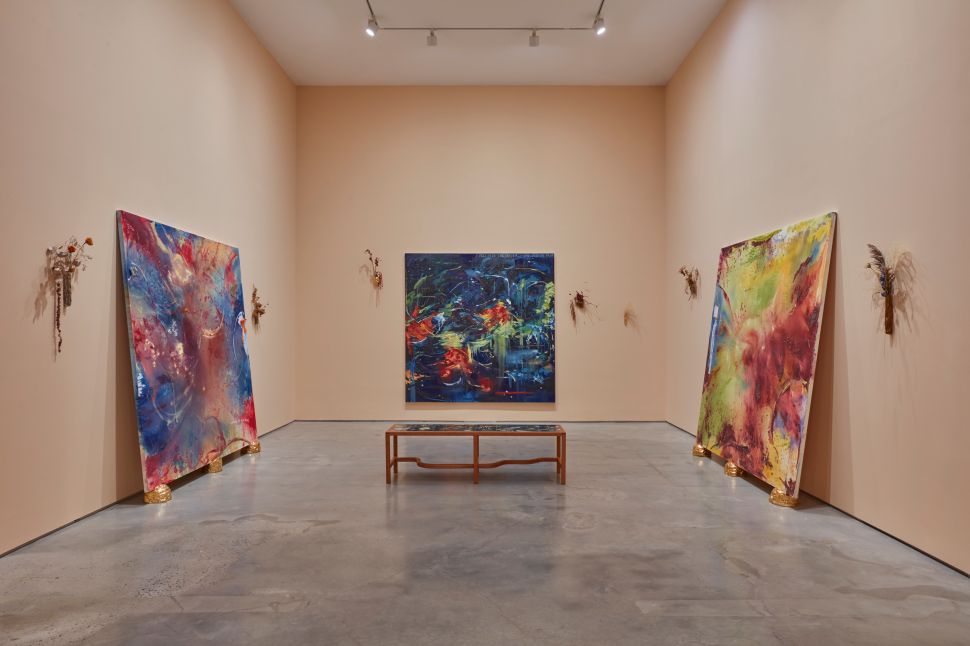
There is something profoundly intimate yet universal in the way Michaela Yearwood-Dan channels her inner world into magmatically luminous canvases. Her abstract compositions come to life as emotional fields, with sweeping, shifting passages of color and flickering, animated brushstrokes evoking landscapes of lush floral life. Small objects—ceramic petals, glass beads, glitter, gold leaf, paper scraps and neatly tied ribbons—adorn the surfaces like deposits of feeling. Lines and fragments of poetry sit lyrically alongside other memorial and symbolic elements, enriching each work’s texture.
Walking through “A Woman of Will,” her new show at Boesky Gallery, Yearwood-Dan explains that this diaristic approach animates her entire practice. “I’ve always thought of them kind of like a diary, with the words being extensions of self,” she tells Observer, tracing the origins of her distinctive visual language to a spontaneous move away from figuration toward a more symbolic, poetic form of abstraction.
“A Woman of Will“
Artist: Michaela Yearwood-Dan
Venue: Boesky Gallery
Address: 509 West 24th Street, New York, NY
Through: December 12, 2026
“The works play with that dichotomy between revealing and concealing parts of yourself, so it’s up to the viewer to decipher elements of meaning,” she continues. Her process is largely intuitive: she begins with a feeling, a place or a mood rather than a fully defined concept. Even the botanical references, the way these abstract mindscapes evoke entire ecosystems, come largely from a subconscious channeling of something within her. “There’s a balance between nature, otherworldliness and the artificial. I don’t want it ever to feel like it’s one exact thing; the references are pulled from all different corners,” she adds, recalling how she grew up in the city, in a high-rise apartment overlooking a park, while her mother filled their home with plants. “I don’t feel I grew up constantly present within nature, but it was always something that felt lush, something that felt like home. It was something that connected me with somewhere else.”
Yearwood-Dan’s practice can be understood as an ongoing act of becoming, a continual negotiation with self and circumstance. It rests on an acceptance that the self is never fixed but continually reconstructed through gestures, memories, cultural references, material encounters and emotional states. The canvases become fluid, intuitive reflections of her complex, layered identity as she navigates the intersecting dimensions of her experience: Blackness, queerness, femininity, Caribbean ancestry, a British upbringing and a Catholic education.
Yearwood-Dan is among the relatively few artists who openly acknowledge the influence of Catholicism on their work, referring directly to passages from religious texts and to biblical figures. Although she distances herself from Catholicism as an institution, its visual, cultural and educational imprint remains deeply embedded in her practice. “I went to an all-girls convent until I was 18. It was interesting because there were no men, really. You had this real sense of feminism because you never had to fight for your voice to be heard; that fight wasn’t linked to your gender. We all grew up these little feminists,” she recalls. That formative environment helped her cultivate an expansive inner world through continuous dialogue with the deeper self—one that now finds spontaneous expression in her canvases. They channel psychic energies and imaginative forces before these are subjected to linguistic or rational control, restoring a fertile connection between inner and outer ecologies.
The exhibition draws on the aesthetics of churches and sacred spaces. Hung against deep burgundy or pastel walls, the richly textured paintings are accompanied by glazed ceramic vases of dried flowers. “I think about shrines and chapels, and rural Catholic churches across Europe and the colonized Americas—Mexico, Italy, Spain. There are always dried flowers. You go to grave sites, and there are dried flowers, remnants of people’s presence, dried out naturally through decay,” she says. “There’s something about that suspended life: keeping those in the space. It’s almost like limbo, almost like purgatory, a once-living thing suspended in itself. There’s also that sense of ritualism. A ritual that our society has lost, but that is still here.”
Several paintings rest on or are held by biomorphic ceramic elements whose tactile, malleable surfaces foreground the artist’s act of creation. Pointing to one of these forms, which cradles a medium-sized work like a pair of hands raised in prayer, Yearwood-Dan recalls one of her favorite childhood roles: holding the book for the priest. “I liked being on the altar, and it felt very important. I remember my small fists holding the Bible and the text up,” she recounts. “It’s funny because I feel so spiritual as a person, and so un-Christian as a person, at the same time. But that experience of ritual feels deeply important to me.”
The exhibition as a whole feels like a sanctuary restoring a space for ritual and contemplation—perhaps the things most conspicuously missing from modern life. “The space has this invitation of stillness, quietness and meditation, entering into a domesticity mindset, being in warmer walls and these chapel energies,” Yearwood-Dan explains. Her aim was to create an environment in which to reimagine collective practices of love, care and liberation. To that end, she introduced benches covered in hand-painted decorative tiles, inviting visitors to sit, pause and linger with the works. “The benches are intentional. They restore that space of contemplation and connection to art. People don’t take enough time to do meditative practices, to do things where you just sit and do the same thing and find joy in doing the same thing daily or weekly—cultivating an inner world.”
The new body of work extends the ideas Yearwood-Dan explored in “The Practice of Liberation,” her touring exhibition in the U.K. For the artist, liberation is not an absolute state but an ongoing practice that requires confronting the tensions and contradictions of lived experience. The show in New York takes its title from a poem by Victoria Adukwei Bulley, which articulates the aspiration to become a “woman of will.” “I wake now / a woman of will / who touches her own body / finding all of her wants / & all of her teeth intact,” it opens. Yearwood-Dan connects these words to her position as a queer woman, her femininity and her Blackness, describing the aspiration to be a “woman of will” as an active negotiation and a way of standing in strength.
This idea finds a more literal expression in the 13 smaller canvases hanging in the first room, which Yearwood-Dan has transformed into a kind of chapel. The paintings represent the apostles, she explains, including Mary Magdalene, a figure whose history has long been shaped by patriarchal narratives. A trusted apostle and respected leader in the early Church, Magdalene was later recast by male clergy as a repentant prostitute. With her portrait, Yearwood-Dan seeks to challenge that image, reclaiming the saint as, in her reading, more likely a widow or a woman of wealth and means who financially supported Jesus’s teachings. “She was more like a Peggy Guggenheim to Jesus than she was a prostitute,” is her stance.
Yearwood-Dan often approaches biblical narratives as fables or mythology: stories and ideologies that might offer ways of living well. She contrasts the teachings of Jesus, as she understands them, with contemporary political uses of Christianity, particularly regarding women, queer people, borders and the distribution of wealth: “The Jesus we were taught about would have no issue with women or queer people, and would not endorse things like ICE or closing borders. That is not the teaching of that man.”
Another key concept is agape, traditionally understood as unconditional or devotional love, which gives the series its title. Yearwood-Dan’s relationship with the notion is rooted in her Catholic schooling. At the convent, she was taught largely by nuns of the Faithful Companions of Jesus, whose Ignatian values emphasize education and social justice. Yet the experience also led her to recognize the disconnect between the Church’s teachings on love and acceptance and its historical actions, particularly its legacy of colonialism and its erasure of women and queer people.
“The parallels between the actual teachings of the main characters in the text and the teachings of Karl Marx are much more aligned than anything we see today in the name of various religions—not just Christian beliefs,” she says, pointing to an understanding of love and compassion that transcends institutional religion. As someone whose family is from the Caribbean, Yearwood-Dan cannot overlook Christianity’s role across the African diaspora, where it was used as a political instrument to colonize, indoctrinate and oppress.
“Agape is almost like a meditative state of love and submission. Then you think about the way religion makes people submit through colonialism and slavery,” she reflects. She also approaches the concept from a more intimate, personal perspective: “As a queer woman, agape could also be seen through sexuality and love and would feel very close to kink and submission, and to being fully in that feeling. That’s part of this idea of agape: submitting to the feeling, submitting to the emotion.”
This surrender to emotion—the practice of listening to and channeling something within the deeper self that transcends the individual to touch something universal—may be the true force animating Yearwood-Dan’s work. Painting is in that context an exercise in self-reclamation and a celebration of the creative energies within.
In her larger canvases especially, which demand a more expansive physical engagement, painting becomes almost ritualistic as Yearwood-Dan allows images to emerge through the process itself. In these newer works, she has relinquished more control, laying the canvas flat, pouring paint and letting movement, evaporation and gravity intervene. The resulting marks hold a tension between intention and material unpredictability.
Ceramics taught her to let go. “With ceramics, there’s so much control in what you do, but you’re completely out of control from the second you put it into a kiln,” she notes. “With the paintings, I had all the control, so I wanted to start introducing elements of intervention that give over control to evaporation, movement and gravity. Then, within that, I have to find the painting.”
She approaches the resulting surface as a kind of map. A slight halo or an area where paint gathers and pulls becomes a starting point she can bring forward with brushstrokes or other interventions. More recently, she has also begun hosting studio dinners at which guests contribute marks to a shared canvas, which she then reads the same way.
Abstraction becomes a way of expanding rather than illustrating identity. It allows the artist to explore identity’s ever-shifting nature beyond societal categories and restrictive definitions and to embrace multiplicity and fluidity as sources of richness. “It is a bit like journaling and being a multifaceted person,” she says, though words arrive only at the very end. Yearwood-Dan acknowledges that her abstract compositions are much closer to music, a key force driving her painting. “When I think about mood and energy, the first things that come to me are music. I feel that it’s quite obvious in the work that there is movement.” Her listening spans genres from Kendrick Lamar to Rosalía to Debussy, each informing the works’ direction.
From a feeling or musical association, she may move toward songs that carry a particular emotional register, and from there to writers, poetry and other literary references. Text enters the work as part of an ongoing conversation, with phrases speaking to one another and to other works. “I say language comes last, but I’m constantly archiving words and lyrics and how they work,” she says. “A song you’ve known your whole life could have meant nothing to you, and then you go through a moment, think of something to do with that song or book, reread it or listen to it, and the meaning completely changes.”
Through this largely intuitive, sometimes idiosyncratic ritual, Yearwood-Dan brings together cultural references and experiences that might seem unrelated, from club culture and street dance to carnival. She does not see herself as bound to a single identity or aesthetic, and her artistic language celebrates the boundless possibilities of the imagination. One can sense this joy, this Bergsonian élan vital, flowing through the energetic, sweeping canvases: an irrepressible life force that speaks to the artist’s understanding of creation as a process of becoming, shaped as much by intention as by surrender to matter’s unpredictable movement.
Her paintings are not simply representations of an inner world. They are environments in which different dimensions of experience—personal, cultural, historical, spiritual and material—can coexist without being resolved into a single narrative, embracing complexity as a source of growth and continual evolution.
“This year of painting has been really a pleasure,” Yearwood-Dan says toward the end of our conversation. She is reflecting on her remarkable trajectory since her rise during the pandemic, from joining the Hauser & Wirth roster to major museum acquisitions, most recently by Tate during Frieze London. For her, this latest show feels like a continuation, almost an introduction to New York, inviting people into the new level of awareness she has reached as she and her work continue to evolve.