
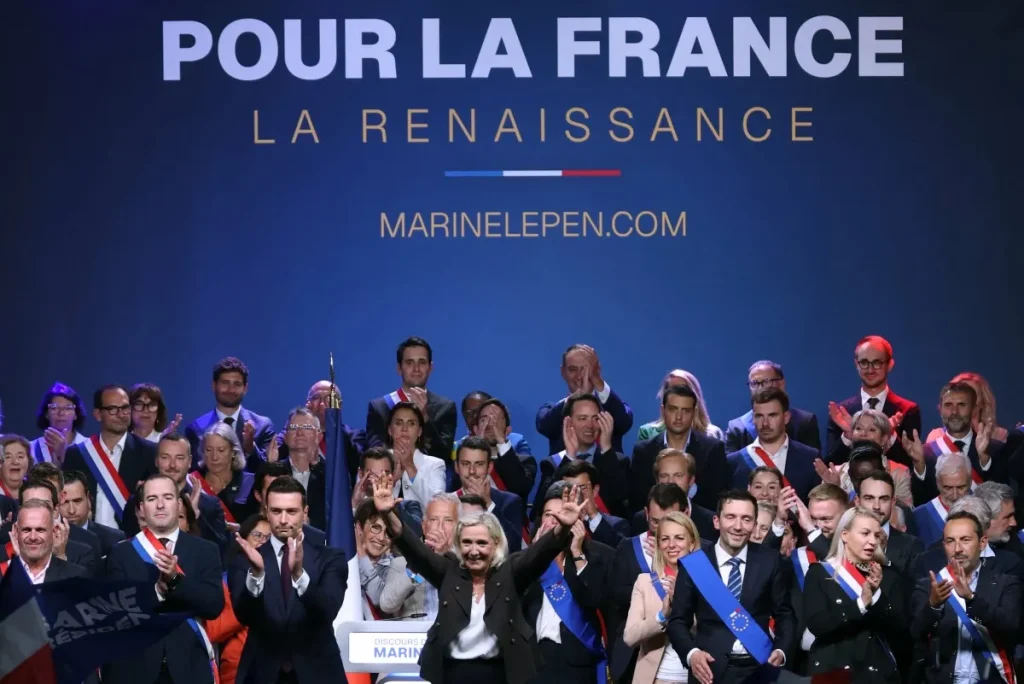
France’s Marine Le Pen has reiterated her support for the idea of ‘French preference’ – a policy that would exclude legal long-term foreign residents of France from certain types of housing, benefits and jobs. But could this ever actually happen?
In her first main campaign speech of the 2027 presidential election campaign, far-right leader Le Pen confirmed that the idea of ‘French preference’ would once again form a main part of her party’s policies.
She told a rally in Hénin-Beaumont, northern France, on Sunday that French nationals would enjoy “more rights in France than others” under a Rassemblement National government.
The policy had already featured in her manifestos for the 2017 and the 2022 elections – but it goes a lot further than simply allowing French citizens to go the head of the queue. The policy bans altogether non French nationals who are resident in France from accessing things such as social housing, benefits or certain jobs.
For the roughly six million foreigners who are legally resident in France, many of whom have been here for decades, it represents a worrying development.
Click HERE for a more detailed look at what this policy would mean for foreigners in France.
But could she actually put this policy into practice, even assuming that she won the 2027 election?
Politics expert John Lichfield said: “It’s not only illegal, it’s unconstitutional under the French Constitution.
“Under the Constitution of the Fifth Republic, people have to be treated equally, and it doesn’t say that nationality is an area that can be suspended.
Listen to the team at The Local discussing this issue in the latest Talking France podcast – download here
“So it would be unconstitutional. If she really wants to push this policy forward, she would have to have a referendum to change the French Constitution.
“It would also be against European law, obviously, because under European law, people from other EU countries have equal rights to jobs and opportunities, housing in France, social benefits – as French people have when they go to other EU countries. That’s a very basic part of the EU freedoms.”
There would, broadly, be three possible barriers to Le Pen putting this policy into action; parliament, legality and the EU.
Parliament – Although the constitution of the Fifth Republic does give quite broad powers to presidents, especially on matters of defence on foreign affairs, a domestic piece of legislation normally has to go through the Assemblée nationale.
The ability of a Rassemblement National prime minister to pass such a piece of legislation would therefore depend on having a majority of MPs back it. The current parliament is deeply divided and even some right-wing MPs who might support the idea in principle could be nervous of a clash with the French constitution and the European Union.
A French president does have the power – under article 49.3 of the constitution – to force through a piece of legislation without a vote, as Emmanuel Macron eventually did with his pension reforms. However, in this circumstance, MPs in parliament also have the power to hold a ‘motion de censure‘, which can topple a prime minister and the legislation if the majority of parliament supports it.
Legal/constitutional – As John Lichfield outlined, the current French constitution does not allow for discrimination against a specific group, even if they are not French.
The Conseil Constitutionnel (constitutional council) has the right of veto over any law, even if passed in parliament, if it judges that it is not in accordance with the constitution. This is not a mere theoretical power, the council frequently either demands changes to laws or blocks them altogether, the most recent example being Emmanuel Macron’s proposed ban on social media for under 15s, which the council judged disproportionately impacted the freedom of expression of a certain group, namely under-15s.
The constitution does allow a president to bypass this measure if they hold a national referendum on the legislation, which is supported by a majority of the population.
Likewise, the French constitution itself can be amended – although this requires either another referendum with a majority, or the agreement of a large majority of both houses of parliament (the Assemblée nationale and the Senate).
The EU – France is a member of the European Union and one of its core planks is Freedom of Movement, which allows citizens of any EU/Schengen zone country to move to another country within the Bloc and, once there, access work, housing and social benefits on the same basis as the locals.
Le Pen’s plan does not distinguish between EU citizens and citizens of a non-EU country, so would exclude – for example – Irish, Spanish and German citizens as well as the non-EU countries like the UK, US or Senegal.
John told us: “Knowing the EU a little, if she did try and push this, leaving aside the French legality of it, the EU would obviously challenge it and bring a case.
“But these things can take four or five years before they come to a head, and France would be fined, potentially quite large amounts of money if it was found guilty of breaking the law, which it clearly would be.
“But the more immediate problem would be, I think, the French law and French constitutional provisions, which she would have to try and get around in some way. Otherwise, any laws she tried to pass of this kind would be struck down by the Constitutional Council.”
So would Le Pen – a lawyer by training – actually try to implement this policy if she won? Or is this just another example of a politician spouting guff on the election trail?
John told us: “It’s a bit of a mess as a proposal, really. Whether or not, if she is elected, she will push ahead with it, it remains to be seen.
“I suspect she will. It’s about the only very clear policy she has, so I suspect she will try and press ahead with it, but it may be quite a while before she can actually introduce it into anything like law in this country.”
He added: “Le Pen, since the beginning of the political campaign this autumn, seems to have doubled down on the more extreme aspects of her policy, partly because of her split with Jordan Bardella, to make that split clear.
“And it seems to me that she’s stressing the policies that appeal to the people who are already voting for her – she is not moving to try and bring into her coalition, into her voting family, the people who are sort of doubtful about these things.
“I don’t see this as a big vote-winner for her in the first round. Can she pursue these policies in the second round when she needs to attract a coalition of 50 percent plus one? She especially needs to attract conservative, older, wealthier people who are perhaps more doubtful about this kind of thing. It probably will attract some votes, but it doesn’t seem to me to be a big vote-winner for her.”
Chilling effect – But laws don’t always have to be successful to have an effect, there can be a ‘chilling effect’ of merely knowing that a government wants to pass such a law. For example, companies may become more wary of hiring foreign nationals – either confused about new rules or reluctant to take the risk that their new hire may become illegal.