
Los Angeles is arguably one of the world’s premier art capitals, even if it doesn’t quite have that reputation. Perhaps that’s because L.A. sprawls, and its distributed ecosystem of world-class institutions, mega-galleries, independent artist spaces and art schools doesn’t feel cohesive the way some other art scenes do. Still, it’s not for nothing that many of the 20th and 21st Centuries’ most influential conceptual and studio artists—John Baldessari, Mike Kelley, Paul McCarthy, Catherine Opie, Mark Bradford, Charles Gaines—made teaching in L.A. an integral part of their practices.
My last visit to Los Angeles was so long ago that I honestly wasn’t sure what to expect, but the scene turned out to be as sprawling as the city itself. The museum landscape ranges from encyclopedic institutions like LACMA and the Getty to contemporary-focused ones like LA MOCA, the Hammer and the Broad. Gallery-wise, there are plenty of blue-chip flagships, as well as innovative midsize and boutique galleries that champion more idiosyncratic talent.
You’ll probably see less art in four days here than you might elsewhere, and even eight days wouldn’t be too many; you could still visit a different art museum every day. Tempering your expectations is important. There’s less traffic than you’d expect, but everything is farther apart, so I recommend planning each day around a single neighborhood. Here’s how I structured my time in the City of Angels, which happened to coincide with Los Angeles Design Week/end.
Day 1
Check into The LINE LA
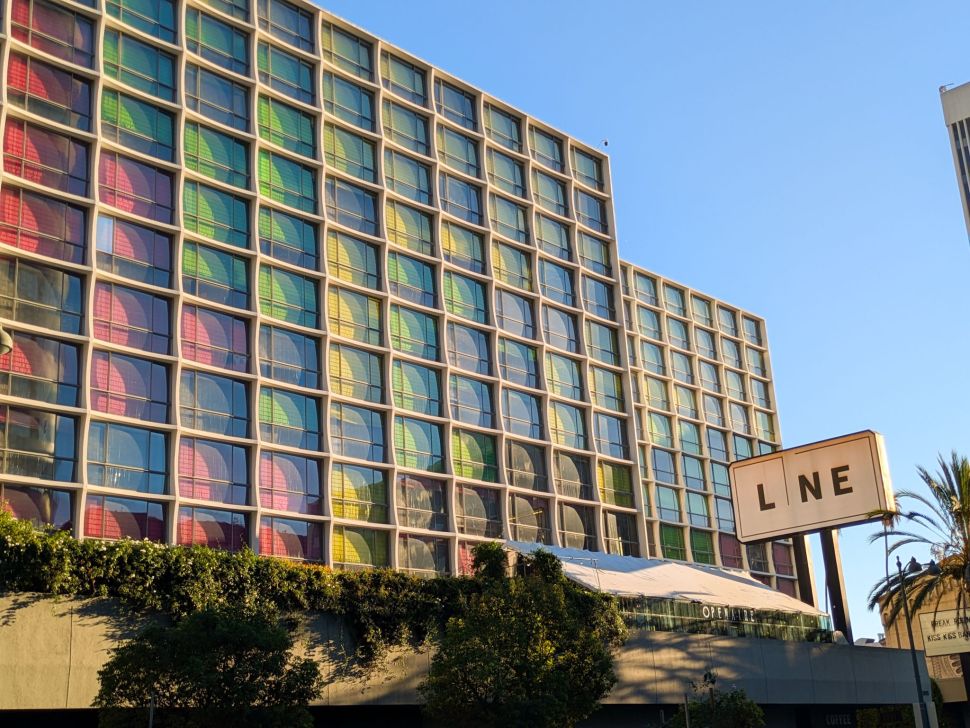
The LINE LA in Koreatown has built a loyal following thanks to its design, music and club credentials. Originally built in 1964 as the Wilshire Plaza, the mid-century modern hotel got a brutalist interior makeover when the LINE took over in 2013. On the outside, it’s classic L.A. Inside, it has a very millennial identity, though not in a bad way, with lobby decor that includes velvet benches and textured wall coverings cut from indigo denim and T-shirt fabric. The hallway to my room felt like a liminal space, all echoey bare concrete, but the room more than made up for it with a massive bed facing floor-to-ceiling windows and a brilliant view of the Hollywood sign. All in all, it’s a wonderful home base for exploring Koreatown and sites along the Metro line.
The Line Hotel In Koreatown.
Photo: Christa Terry for Observer
Explore Koreatown
Koreatown is one of the most walkable neighborhoods in Los Angeles, covering roughly three square miles along Wilshire Boulevard, Olympic Boulevard and 6th Street. Wander without a destination and you’ll run into dessert cafés, soju bars, pocha, Art Deco apartment buildings that look frozen in time and plenty of street art. The neighborhood also has the city’s highest concentration of nightclubs and 24-hour businesses, so if all-night private karaoke (noraebang) is your thing, you’re in luck. Keep in mind that much of what Koreatown has to offer hides in plain sight: behind parking lots, up unmarked staircases, on second-floor balconies and inside shopping plazas that give no hint from the sidewalk of what’s within. Finding the best of it takes a willingness to go looking. If you’re pressed for time, head to Chapman Market, a Spanish Colonial Revival plaza turned food hub, for Korean pub food at Toebang Cafe.
L.A.’s Koreatown is loaded with great street art.
Photo: Christa Terry for Observer
Have dinner at Openaire
If you’re staying at the LINE LA, plan to eat at least one meal at Openaire, the hotel’s in-house restaurant. Set on the pool deck inside a glass conservatory framed by exposed ironwork and filled with lush greenery, it makes for a very cool indoor-outdoor experience. Chef Josiah Citrin’s menus focus on seasonal ingredients and California cuisine, and dinner options tend toward simple ingredients, creatively prepared. We sampled the milk bread with porcini butter (which was to die for) and the roasted Japanese sweet potato with miso cream, and from there we worked our way down the entree list, from branzino to brick-pressed jidori chicken. The cocktail program is built around botanical infusions and fresh citrus, with nods to Koreatown’s East Asian flavors. I recommend the Forbidden Fruit, a light, effervescent mix of vodka, jasmine green tea, lychee, lemon juice and sparkling white wine.
Openaire, on the pool deck of the LINE LA, is in an actual greenhouse.
Photo: Christa Terry for Observer
Grab drinks at Kiss Kiss Bang Bang
The LINE LA has two speakeasy-style clubs dreamed up by nightlife veterans Mark and Jonnie Houston: Break Room 86 and Kiss Kiss Bang Bang. Break Room 86 is a love letter to 1980s pop culture, with cassette tapes, TV sets playing period broadcasts, vintage lockers and classic Atari arcade games. Kiss Kiss Bang Bang, meanwhile, leans into 1970s Studio 54-style disco decadence; you enter through a concealed facade built to look like a working bank of ATMs. Inside, there’s a multicolored light-up dance floor, mirror balls, plush velvet and brass. DJs spin disco edits, funk, house and classic dance cuts for roller-skating performers and go-go dancers, and the drinks are throwbacks made modern: elevated Harvey Wallbangers, tropical sours and champagne cocktails. Both clubs draw lines down the block by 10:30 p.m. on Friday and Saturday nights, but you can book table service or a karaoke room ahead of time if you want to feel like a VIP.
You reach Kiss Kiss Bang Bang, which has a decadent 1970s glam feel, by walking through an ATM.
Photo: Dylan James Ho and Jeni Afuso, courtesy of the LINE LA
Day 2
Unwind at Wi Spa
Wi Spa is Los Angeles’s most famous and expansive traditional Korean bathhouse, with four floors open 24 hours a day, seven days a week. The gender-segregated floors have hot, warm and cold-plunge soaking tubs, dry saunas, steam rooms and shower stations, both seated and standard U.S.-style. (Note: clothing and swimsuits are strictly prohibited in the tubs, so be ready to chill out in the buff.) The big draw is the signature scrub, known as seshin or simply the “Korean Buff,” Wi Spa’s most renowned treatment, in which a practitioner exfoliates nearly every inch of you with textured viscose mitts. After the shampoo and oil massage that followed, I was probably the cleanest I’ve ever been. On the communal floor, some spa-goers nap on mats in a large open space while others pop in and out of several saunas with different health benefits, including salt, clay, jade and ice. The clay sauna, where you can burrow into a bed of warm beads, felt cozy. The bulgama, which heats up to about 230°F, was punishing.
The soaking tubs at Wi Spa.
Courtesy Wi Spa
Have lunch at Hangari Kalguksu
Hangari Kalguksu is one of Koreatown’s most beloved comfort-food destinations, known for its huge portions and equally huge lines. Luckily, the queue moves fast, so you’ll be sampling traditional noodle soups, bossam, sujebi and dumplings relatively quickly. Start with the pork belly (or jowl) served with radish kimchi, leafy greens and condiments, then, if it’s a hot day, choose a cold noodle dish like the perilla oil makguksu. Just be aware that the enormous stoneware bowl will be filled to the brim, with more than enough for two, maybe three, lunches.
Pork belly and pork jowl served with crunchy cabbage leaves and sweet and spicy radish kimchi.
Photo: Christa Terry for Observer
Tour the David Geffen Galleries at LACMA
LACMA as a whole holds some 120,000 objects and works, making it the largest museum collection west of the Mississippi and, by its own description, an encyclopedic one. The new David Geffen Galleries is an elevated, single-story structure that sprawls like an amoeba across Wilshire Boulevard, and it has been generally well received, considered a must-see for art lovers. The works inside aren’t sorted by era, movement or national boundaries, but loosely by ocean. “One of our junior curators asked, could we get away from the politics of land and think about how ideas and people and goods moved over waterways to create culture?” Rebecca Morse, LACMA’s curator of photography, told me. The eclectic mix of contemporary paintings alongside ancient artifacts and classical sculpture heads off museum fatigue, as does the deliberate lack of placards. “There are QR codes and some extended information, but there’s not a ton of didactic information, and that’s by design. We wanted people to have a really visual experience and not feel like they had to read. Of course, how people feel about that varies.” The works in the main loop and the walled-off galleries are more spaced out than you’d expect, so a visit can be quick without feeling thin.
Manjunath Kamath, Vikatonarva, 2024.
Photo: Christa Terry for Observer
Shop at ROW DTLA
ROW DTLA is ostensibly a self-contained retail and dining district, but it feels like more than that when you’re strolling around after sundown. There’s Rappahannock Oyster Bar, design shops, third-wave coffee, the famous Pizzeria Bianco and two Michelin-starred restaurants, Kato and Hayato. There’s also high-end curated vintage fashion, Japanese design goods and artsy ceramics. If it’s art you’re after, Friday Gallery focuses on talent from the Middle East, South Asia, Latin America and elsewhere in the Global South. On Sundays, LA Smorgasburg transforms the central lot into a sprawling street-food festival, but my visit was built around Christina Chae’s silver clay workshop at Claedo Studio. She walks you through the ins and outs of working with silver clay as you create an original design (with or without gemstones), which is then fired and polished while you wait.
Sculpt a custom ring in Christina Chae’s silver clay workshop at Claedo Studio.
Photo: Christa Terry for Observer
Have dinner at Manuela
Manuela, the restaurant inside the Hauser & Wirth complex in the Arts District, pairs easily with a visit to the galleries. Set in the restored Globe Mills complex, a collection of interconnected late 19th- and early 20th-century indoor-outdoor spaces, it has a luxuriant vibe, with loads of greenery. Across the courtyard, the restaurant keeps a potager where herbs, pomegranates, chiles and more are grown for the kitchen and bar, and resident chickens supply at least some of the eggs. Executive chef Kris Tominaga, whose background is in Southern cuisine, runs a seasonal menu with vegetables, grains, fish and game sourced from Southern California farms and producers. Our table shared the ceviche, a Persian cucumber salad, cream biscuits with honey butter and country ham, cornbread with a generous topping of butter and several other starters with and without down-home flair. The cocktail program uses house-made bitters and tonics. The parsley gimlet was particularly refreshing on a hot night, and the nonalcoholic Ta Ta Tatiana, with watermelon, ginger, honey, lemon, mint and bitters, made a great chaser. For my main, I ordered a simple steak so perfect I still think about it.
Just a few of the apps at Manuela in the Arts District.
Photo: Christa Terry for Observer
Find a party, see some art
My trip overlapped with the kickoff of Los Angeles Design Week/end, a citywide grassroots festival spotlighting the region’s design community. It opened with a party at Small Green Door, a boutique creative production studio and community art space, with live DJs, art installations, design, drinks, food, dancing, flash tattoos, workshops and magic. Just inside was “After the Tide,” a materially oriented group exhibition curated by Nadia Khagani and Rose Zhang featuring ceramics, sonic works and sculpture. Rather than the warehouse I’d expected, the space beyond the show was a maze, with art and activities around every corner. The crowd was an eclectic mix of ages and dress codes, showcasing the diversity of L.A.’s creative community. (To find a party happening while you’re in town, try Resident Advisor.)
One of the works at Rhythm of the Night, a Los Angeles Design Weekend
celebration presented with Dublab at Small Green Door.
Photo: Christa Terry for Observer
Day 3
Check in at Silver Lake Pool & Inn
Swapping hotels is a little insane, I’ll admit, but when time is limited and you’re spending most of a day in one neighborhood, it’s not a bad idea given the city’s sprawl. We chose the boutique Silver Lake Pool & Inn (one of Observer’s best boutique hotels in L.A.) at the intersection of Santa Monica Boulevard and Griffith Park Boulevard, in the heart of Silver Lake. It has a relaxed mid-century California aesthetic with Mediterranean coastal influences. The centerpiece is the classic palm-fringed rooftop pool deck with its bar and striped lounges shaded by scalloped umbrellas. The rooms are styled with warm wood accents, terrazzo tiling and custom mid-century modern revival furniture. While I appreciated the LINE LA’s buzzy location and expansive view, my room at Silver Lake Pool & Inn felt homey and cozy—more like a studio apartment than a hotel.
The eponymous pool at Silver Lake Pool & Inn.
Photo: Christa Terry for Observer
Walk around Echo Park
After getting settled in Silver Lake, we met up with Holland Denvir, founder of Los Angeles Design Week/end, to check out the Eastside design scene. This was the third year of LADW, and “the goal is really to share with residents and visitors what’s here locally—artist studios, galleries you might not know about, workshops, wood shops, welding shops. This is a really good picture of what’s happening,” Denvir said. We saw only a tiny slice of it, since this year’s edition spanned more than 15 neighborhoods, with 130 designers, studios, galleries and brands participating. It’s anything but fussy. “We thought, there’s not going to be panels, because panels kind of stop you from discovering and progressing—it’s expert versus novice energy, and we didn’t want that,” explained Meghan McNeer, co-founder and creative director of LADW. “We’re in the Wild West, we’re dreamers. So let’s get people on the street, let’s give them places they already know, but then next door there’s something activated that they can discover.” In Echo Park, we visited several spaces, including Dusk & Sun, a furniture showroom that hosts collaborative exhibitions with independent makers, and the studio of artist Peter Shire, known for boundary-defying work across fine art, ceramics and industrial design. Asked why he gravitates to bright colors and playful patterns, he said, “it’s a mystery. You’re in the middle of doing it, and you know, after a while you’re doing it some more, and then you get known for it and people want you to just do it. You’re constantly trying to figure out where it came from… But seriously, it makes me feel good. It’s really that simple.”
Artist Peter Shire was born in the Echo Park district of Los Angeles, where he still lives and works.
Photo: Christa Terry for Observer
Visit the Paul McCobb Museum
Sticking with design, we headed back to Silver Lake for a tour of the Paul McCobb Museum, which is far from a typical museum experience. Founded by artist and conceptual collector Yogi Proctor, it occupies his mid-century home and is both a curatorial project and a scholarly archive devoted to preserving, documenting and studying the work of mid-century industrial designer Paul McCobb. Proctor led our tour himself, in the manner of classic house museums like the Sir John Soane’s Museum in London. Some pieces are arranged much as they were in Edgar Kaufmann Jr.’s “Good Design” exhibition series at MoMA in the 1950s. “This lamp, the armchairs, this table—those pieces were all included in that exhibition,” Proctor explained as he walked us through his home, which is beautifully styled with McCobb pieces in every room. Beyond furniture, the displays include McCobb-designed textiles and archival materials. (Note: tours are by appointment only, and the address is shared once you book at paulmccobbmuseum.org.)
The Paul McCobb Museum, housed
in a private residence, is dedicated to the influential American designer’s work.
Photo: Christa Terry for Observer
Have lunch at Bar Besito
Bar Besito is a tapas and wine bar in Silver Lake that pairs Spanish culinary traditions with seasonal California produce. The dining room is small but doesn’t feel cramped; sit at the tiled bar and you can watch the action in the kitchen. Chef Keith Phillips’s menu features shareable small plates and conservas alongside an all-Spanish beverage program of wines, vermouth, sherry and ciders. We ordered olives, croquetas, heirloom beans and tortilla for the table, then shared several bocadillos. The white sangria was the perfect touch, though if you’d rather have something nonalcoholic, there’s a Ghia lime and salt spritz. It was a relaxing pause before I set off on my own to go museum hopping.
Bar Besito is a Spanish-Californian tapas and wine bar in Silver Lake.
Photo: Christa Terry for Observer
Tour the Broad
Admission to the Broad is free and walk-ups are welcome, but without a timed ticket, you’ll have to wait in the line that snakes around the lobby. Founded by Eli and Edythe Broad, the museum holds a collection of postwar and contemporary hits. In other words, even if you can’t name the works on view, you can probably name their makers: Jean-Michel Basquiat, Keith Haring, Andy Warhol, Roy Lichtenstein, Barbara Kruger, Kara Walker and so on. During my visit, one room compellingly paired works by John Baldessari and Cindy Sherman. The Koons display was popular, with a good selection of the classics. Everyone was taking pictures with Balloon Dog, but much cooler was the canvas Party Hat (1995-1997), with its mind-bending reflections. My favorite work of all was probably Anselm Kiefer’s monumental Grenze (Border) from 2024—or maybe Jasper Johns’s Watchman (1964), or, as it appears in my notes, “the one with the leg.” There’s plenty more to see, and ahead of the 2028 Olympics, the Broad will add a 55,000-square-foot expansion designed by Diller Scofidio + Renfro that will increase its gallery space by 70 percent.
Robert Therrien, Under the Table, 1994. Wood, metal and enamel
117 x 312 x 216 in. (297.2 x 792.5 x 548.6 cm).
Photo: Christa Terry for Observer
Pop over to LA MOCA
Hitting the Broad and LA MOCA back-to-back is easy, since they’re essentially across the street from each other on South Grand Avenue. Established in 1979, LA MOCA is a relatively small artist-founded institution dedicated exclusively to Postwar and contemporary art made from 1940 to the present. Admission is also free, and without the congestion at the entrance and in the galleries, the experience is more relaxed. During my visit, the main exhibition was “In These Times: Recent Acquisitions,” a survey of works added to the collection over the past five years by artists including Christina Forrer, Charles Gaines, Sawako Goda, Jacqueline Humphries, Alex Israel, Tomashi Jackson, Julie Mehretu and Nairy Baghramian, Rebecca Morris, Diane Simpson, John Sparagana, Magdalena Suarez Frimkess, Henry Taylor and Ulla Wiggen. If you’ve always wanted to see one of Kathleen Ryan’s creations in person, her Screwdriver (2023) is on view. And if you’re visiting before the end of the year, don’t miss Alexander Apóstol’s “Regime: Dramatis Personae,” tucked away in its own gallery.
Andrea Bowers, Abolish Ice, 2018. Cardboard and LED lights, 84 × 68 1/2 in. (213.36 × 173.99 cm).
Photo: Christa Terry for Observer
Have dinner at Sous Sous at Hotel Lucile
Hotel Lucile, in a former church, opened in September as the latest iteration of a space that has had many lives. Built in 1931, it hosted religious services into the 1980s, after which it became an antiques market. The recent renovation kept the existing bones, including the original stained glass and molding, so the property still has a churchy feel. Its art program is curated by dealers Rhett Baruch and Patty Sanchez, who have assembled a collection of antique and contemporary works that guests can purchase if they’re so inclined. The former chapel is now Sous Sous, a restaurant open to the public for dinner, with a menu inspired by the culinary traditions shared by the South of France and the American South. Think Marseille and Nice by way of Charleston and New Orleans: locally sourced seafood and produce, plenty of herbs, a raw bar and a cocktail program built around citrus and spice. We sat in the pulpit, sharing tomato salad, chicken liver mousse, crab salad and oysters. The New York strip was solid, but the standout entrees were the roasted half chicken and the Parisian gnocchi with summer corn. For dessert, get the chocolate mousse topped with whipped burnt marshmallow. You won’t regret it.
Sous Sous in Hotel Lucile.
Photo: Christa Terry for Observer
Day 4
Stroll around Silver Lake
The initial plan was to hike the Silver Lake Reservoir Loop, a 2.2-mile walking path that circles the reservoir and offers panoramic views of the surrounding hills, the San Gabriel and Verdugo Mountains and local architecture like John Lautner’s Silvertop. But my trip coincided with a heat wave that had temps approaching one hundred around 9 a.m., so we decided to stick closer to our home base. Not far from the hotel was the Black Cat Tavern, a historic LGBTQ+ civil rights site that now has landmark status, the Music Box Steps immortalized in Laurel and Hardy’s 1932 Oscar-winning short The Music Box, the historic Vista Theatre and plenty of great architecture spanning periods and styles. Before you head off on your own Silver Lake adventure, stop by Yala Coffee for a cup of their signature sand-brewed coffee, a pistachio milk latte or an apricot cardamom spritz. The pastries are out of this world.
The Micheltorena Steps in Silver Lake.
Courtesy Los Angeles Tourism
Tour the Lucas Museum of Narrative Art
The Lucas Museum of Narrative Art is worth a visit, though after walking through the first-floor gallery, “Heroes • Myths • The Sacred” (tucked away past the gift shop), I expected a more curated experience on the upper levels. The museum’s premise, according to George Lucas, is to show “art that illustrates a story,” which it does. My main criticism is that the story, at least as told through the fine art, is woefully incomplete. The Men at Work gallery is very clearly one man’s idea of work—burly guys pounding rivets—with just three images of women working. It was all too idealized Americana for me. Jean LaMarr’s Naming of a Grandchild, Kadir Nelson’s Black Gothic and Ernie Barnes’s The Critic’s Corner nod to the non-white experience, a Kahlo and Rivera section appears out of nowhere, and there are few, if any, Asian or Indigenous faces. The Comics galleries are better, with something to say about the evolution of the form, as are the rooms upon rooms of paintings you’ll recognize if you subscribed to Heavy Metal back in the day or are a sci-fi fan.
Stevan Dohanos, Model Home, 1974. Oil on board.
Photo: Christa Terry for Observer
Have lunch at Skywalker Grill
Skywalker Grill was apparently the hard-to-get reservation after the Lucas Museum opened to great fanfare in late September. The curving rooftop restaurant overlooking Exposition Park offers upscale but relaxed California dining, with a menu that’s a bit of a head-scratcher: cream of chicken soup and pigs in a blanket share space with lobster salad and wagyu beef. Nibbling caviar-topped chicken fingers and other “elevated kid food,” as someone put it, we theorized that these might be some of George Lucas’s favorite foods. I later learned that the restaurant’s culinary directors worked with Lucas and Mellody Hobson to translate recipes from Skywalker Ranch. Speaking of the ranch, all the beef and honey come from Lucas’s own cows and bees (the honey butter is amazing). The cocktail menu goes weirdly hard for a museum restaurant; you can’t go wrong with the House Lights, a lemon and herb vodka spritz.
Chicken tenders served with a ramekin of Royal Siberian caviar-topped ranch.
Photo: Christa Terry for Observer
See the Endeavor shuttle at the California Science Center
The new Samuel Oschin Air and Space Center, the 200,000-square-foot expansion of the California Science Center, is the only place to see a decommissioned space shuttle in launch position, and it’s just as awe-inspiring as you might imagine. The wing’s 100 aerospace artifacts and 100 interactive exhibits are literally dwarfed by its centerpiece, the 20-story-tall Endeavor. (Some will remember how in 2012, after landing at LAX, it made a legendary 12-mile, 68-hour crawl through the city past cheering crowds totaling more than a million people.) My group was lucky enough to get a behind-the-scenes tour with Dr. Kenneth Phillips, curator of aerospace sciences. “We wanted people to have the full encompassing view of the shuttle—the whole vehicle,” he said, pointing out features of the interior visible through the open payload bay doors. “But we also wanted people to feel close to it and keep it safe.” Nearby, all 135 flights of NASA’s Space Shuttle program are summarized, including the Challenger and Columbia accidents. A memorial is still being installed.
The Space Shuttle Endeavour is now permanently on display at the California Science Center in Exposition Park.
Photo: Christa Terry for Observer
Visit some art galleries
With a little free time, I decided to hit a gallery. L.A. has many, but gallery hopping outside the Arts District is tough because everything is so far apart. I chose Chris Sharp Gallery on Santa Monica Boulevard for its proximity to Silver Lake, because the eponymous dealer happened to be around that day and because I’m a big fan of the weird world of Adam Higgins. His show “Lollipop” was on during my visit, featuring rather mysterious paintings of translucent-handled screwdrivers set in the foreground of vignettes captured from real life. (Juliana Halpert called it “the most bewildering show [she] saw all season.”) The title makes it feel a little perverse; on the surface, nothing sinister is happening, but the oddness of the pairings creates associations in the viewer’s mind. “It’s really covered in strangeness, and I think it reads on a number of levels,” Sharp said. “In the spirit of Lee Lozano, the screwdrivers are basically phallic, right? But there’s also a kind of violence to putting them on top of these images—at times they read as weapons. And then in the end they’re really literal and strange and weird. But then the paintings are also just beautiful, sensual paintings doing things I haven’t really seen before.”
Adam Higgins, Redondo Beach with Screwdriver, 2026. Oil on canvas, 56 x 78 in (142.2 x 198.1 cm).
Photo: Evan Walsh
Have dinner at Marco Polo
For my final meal in L.A., I stayed close to my hotel room. Marco Polo Trattoria and Bar, set in what is essentially the courtyard of the Silver Lake Pool & Inn, is a laid-back, Italian-inspired al fresco spot serving handmade pastas, seasonal salads, aperitivo spritzes and natural wines. Looking for lighter fare after some heavy nights out, we started with calamari, oysters and a classic Caesar before tucking into the pastas, which are basic in the best way: cacio e pepe, linguine alle vongole and so on. Between bites, I sipped a spritz made with grapefruit gin and Luxardo Bitter Bianco. Tired and with an early flight to catch, I declined dessert but received one anyway, carefully boxed. I didn’t open it until I got home, where I found a still-moist, aromatic olive oil cake topped with herbs and candied orange peel.
Marco Polo Italian Trattoria & Bar.
Courtesy Marco Polo Italian Trattoria & Bar