
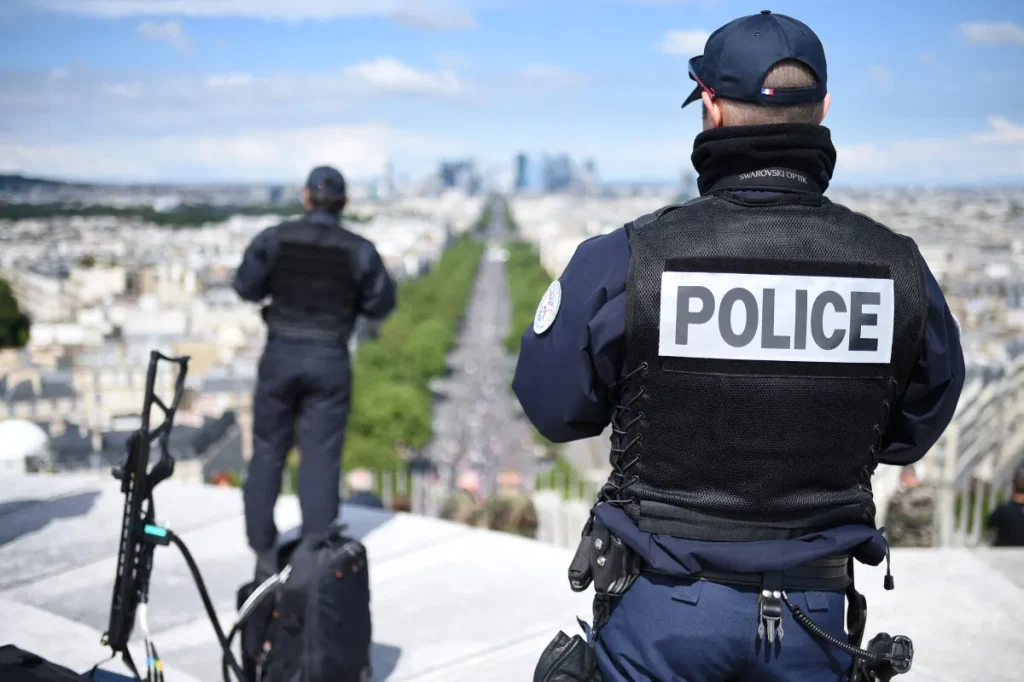
France’s parliament on Friday granted further protection to law enforcement officers using their weapons, after alleged police brutality was thrust back into the spotlight in student-led protests in recent weeks.
Backers of the new bill — including the government and the party of far-right presidential candidate Marine Le Pen — say the law is needed to avoid officers being automatically suspected of using disproportionate force.
Activists, however, argue it would amount to a “licence to kill”, as it would hamper the opening of investigations and make holding security forces accountable even harder in a country where alleged police brutality cases rarely reach a criminal court.
The right-leaning Senate approved the text 205 votes to 110, after the lower house did so in July.
The left has pledged to appeal to the Constitutional Council, the country’s highest constitutional authority, to try to halt the bill from coming into law.
The text stipulates that “when they use their weapons”, police officers “are presumed to have acted” within the framework of the law.
Interior Minister Laurent Nunez on Thursday said it would “put an end to the automatic practice of taking into custody a police officer or gendarme who has used their weapon”.
He said it would “correct this reflex of systematically calling into question the daily, highly demanding work of our security forces”.
But France’s Human Rights League has argued it will “block the opening of an investigation in the event of a police shooting following a failure to comply” with a traffic stop “or in the context of crowd control” during protests.
Young men “perceived as Arab, black or from North Africa” are four times more likely to be stopped than the rest of the population, according to a report last year by France’s rights chief.
‘I’m angry’
Hundreds of protesters gathered near the Senate on Thursday to protest the bill.
“No justice, no peace,” shouted the crowd, sharing umbrellas under autumn drizzle.
Earth and tombstones bearing the names of people killed by police were piled to resemble graves in front of gates to the famed Luxembourg gardens.
“I’m angry because the state is responsible for protecting our lives,” Samia El Khalfaoui, co-founder of the organisation Stop State Violence, told the crowd.
“By passing this law, it is putting the power to decide who lives and who dies into the hands of police officers.”
El Khalfaoui’s nephew Souheil El Khalfaoui was killed in 2021 during a traffic stop in France’s second city, Marseille.
Souheil’s father Issam El Khalfaoui spearheaded a petition against the law that has more than 730,000 signatures.
Lawyers have denounced alleged police violence at recent student-led protests since September that they say led to “mutilations”, including hand, foot and eye injuries.
Police unions have in turn been pressing for an increase in officers’ hazard pay after weeks of unrest.
“In an exhausting climate for everyone, our law enforcement officers need support,” conservative Senator Lauriane Josende told AFP.
The measure would give police officers “greater scope to defend themselves”, she said.
Burden of proof
The bill builds on a 2017 security law that expanded the circumstances in which police officers are allowed to use their firearms.
The law includes five specified situations, including when they face a threat to life, to stop dangerous fugitives, or to prevent further killings during a deadly attack.
The mock cemetery set up at the protest represented the victims of fatal police shootings since 2017, organisers said.
Backers of the bill say it would shift the burden of proof, giving police officers and gendarmes greater legal protection.
But this is equally a key criticism from those opposed.
“A presumption that the shooting was lawful would mean that it would instead be up to the victim of the shooting to prove that it was neither necessary nor proportionate,” lawyer Vincent Brengarth told AFP.
“The risk is an increase in cases of violence, but also greater difficulties for victims seeking to assert their rights through the legal process.”
Guilty verdicts in cases of alleged police brutality are rare.
But this week an appeals court sentenced a policeman to eight years behind bars for the 2020 murder of a black man while driving his car.
A judge has ordered that a French policeman also be tried for the fatal shooting of 17-year-old Nahel Merzouk at point-blank range in 2023 outside Paris, in a case that sparked nationwide protests.