In the 1980 BBC series The Shock of the New, art critic Robert Hughes described land art as “one of the last acts of modernism.” By taking artworks out of white-cube galleries and into the wilderness, the practice rejects the idea of art as an object to be sold, collected, exhibited or reproduced. Instead of masses swarming a museum, land art prefers a smaller audience and their undivided attention. “Remoteness gives all efforts to see it the character of a pilgrimage,” Hughes said.
Emerging in the mid-1960s, land art was never a formalized movement, so its boundaries are hard to define—overlapping with sculpture, architecture and landscape design—though its style is typically minimalist and abstract. In essence, land art is earthbound, literally and metaphorically. The natural environment serves as the artist’s canvas, gallery, muse and source of materials. If landscape painting depicts the beauty of nature from afar, land art shatters the frame and takes you to the source of sublimity. If landscape painting is flat and picturesque, land art is spatial and theatrical.
A magnum opus, 50 years in the making, is James Turrell’s Roden Crater, built on an extinct volcano in Arizona. The observatory complex connects several of his Skyspaces via tunnels that capture light from celestial bodies and project it onto water or stone. Though the work was slated to be finished in 2024, keen observers remain hopeful that it will open any year now.
At its best, viewing a work of land art is an awe-inspiring spiritual experience that recalls the mystique of ancient monuments. It makes us humans feel tiny as we reconnect with the grandeur of the planet our species has despoiled. Michael Heizer, a pioneer of land art, said in a 1970 interview with Avalanche magazine that the genre represents a departure from art as commodity and a return to art as religion. Fittingly, given how many of these artists have gone to great lengths to guard their sites from crowds, the following works reward the traveler willing to seek them out on their own terms.
The farthest-flung land art:
Bunjil (2006) by Andrew Rogers
Little River, Victoria, Australia
Geoglyphs, massive designs inscribed on the ground, are perhaps the most primeval form of land art. In Peru, the Nazca lines were drawn by removing pebbles to reveal the soil beneath. In the south of England, the Uffington White Horse was realized by filling trenches with crushed chalk.
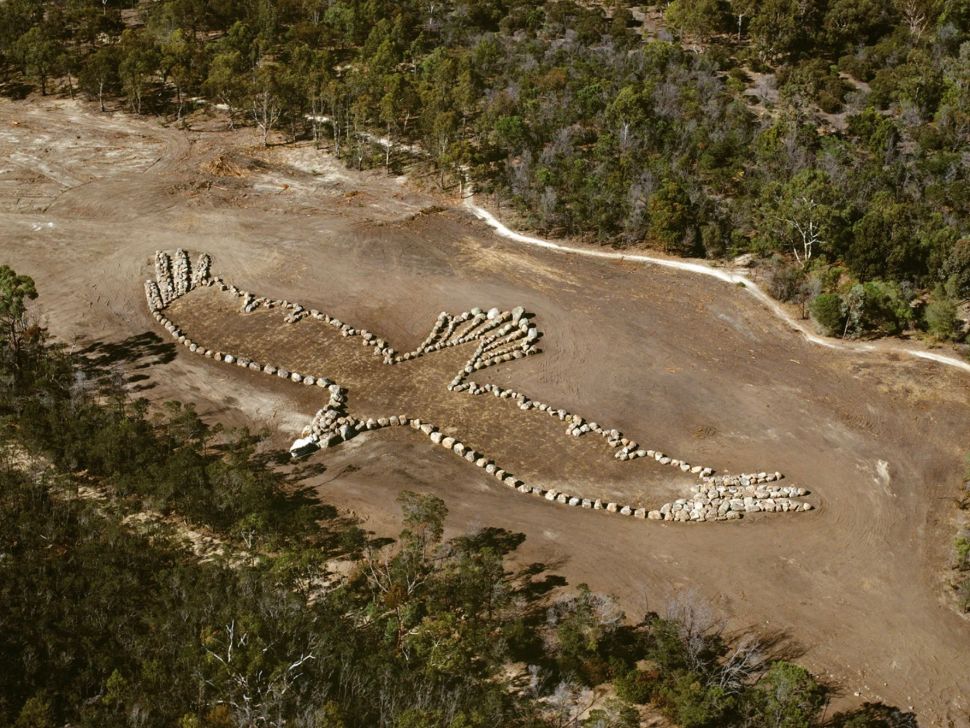
A modern example is Bunjil, commissioned for the 2006 Commonwealth Games and located in the You Yangs Regional Park outside Melbourne, Australia. Honoring the creator god of the Wadawurrung nation, Andrew Rogers had fragments of granite arranged in the shape of a wedge-tailed eagle, the continent’s largest bird of prey, with a wingspan of 100 meters.
In a project of a far larger scale, his Rhythms of Life series established 51 geoglyphs in far-flung corners of every continent of the earth.
Andrew Rogers, Bunjil, 2006.
Satellite image © DIGITALGLOBE
The Lightning Field (1977) by Walter De Maria
Catron County, New Mexico, United States
“Isolation is the essence of Land Art,” Walter De Maria wrote in an Artforum piece explaining his 1977 work The Lightning Field. As if the artwork, set in the high desert of New Mexico, weren’t inaccessible enough, the pilgrimage administered by the Dia Art Foundation is subject to further constraints: only six guests are allowed at a time and reservations for the year are released at midnight on February 1. An overnight visit of roughly 20 hours costs $300.
Since the exact location is unknown, pilgrims report to Quemado (population: 163) before being driven 45 minutes to the site. The installation is an array of 400 pointed steel poles in a 16 by 25 grid that mostly disappears in the midday sun but seem to extend infinitely during twilight. Photography is not allowed. Neither is touching the poles, though the chances of the titular lightning are very low.
Not everyone is a believer. “There is, then, an enormous disparity between the actual sculpture, which is a minimalist understatement, and the promotion it receives, which is anything but,” John Beardsley wrote in his essay “Art and Authoritarianism” (1981). Although visitors “fully expect to see God,” he concludes: “No artwork could live up to this hype.”
Walter De Maria, The Lightning Field (1977).
Photo: John Cliett © Dia Art Foundation
Khao Yai Fog Forest (2024) by Fujiko Nakaya
Korat, Thailand
Since the 1970 World Expo in Osaka, Fujiko Nakaya has been creating “fog sculptures” using high-pressure nozzles that produce billions of micro-droplets of water, mimicking the natural phenomenon. Her largest permanent iteration is found in Khao Yai Art Forest, an 89-hectare park in Thailand opened in 2025 by philanthropist Marisa Chearavanont. This outdoor art museum also runs an artist residency that encourages the pursuit of land art.
Installed on an undulating landscape designed by MET Team Architects, the system draws moisture from the atmosphere and “reveals latent forces within nature,” as the fog emitted flows and dissipates in response to temperature, humidity and the circulation of air and people. Unlike most land art, Nakaya’s work is evanescent and unpredictable, imposing neither a fixed image nor a massive structure upon the site.
Fujiko Nakaya, Khao Yai Fog Forest, Fog Landscape #48435, 2024.
Courtesy the artist and Khao Yai Art Nakhon Ratchasima / Photo: Andrea Rossetti
Ash Dome (1977) by David Nash
Blaenau Ffestiniog, Wales, United Kingdom
In 1977, the wood sculptor David Nash planted a ring of 22 ash saplings near his home in North Wales. In response to his country’s short-sighted policies that inflicted unemployment and environmental damage, he saw planting something for the 21st Century as a “long-term commitment, an act of faith.”
Over decades, Nash tended the living sculpture, grafting, pruning and fletching (bending) the trees to twist counter-clockwise and form a dome-shaped communion. To preserve the work, he has kept the location secret. Film crews are led via roundabout routes.
But a living sculpture eventually becomes a dying one. In the late 2010s, the trees became infected by a deadly fungus that causes ash dieback. Leaves and branches fell off, the bark grew pale and scabrous. Nash accepted the disease as an element of nature and hence a part of the artwork. In 2019, however, he planted a second ring around the ash trees, this time of 22 oak saplings that will eventually be fletched, in a clockwise direction, by his successors.
David Nash, Ash Dome, 1977. Still from the documentary ‘Forest, Field & Sky: Art out of Nature’ (2016)
© BBC
Tunnel of Light (2018) by Ma Yanson
Tōkamachi, Niigata, Japan
Land art is a common feature of biennials and triennials aimed at revitalizing rural regions. One of the newest—and highest—is this month’s sā Ladakh Biennale, spread across eight sites up in the mountains of Indian Kashmir.
Over in the snow country of Japan’s Niigata prefecture, the Echigo-Tsumari triennial has been successfully running since 2000. For the 2018 edition, Ma Yansong of MAD Architects presented Tunnel of Light, a transformation of the half-mile pedestrian tunnel at Kiyotsu Gorge into a permanent artwork. The path through the tunnel culminates in a light cave with stainless steel walls and a shallow pool of water that frame and magnify the scenery beyond.
Ma Yansong, Tunnel of Light, 2018.
Photo: Osamu Nakamura
Stellar Axis (2006) by Lita Albuquerque
Ross Ice Shelf, Antarctica
Land artists like Andy Goldsworthy and Strijdom van der Merwe are known for their fragile, ephemeral works that use onsite materials and are left to disintegrate naturally. On the process of making Rowan Leaves and Hole (1987), Goldsworthy wrote: “collecting the last few leaves / nearly finished / dog ran into hole / started again.”
In 2006, Lita Albuquerque journeyed nearly to the South Pole to install Stellar Axis on the floating ice, a constellation of 99 ultramarine fiberglass spheres “mirroring heaven on earth,” as Made in Bed magazine put it. The placement of each sphere corresponded to a star’s position in the Antarctic sky; its size correlated with the star’s brightness. Sirius, being the brightest, had the largest sphere, 4 feet in diameter.
Three weeks later, on the summer solstice (December 22), staff from the McMurdo research station joined a closing performance, walking among the spheres and tracing a Fibonacci spiral in the snow to mark the end of the artwork.
Lita Albuquerque, Stellar Axis, 2006.
Photo: Jean de Pomereu
City (2022) by Michael Heizer
Lincoln County, Nevada, United States
At the other extreme of the permanence spectrum is Michael Heizer’s City, which took half a century to complete, partly due to the disruptions related to the artist’s financial woes and debilitating nerve disease called polyneuropathy.
Taking inspiration from Mississippian tumuli and Mesoamerican pyramids, the architectural marvel blends ancient monumentality with modern minimalism and turns the Nevada desert into an otherworldly sci-fi landscape. The work comprises colossal structures separated by a mile-long stretch of mounds, depressions and pathways constructed largely from local clay, sand and rock.
Likely borrowing from the Lightning Field playbook, City allows six visitors per day, forbids photography and accepts reservations once a year. A three-hour visit costs $150.
Michael Heizer, City, 2022.
Photo: Mary Converse, courtesy Triple Aught Foundation