
Launched in 2002, the same year as the first edition of Art Basel Miami Beach, SCOPE predates the proliferation of satellite fairs that have turned Miami Art Week into a must-visit, if increasingly crowded, calendar item. The choice to rebrand this year as InScope is an attempt to rethink the fair’s identity and reposition it within an art world—and a fair ecosystem—that have changed considerably since its beginnings. “This edition is really built around intention and thinking about how art fairs generally function, and how we can instead create a more engaging, intentional and thoughtful experience for everyone involved, whether artists, galleries or attendees,” director Hayley River Smith told Observer.
Running Dec. 1–6 on the sand at Ocean Drive and 8th Street, InScope is billing itself as “a new cultural event built for emerging artists, galleries and collectors” in an effort to differentiate itself from Miami’s traditional, trade-centered fairs. The new format expands into cultural and lifestyle experiences while keeping contemporary art and artists at its center: gallery presentations and large-scale installations will share space with site-specific projects, conversations, dinners, music, wellness and hospitality experiences in a multi-event program designed to bring together audiences from across the creative and business worlds.
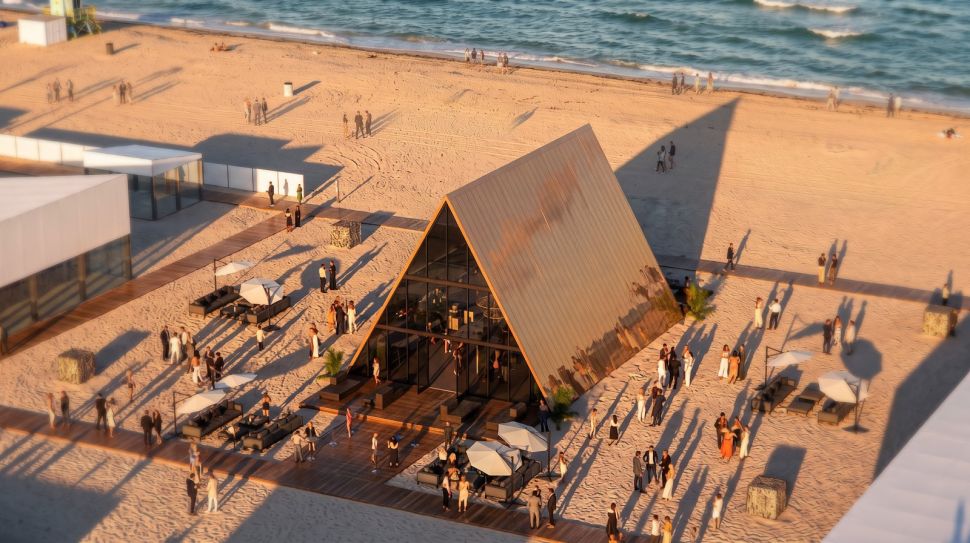
“We tend to think of these spaces in fairly simple terms: artists make work, galleries put it on the wall, and people look at the work,” River Smith explained. “So how do we get people to engage differently?” The organizers approached that question from several angles, starting, necessarily, with the layout. Rather than unfolding in a single pavilion, the fair will open across four gallery tents with two additional areas for content and stage programming. Among them is A-Different Frame, a Feature Project by artist Alain Perez presented by Aloyd. Its monumental 45-foot equilateral A-frame structure explores the relationship between architecture, art and the people who inhabit it and serves as a temporary hub for wellness programming, artist conversations, cultural experiences and evening hospitality.
“The layout is meant to encourage people to move through and experience the space differently, and take their time with each,” River Smith said. “We want to give visitors the experience in bite-size sections, allowing them to go through one space and really see everything. We are trying to create a more focused, contained and approachable experience.”
In line with that approach, the number of participating galleries has been deliberately reduced, from the roughly 100 the fair has traditionally hosted to around 70. “We don’t believe a better art fair is simply a bigger one,” River Smith added.
The four tents will not have set themes; the gallery presentations and Feature Projects will instead be distributed throughout. The 21 Feature Projects involve more than 50 artists, creating additional opportunities to encounter work beyond the conventional booth. “The projects vary in terms of experience and focus, but we see them as another opportunity for people to engage with the work, spend time with it and really understand it,” River Smith said. They span large-scale installations and murals, immersive environments and cross-industry collaborations.
Among the more ambitious projects are The Art of Dancehall by Cleark “Nurse” James and Sassa Frass, curated by Walshy Fire; The House Our Families Built by Swoon, presented by the San Francisco Mural Museum, SightlineSF, Superchief Gallery and Mortal Machine Gallery; and Alake Shilling’s Buggy Bear Crashing a City Near You, presented in collaboration with Tlaloc Studios. The program also includes Ceren Arslan’s Pixel Theory Lounge, a spatial environment developed with EXIT, and The Garden Salon by Mr. Flower Fantastic.
InScope is also continuing its collaboration with FUZE Caribbean Art Fair through The Blue Floor Project showcasing contemporary Bahamian and Caribbean practices. This year, it brings to Miami nine Bahamian artists featured in FUZE’s latest edition under the curatorial theme “Coming Home,” including John Cox, Amaani Hepburn, Lynn Parotti, Antonius Roberts, Heino Schmid, Keith Thompson and Averia Wright.
Other projects turn the fair’s functional spaces into artist-designed environments. Developed by SCOPE founder Alexis Hubshman and Chris Darsow in collaboration with Art Force, The Dive, The Speakeasy and The Oasis will offer places to gather, eat, listen and unwind, with live programming, music, hospitality and conversations throughout the week.
Galleries usually pay for such installations, whether in curated sections or along the aisles. Here, the fair produces some commissions directly, giving artists room to extend their practices beyond the booth walls without placing the full financial burden on the gallery. By way of example, River Smith pointed to The CAMP Gallery’s presentation of Jason Hackenwerth, which includes an installation extending above the booth.
The fair is also becoming a platform that connects people, industries and opportunities, opening up alternative ways to fund more ambitious work or different levels of distribution and circulation modalities that galleries are often not yet exploring. The Art of Wealth, hosted by Future Proof, and The Creator Compound, hosted by Create & Cultivate, are among the daytime events. The Wellness Oasis will offer talks, workshops and movement and mindfulness sessions addressing mental, physical, emotional and spiritual well-being. On the evening of Dec. 3, Create & Cultivate will host Supper Club Miami, an event for women in business combining cocktails, a seated dinner and a fireside chat. The social calendar also includes the Hypebeast HypeAwards; Art of the Party, hosted by Modern Luxury’s Ocean Drive magazine; and the Art Week Issue Celebration, hosted by Miami magazine.
For River Smith, the experiential and commercial dimensions are inseparable. “I think we have focused so much on the transactional nature of fairs that we have lost the experience in a way,” she reflected. “I believe that the more time people spend with the work, the more they will buy, because they get to have a personal experience with it. I have always believed that collecting is very experience-driven. When you see people collect something, they have often spent time with it, and often with the artist behind it.”
Asked who the fair is for, River Smith answered unequivocally, “everyone.” While SCOPE has long been associated with emerging artists and galleries, InScope aims to welcome collectors and newcomers alike. “You can be a seasoned collector interested in buying art, or someone who has not yet bought their first piece. We are also focused on cultivating a new audience of people who have the means and desire to buy but may not always feel these spaces are for them. The fair is meant for everyone, and that also means offering a range of accessibility.”
That ambition is reflected in the fair’s spectrum of price points, which include works beyond the reach of most visitors and more accessible pieces. An initiative launched last year highlights works priced under $5,000, with participating booths identified by a QR code that gives visitors access to a dedicated list. “It takes away some of the fear of asking about prices, which I think is half the battle,” River Smith said. Talks throughout the week will address both collecting and artists’ practices, with the broader aim of encouraging curiosity and making conversations about art more approachable. “It is really about education, but it does not have to be exclusively about collecting. It is about what interests people and how to make them comfortable having a conversation.”
For her, this kind of experience-led evolution is a necessity amid widespread talk of fair fatigue. InScope’s ambition, she said, is to create an environment in which visitors do not have to adopt a narrowly defined “art-world” identity but can take part as whole people, with varied interests and concerns. “In this industry, you walk into these spaces and put on one hat. How do you get to be yourself, holistically, with all your different interests and identities, in a space that traditionally has not always welcomed that?”
That emphasis on the human dimension is connected, she added, to the role of art itself: “When we consider the humanity of it all, there is always a person behind the artwork, before the price. Artwork feels more important than ever as a way to process the world around us, understand it and engage with it. Artists are, in many ways, the keepers of history.”