
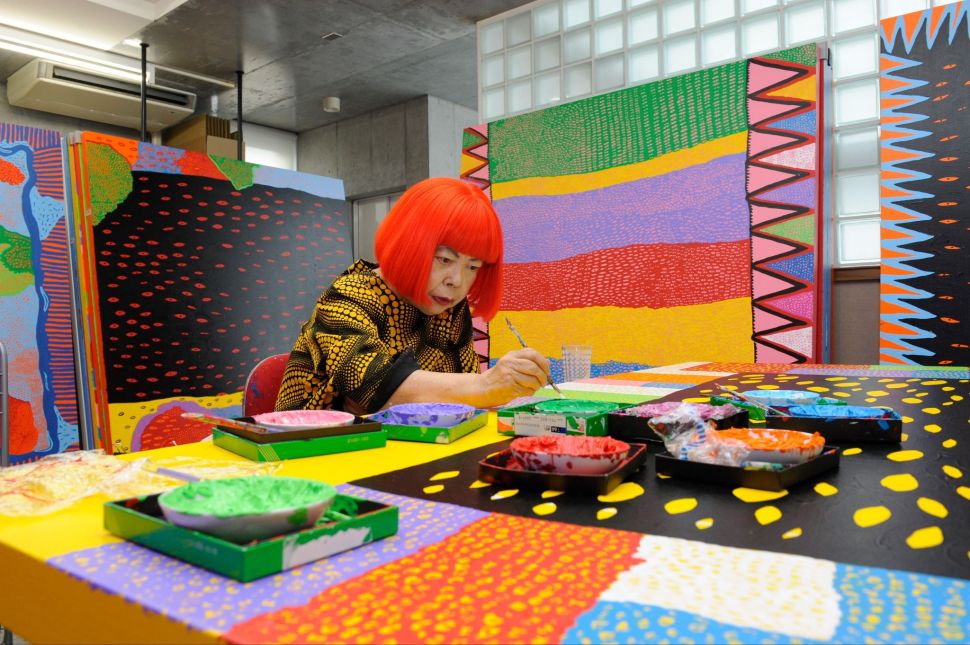
Yayoi Kusama works at a table in her studio, surrounded by brightly colored canvases, polka-dot patterns and trays of paint.” width=”970″ height=”646″ data-caption=’Kusama creating paintings for her <em>My Eternal Soul series</em> in 2014. <span class=”media-credit”>© YAYOI KUSAMA</span>’>
Yayoi Kusama died at the age of 97 on August 14 of multiple organ failure at a hospital in Tokyo, as reported by Kyodo News and confirmed by David Zwirner, her longtime gallery. With her obsessively repetitive, vibrant fields of dots emerging from an unbridled imagination, Kusama became one of the most popular artists of our time. Emerging from New York’s avant-garde scene of the 1960s, she developed a unique psychedelic visual language whose vibrancy and almost hallucinatory quality would become a global phenomenon decades later. Her pioneering Infinity Rooms then offered the perfect collision of popular culture and the art world, intersecting with fashion, spectacle and social media while transforming her own iconic image into a myth.
The last time Kusama visited New York, a city where she lived for many years, was in 2013, David Zwirner recalled in the gallery’s statement. “During that visit, she opened the first of many exhibitions in our galleries that had hour-long lines for the chance to experience her work,” he added. “Her steadfast message of love and peace has now reached millions of admirers around the globe. At the time of her passing, Kusama was, without a doubt, the most famous living artist in the world. I will miss her terribly.” She presented six solo exhibitions at the gallery, in 2013, 2015, 2017, 2019, 2021 and 2023, each of which broke attendance records.
Kusama emerged as a global cultural icon even while uncompromisingly pursuing an avant-garde vision rooted in personal trauma and an extraordinary imaginative capacity for creative metabolization of those experiences. Over the course of seven decades, she honed a singular personal aesthetic and a core philosophy of life, conceiving a form of art that, beyond the mythology surrounding her, was first a necessity for herself and then, in her own words, “a healing of all mankind.” That idea was central to her recent survey “Yayoi Kusama: 1945 to Now” at M+, the largest retrospective of Kusama in Asia outside Japan, which sought to reveal the essence of her unique creative genius beyond the spectacle.
Remaining always true to her sensibility and inner world, Kusama demonstrated how, even within a production-driven materialistic society, creative obsessions can also find a place and, when propelled by a genuine urgency for expression, healing and the processing of trauma, generate new aesthetic languages through which to reconcile oneself with the world and other beings. “When we obliterate nature and our bodies with polka dots, we become part of the unity of our environment—part of the eternal—and we obliterate ourselves in love …” Yayoi Kusama said in a 1971 statement presented as part of the M+ exhibition.
Pursuing this universal level of reach and purpose, she proved capable of fully participating in the society around her, circulating her vision widely across both luxury and mass-market channels to touch the imaginations of diverse audiences.
Yayoi Kusama’s early career
Yayoi Kusama was born in Matsumoto, in Nagano Prefecture. As the youngest daughter of a family that ran a seed nursery, she routinely spent time immersed in flowers and natural life, which nurtured both her sensitivity and her imaginative world. The intensity with which she experienced that world manifested early: as a child, she had hallucinations involving “flashes of light, auras or dense fields of dots” and felt she was able to speak with animals. From the beginning, art was both a tool and a necessity, an attempt to translate the synesthetic intensity with which the world manifested itself to her.
In 1948, at 19, she enrolled at the Kyoto Municipal School of Arts and Crafts, where she studied nihonga, or traditional Japanese-style painting. Yet from the beginning, she felt constrained by postwar Japanese society and its limitations on her unbridled creativity. For an artist who went against virtually every canon and convention, it could hardly have been easy to express the libidinal energies of the mind and body that would later fuel the boundless creativity she came to embody.
Kusama arrived in the United States in 1957, at a time when the American art scene was dominated by Abstract Expressionism and beginning to move toward Minimalism, Pop and Conceptual art. Encouraging her to move was Georgia O’Keeffe, who had replied to her after Kusama sent her several watercolors. By 1958, Kusama had made her way from Japan to Seattle, then to New York, soon joining its vibrant downtown scene.
Back in Japan, she had already begun making obsessive paintings covered in repetitive marks, what she called her “Infinity Net” paintings. In New York, she radically expanded their scale and ambition, producing what would become the breakthrough body of work of her early career. Thousands of tiny, repetitive loops stretched obsessively across enormous canvases. They were radically different from the heroic gestures of Abstract Expressionism, yet they belonged to the same conversation around painting, repetition, scale and infinity.
When, in 1959, she exhibited five enormous white Infinity Net paintings at Brata Gallery, Donald Judd, then a young critic and artist, praised them as powerful and original in his review for ARTnews. “The expression transcends the question of whether it is Oriental or American. Although it is something of both, certainly of such Americans as Rothko, Still and Newman, it is not at all a synthesis and is thoroughly independent,” he wrote. Kusama was only 30 at the time.
By the early to mid-1960s, she was working fluidly across painting, sculpture, installation, performance and happenings. Her obsession with repetition and accumulation became increasingly physical as she translated and materialized her intensified vision across media. It was around this time that she began covering objects and furniture with soft fabric forms, her famous Accumulation works. A chair, sofa or boat could disappear beneath hundreds of phallic-looking protrusions in sculptures and installations that now reside in major museum collections.
There was also a powerful element of personality behind her success. Kusama was extraordinarily ambitious and understood the importance of publicity and visibility. During these years, she staged happenings, organized exhibitions and aggressively promoted her own work. That impulse reached one of its climaxes with her memorable 1966 installation Narcissus Garden at the Venice Biennale. Although not officially part of the exhibition, she installed 1,500 mirrored balls and offered them to visitors for $2 each. An accompanying sign read, “YOUR NARCISSISM FOR SALE.”
It was a powerful guerrilla intervention that anticipated the blockbuster, mesmerizing installations for which she would later become famous, while also offering a pointed commentary on commercialism, spectatorship and the art market, particularly at a time when the commercial dimension of the Biennale itself was far more explicit. (It was only after the protests that year that the Biennale downgraded its official sales office to a “sales service,” which continued operating until 1973.)
Most importantly, the operation already reveals Kusama’s early understanding of something that would later become fundamental to contemporary art: an artwork could simultaneously be an event, an image and a public spectacle. The artist, too, could become both myth and product, fundamentally influencing and informing the value of the work itself.
Yet Kusama also understood that mystery was part of constructing that myth. By the early 1970s, she had left New York and returned to Japan. She voluntarily entered a psychiatric hospital in Tokyo in 1977 and continued working from there.
Isolated in Japan, her career and international visibility declined dramatically. For years, she largely disappeared from the international circuit until a younger generation of curators and scholars began increasingly reassessing her work, particularly from the 1980s onward. Among them was art critic Akira Tatehata, who was instrumental in her participation in the 1993 Venice Biennale, where she represented Japan.
Before that, in 1989, the Center for International Contemporary Arts in New York had already organized a retrospective of her work. What followed throughout the 1990s and into the 2000s was an extraordinary surge of institutional attention as museums and curators began reassessing her 1960s work and its relationship to Minimalism, Pop, feminism, performance and Conceptual art.
In 1998, the Los Angeles County Museum of Art opened “Love Forever: Yayoi Kusama, 1958–1968,” which subsequently traveled to the Museum of Modern Art in New York, the Walker Art Center in Minneapolis and the Museum of Contemporary Art Tokyo. The exhibition prompted a major reassessment of the radical work Kusama had produced during her New York years.
Another key moment came when Tate Modern in London staged a major retrospective in 2012. From 2012 to 2015, three major solo presentations traveled simultaneously through Japan, Asia and Central and South America.
“Infinite Obsession” drew nearly two million visitors across Buenos Aires’ MALBA-Fundación Costantini and Rio’s Centro Cultural Banco do Brasil before opening at Museo Tamayo in Mexico City. A 2011-12 retrospective traveled to the Museo Nacional Centro de Arte Reina Sofía in Madrid, Centre Pompidou in Paris, Tate Modern in London and the Whitney in New York. In both 2012 and 2023, Kusama also collaborated with Louis Vuitton on special collections.
Still, what arguably transformed her into a true mass-cultural phenomenon was the Hirshhorn Museum and Sculpture Garden’s 2017 exhibition in Washington, D.C., “Yayoi Kusama: Infinity Mirrors.” The show centered on environments that were already perfectly suited to the emerging visual language of Instagram, their endlessly reflected spaces generating lines stretching around the block, and doing the same at subsequent iterations across the country and the world. Some 475,000 visitors saw the show in Washington before it traveled to the Seattle Art Museum, The Broad in Los Angeles, the Art Gallery of Ontario in Toronto, the Cleveland Museum of Art and the High Museum of Art in Atlanta.
Savvy, and at precisely the right moment, Kusama openly embraced this fluid circulation across genres, products and sectors, allowing her unique visual language to penetrate far beyond the art world. In 2012, she embarked on her first major collaboration with Louis Vuitton, translating her polka-dot vocabulary across the fashion house’s products. The partnership expanded on an even larger scale in 2023, when monumental polka dots and animatronic figures modeled after Kusama transformed Louis Vuitton stores in New York, Paris, Tokyo and other cities, further fueling the global social-media phenomenon surrounding her name.
In 2022, M+ in Hong Kong staged “Yayoi Kusama: 1945 to Now,” a sweeping retrospective featuring roughly 200 works spanning nearly eight decades. The exhibition reframed her entire trajectory, redirecting attention toward the singular vision, mind and character behind the work and beyond the viral dots and Instagram spectacle of the Infinity Rooms.
“Yayoi Kusama: Infinite Love” was presented at the San Francisco Museum of Modern Art in 2023 and 2024, while a comprehensive retrospective at the National Gallery of Victoria in Melbourne in 2024-25 became the highest-attended ticketed exhibition in the museum’s history, drawing 570,537 visitors.
In 2025, a major traveling European exhibition opened at Fondation Beyeler in Riehen/Basel, making it the first Kusama retrospective in Switzerland, before traveling to Museum Ludwig in Cologne, where it became the most successful exhibition in the museum’s history, drawing 480,335 visitors. In September, the show is scheduled to open at the Stedelijk Museum in Amsterdam.
By the 1990s, Yayoi Kusama had also become a market force, with her works eventually surpassing seven figures. In 2021, her auction sales grew nearly 160 percent, climbing to $183.5 million. Kusama’s auction record stands at $10.5 million: her 1959 painting Untitled (Nets) sold for $10,496,000 at Phillips New York on May 18, 2022, against a $5-7 million estimate. This year she topped the Hiscox Artist Top 100 2025 not only as the leading contemporary female artist by sales of works produced after 2000 but also as the top artist overall, surpassing figures including François-Xavier Lalanne and George Condo. According to the 2025 report, Kusama generated $58.8 million in auction sales in 2024.
Yayoi Kusama’s art world legacy
Kusama leaves behind a legacy that embodies many of the contradictions defining today’s art world, which has increasingly replicated the same dynamics of celebrity and branding embraced by other creative sectors. An avant-garde artist who once lived as an outsider on the margins became a global cultural icon, having understood early many of the mechanisms the art world was already beginning to absorb from consumer culture: celebrity, repetition, spectacle and commodification, dynamics that were already taking shape when she was struggling to establish herself in New York’s downtown scene. She eventually became one of contemporary art’s most commodified and recognizable cultural brands, one of its most widely exhibited artists and one of the highest-selling at auction.
Yet this success was possible precisely because she remained faithful to a uniquely identifiable vocabulary. Kusama created a visual system capable of moving between the gallery, museum, fashion world, popular culture and internet without losing its identity. At the same time, her language was fundamentally universal, transcending cultural barriers and speaking directly to the subconscious. Her personal mythology of the “true artist,” something increasingly rare in contemporary culture, gave substance to this dense symbolic universe and the storytelling surrounding it, allowing that vocabulary to translate almost naturally into popular culture, products and endless variations without entirely severing itself from its artistic and psychic origins.
Arguably, that is why Kusama became Kusama: the obsessive repetition of her symbolic world itself became a mechanism of cultural recognition but also cultural relevance, capable of fascinating audiences across generations, capturing attention and continually triggering the imagination through her unbounded creativity, which is, in the end, what allows an artist to withstand the test of time.