
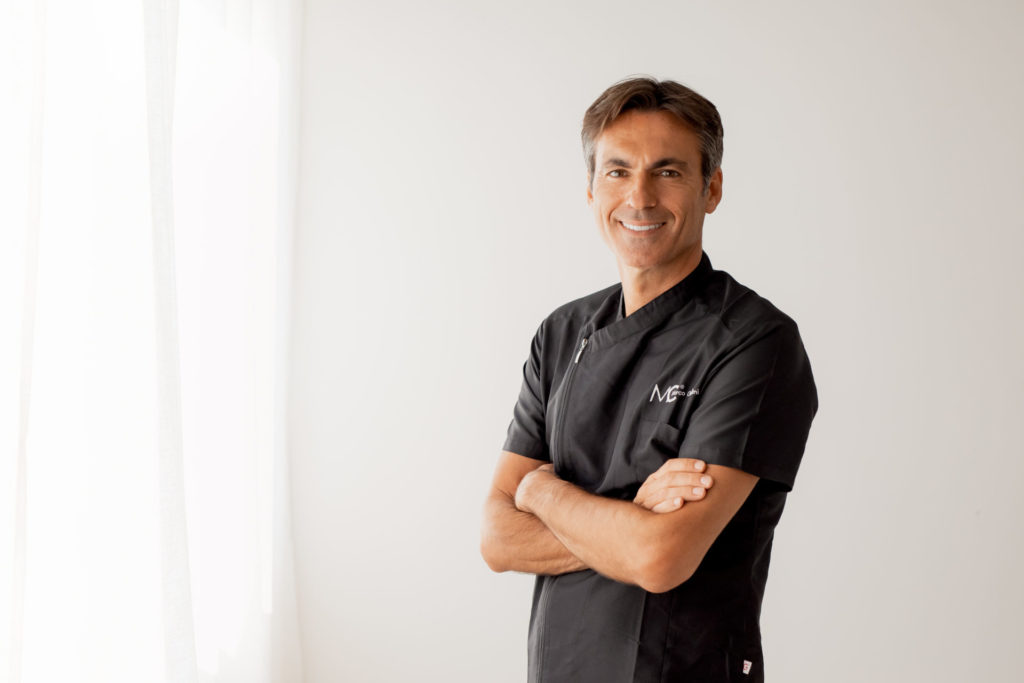
In Italy, Dr. Marco Chiellini has established himself as one of the most distinctive voices in aesthetic dentistry, building his work around a specialization that remains unusual in Europe: the female smile. With roughly 25 years of experience, Chiellini was among the pioneers in Italy in developing a dental practice specifically focused on women, approaching cosmetic dentistry not as the pursuit of standardized perfection, but as the creation of a smile tailored to the individual face, personality and natural proportions of each patient.
His professional philosophy has been deeply influenced by the United States and by the Hollywood tradition of cosmetic dentistry: he traveled to New York to exchange methods and techniques with internationally renowned aesthetic dentist Michael Apa and later developed a professional collaboration in Los Angeles with Sam Alawie, whose dental laboratory has worked with some of Hollywood’s best-known faces.
That American journey also became the subject of the television documentary Sorrisi a Beverly Hills, which explored the techniques and culture behind the Hollywood smile and Chiellini’s ambition to reinterpret them through an Italian sense of craftsmanship, natural beauty and personalization. His work has also extended beyond the dental practice through books and media projects devoted to the psychology, aesthetics and social importance of the female smile. In 2024, his professional trajectory and ability to create a bridge between Italian expertise and American innovation were recognized in New York, where he received the Italian Reputation Award at the Italian Cultural Institute, an honor dedicated to Italians whose work, innovation and professional standing contribute to strengthening Italy’s reputation internationally.
For our American readers who don’t know you yet: who is Marco Chiellini? Tell us who you are, where you work, and how you would describe what you do.
Marco Chiellini is an aesthetic dentist who focuses above all on caring for women’s smiles. I was the first in Italy to create a dental practice focused specifically on women’s smiles, and I’ve been working in dental aesthetics for 25 years now. Dental aesthetics, which is very popular in the United States, hasn’t become as established in Italy yet. What I do is help women rediscover their self-confidence through a beautiful smile.
You began in dentistry very young, first training as a dental technician and later becoming a dentist. What drew you to this field in the first place?
Yes, I started very young, around 13 or 14 years old. I began by attending dental technician school. It’s a profession that always fascinated me, caring for the mouth is always part of caring for the person, part of the medical field that has always drawn me in.
One chapter of your book is titled “The Dentist Who Didn’t Want to Be a Dentist.” What made you resist the profession at first, and what changed your mind?
It’s a fairly playful title, in the sense that I always realized, from the very beginning, how strong I could be working outside the chair, building a real relationship with patients, rather than working directly in the chair with my hands in the patient’s mouth. That has always been my strength: the relationship I built with people.
At some point you made a decision almost no dentist makes: to dedicate your practice entirely to women. What led you there?
Opening a practice dedicated exclusively to women happened because my patient base had become almost entirely female. I worked in aesthetics, so my patients had, in a sense, self-selected over time. As a result, I decided to dedicate the practice solely to women, since I already had a prevalence of around eighty percent female patients.
You’ve mentioned your mother as one of the experiences behind that choice. How did that shape the way you work with your patients today?
My mother influenced my choice to open a practice focused on women in the sense that she was always someone very attentive to her smile, and so was my grandmother. Back when dental care wasn’t thought of in such an aesthetic way, they already were. Even today, that still influences my aesthetic choices: the fact that my mother, and my grandmother too, despite their age, were always focused on the aesthetic side of the smile and not just the functional one.
Beyond the personal side, what did you notice clinically that convinced you women needed a different approach?
What influenced me clinically, what I noticed as the difference, is that there’s a close correlation between a person’s face and their teeth. Women’s teeth are often smaller, and what pushed me toward this was seeing, very often, women with teeth that had been reconstructed too large, teeth that didn’t reflect their smile at all. So I thought about recreating the correct harmony between a woman’s face and the teeth she rightfully carries.
In your book you write about “the girl without a smile,” a real patient. What was her story, and why has it stayed with you?
It stayed with me because she was a woman who had been shut in at home by her husband, who never allowed her to go out, never even allowed her to get a driver’s license. When she finally managed to free herself from that oppressive husband, the first thing she did was come to my practice to redo her smile.
You describe a smile as something designed around the individual, not simply “perfected.” What makes a smile truly harmonious and natural, in your view?
A truly harmonious smile is one that, within a person’s face, doesn’t stand out as anything other than genuinely their own, not something fake stuck on top of their teeth. Harmony is naturalness, it’s not standing out.
You let patients try on their future smile before any treatment begins, much like trying on a dress. How does that work, and why did you decide that trusting the result after the fact wasn’t good enough?
Trying on the smile before it’s actually made is essential, because through that trial we can correct anything that doesn’t look as good as we imagined. The patient gets to give their opinion on what the future work will be. It’s an absolutely fundamental part of the treatment, maybe even the most important part.
How much can a woman’s smile influence her confidence, the way she communicates, even the way she sees herself? What are you really giving back to a patient who has spent years hiding it?
A woman’s self-confidence is strongly influenced by her own smile. If you think about it, the smile makes up most of what people see when they look at your face, even before the eyes, so the smile is truly a fundamental part. For women it’s even more so. In my experience, I’ve seen so many women cry after seeing the trial version of their smile, or even the finished work. I’d like women to become increasingly aware of how important their smile is for their self-confidence and their beauty, and above all, for them to stop coming to the dentist saying they need to talk to their husband first, and instead make the decision themselves, upfront, regardless of what others think, even people who matter to them.
Looking ahead: where is aesthetic dentistry heading over the next ten years, and what would you like women, in Italy and in the United States, to understand differently about their smiles?
Over the next ten years, aesthetic dentistry will definitely keep gaining ground in Italy, partly because fewer and fewer patients will lose all their teeth and need implants, since young people take much better care of their teeth today. In the meantime, they’ll pay much more attention to their beauty and the beauty of their smile.