
Amid a recalibration of the global art market, Japan’s art scene has stood out for its consistent growth over several years. Following a 38 percent drop in 2020, the market rebounded to $756 million in 2022 and has since stabilized. Sales reached $692 million in 2024, up 2 percent year on year even as global sales declined by 12 percent, according to The Japanese Art Market 2025 report, prepared by art-market economist Clare McAndrew and published as part of the FY2025 Art Ecosystem Infrastructure Development Promotion Project, commissioned by the Agency for Cultural Affairs.
This sustained growth has come as the broader Japanese economy has entered a more stable, if still transitional, phase, as the country appears to have found the elusive formula for escaping its long-standing stagnation, instilling greater confidence among both local consumers and international investors.
The IMF expects real GDP to expand 0.8 percent in 2026, supported by a 1.1 percent rise in both private consumption and business investment, even as weaker external demand and global trade tensions weigh on growth. Inflation, which remained above the Bank of Japan’s 2 percent target for more than three and a half years, is also projected to moderate to around 2.1 percent this year. Most importantly, the Japanese economy has entered a new phase in which labor shortages are slowly but meaningfully changing traditional wage-setting structures and workplace hierarchies. Social shifts, from gender equality to evolving corporate traditions, have also been driven in part by younger generations, who are helping foster greater openness to international exchange. “Moderate inflation and the best period of nominal economic growth since the collapse of its asset bubble in the early 1990s are helping usher in a generational shift in Japan’s economy and markets,” noted Morgan Stanley’s chief Japan economist Takeshi Yamaguchi in a recent report.
This new internationalization is probably the most significant change for the Japanese art market in recent years, as a new cohort of young galleries and art professionals has entered the scene and begun participating more actively in international fairs.
“The Japanese art market has been somewhat isolated, with its own unique ecosystem,” acknowledged Takayuki Ishii, founder of Taka Ishii Gallery. Yet, compared with internationally acclaimed emerging artists, those who command high prices at local Japanese auctions tend to hold a particularly strong influence domestically. “A key reason for this could be the lack of Japanese magazines and online publications covering global market dynamics.”
This may also explain why younger Japanese artists who have recently seen a renewed surge in international interest often arrive on the global stage with trajectories already solidly built on a strong local collector base. Rising stars such as Yu Nishimura climbed quickly at auction toward the seven-figure mark only once their work began circulating more internationally through galleries such as Crèvecœur and Sadie Coles HQ, but the artist had already been in strong demand in Japan and Asia. His market position was further lifted by representation by David Zwirner, elevating him into the ranks of internationally established contemporary artists. Interestingly, Nishimura may also prove a particularly resonant figure if we consider how his genuinely anime-inflected, intuitive style allows his paintings to be perceived almost as cultural testaments to an era for a generation now in its thirties and forties, whose visual vocabulary was shaped by the global spread of manga and anime in the late 1990s and 2000s. Nishimura’s most recent auction record was set last May at Sotheby’s New York, when Leaves Carpet (2017) sold for $998,400 (40 percent above his previous benchmark).
Meanwhile, the previous generation of Japanese artists who emerged internationally between the late 1990s and 2000s remains firmly at the very top of the global market, with Yoshitomo Nara and Takashi Murakami still the most expensive living Asian artists. Yayoi Kusama, who passed away in late August, maintained the highest level of the auction market for two consecutive years, topping the Hiscox Artist Top 100 in 2025 not only as the leading contemporary female artist by sales of works produced after 2000, but also as the top artist overall, ahead of figures including François-Xavier Lalanne and George Condo. According to the 2025 report, Kusama generated $58.8 million in auction sales in 2024.
What is perhaps even more noteworthy, however, is how much the gallery ecosystem itself has evolved. New spaces have continued to emerge, while major international names such as Pace Gallery and Ceysson & Bénétière have opened in Tokyo over the past two years.
“As the second-largest art market in Asia, Japan is home to a robust infrastructure of galleries and institutions shaping the scene, numerous experienced and dedicated collectors, and contemporary artists creating work that resonates on the global stage,” said Eri Takane, director of Tokyo Gendai, which just a few editions in had established itself as the country’s leading international fair. Since the fair’s debut in 2023, the country’s cultural infrastructure has significantly expanded, she told Observer, pointing to new galleries that bring their own approaches to the market and provide platforms for emerging artists and practices. “This network of galleries has been met with great support from international and local audiences, and has forged new relationships that will continue to propel the market forward. Meanwhile, it is great to see Japanese artists as the subject of major exhibitions across the world.”
In terms of collectors, the country’s art market has long relied on Japanese high-net-worth individuals, many linked to some of the country’s largest corporations. According to the report, they were particularly active in 2024, visiting an average of 10 gallery exhibitions—four locally and six abroad—surpassing the global average. Their reliance on long-term dealer relationships remains an important factor that both shapes and sustains the market, though it has also limited its innovation.
In the past several years, Japan has been developing a new generation of highly committed younger collectors, many of whom began with fashion and sneakers in their twenties and are now moving toward design and art. In parallel, a growing number of wealthy younger people from across the region—particularly China—have bought homes in Japan and, in some cases, relocated there, creating a new audience for Japanese galleries and artists. “We are seeing a new generation of collectors, from Japan and abroad, become more actively engaged in the art market, as family wealth is also being passed down,” Takane confirmed.
The government has also stepped in, strongly supporting the cultivation of Japan’s contemporary art scene in recent years through new initiatives designed to catalyze this growth.
As a result, Japanese dealers and galleries generated about $494 million in 2024, equivalent to 71 percent of the country’s entire art market, with sales rising 7 percent year on year even as dealer sales globally were falling. Japan now has more than 2,080 dealers and galleries, roughly 59 percent of them in Tokyo. More strikingly, around 20 percent of dealers and galleries currently operating were founded after 2020.
Still, Japan’s art market remains overwhelmingly concentrated in lower price tiers. In 2024, works priced below $50,000 accounted for 95 percent of dealer sales, up sharply from 65 percent the previous year. The auction market tells a similar story, with 91 percent of lots selling for less than $10,000, a clear reflection of the market’s cautious approach to high-stakes investment. Yet it remains extremely dynamic, functioning through volume rather than headline prices and sustaining a healthy, comparatively accessible market for an audience that continues to expand. “If you only look at raw transaction volume, you miss what makes Japan so unique: it is a market driven by true enthusiasts, not trend-chasers,” Julia Gai, a gallery manager at Ceysson & Bénétière Tokyo, told Observer. “Here, appreciation takes time—time to feel, time to grasp the meaning behind a piece and to build a real connection. Because people buy out of pure passion, collecting transcends a transaction. It becomes an enduring link between the artwork, the collector and the artist.”
Japan now accounts for 5 percent of the Asian art market, according to the report. This places it well behind China’s overwhelming 80 percent share but ahead of South Korea, which trails in fourth place with 2.5 percent. Artnet Price Database figures reinforce that picture, showing Japan accounted for 5.1 percent of Asia’s auction market between October 2023 and September 2024. Meanwhile, South Korea saw a sharp 27.2 percent year-on-year decline in auction sales during the third quarter, falling to $17 million, according to the Korea Art Authentication and Appraisal Institute.
While Japan’s share of the global art market remains a modest 1 percent, government reforms in recent years have begun laying the groundwork for broader international engagement. Chief among these was a 2021 tax overhaul that eased restrictions on artworks sold or displayed through free-port zones. The reform proved pivotal to the launch and success of Tokyo Gendai, a relatively new addition to The Art Assembly portfolio, strategically held at PACIFICO Yokohama, a port area where the fair can benefit from the lifting of duties and taxes, making participation significantly more feasible for international galleries.
Since its launch in 2023, the fair has expanded its international reach and its VIP program. International collectors have increasingly come from South Korea and neighboring Asian markets, with fair director Eri Takane noting a significant younger presence. Each year the VIP program takes guests across some of the country’s most compelling art destinations, including intimate visits to Naoshima and Teshima, anchored by Benesse Art Site Naoshima, as well as the Enoura Observatory, designed by celebrated artist Hiroshi Sugimoto, where art, architecture and landscape converge along the Odawara coastline. This year, the VIP itinerary also includes a visit to the inaugural Maebashi Biennale, opening just days after the fair.
Tokyo Gendai as a catalyst
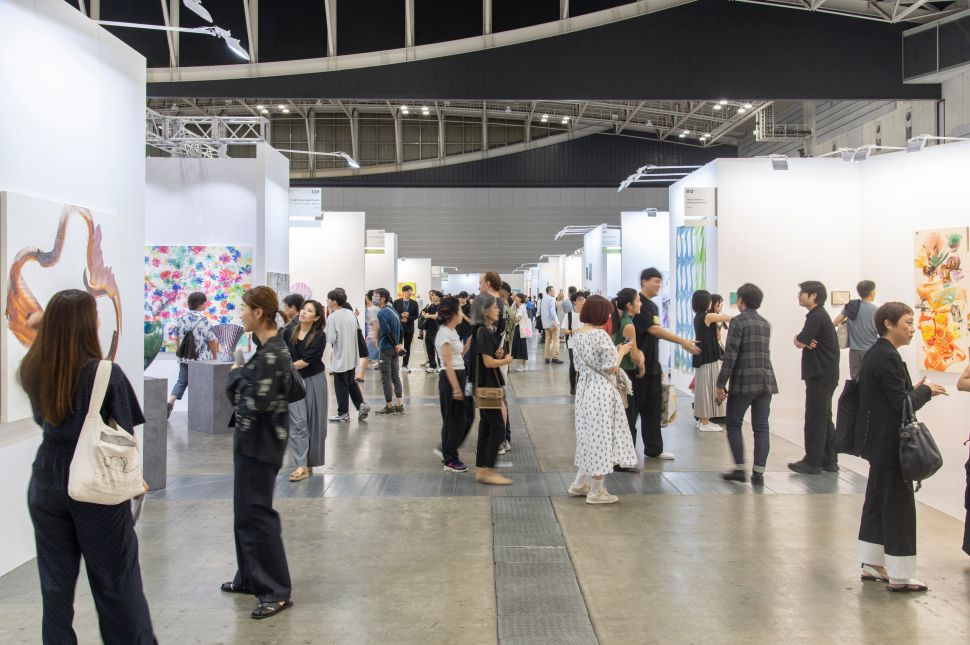
Tokyo Gendai returns this year September 11-13, with a VIP Preview and Vernissage on September 10, featuring 63 galleries, including 30 international exhibitors. While several prominent galleries that participated last year are not returning, including Almine Rech, Galerie Eva Presenhuber, Galerie EIGEN + ART and Gallery Baton, many others are participating in the fair for the first time, including A2Z Art Gallery (Paris), Art of Nature Contemporary (Hong Kong, Fuzhou), ARTCUBE 2R2 Gallery (Seoul), Dom Art Gallery (Dubai), JD Malat Gallery (London, Dubai), NOGADA (Seoul), noon (Antwerp, Ghent, Knokke), Sofi Gallery (Bergamo, New York, Shanghai), Suppoment Gallery (Seoul), THE HARTZ PROJECT (Hong Kong), W-Galería (Buenos Aires, Pueblo Garzón), Project Fulfill Art Space (Taipei), TAEX (London), ART ON SPACE (Foshan), Bangkok CityCity Gallery (Bangkok), Boogie Woogie Photography (Hong Kong), Curatorial Gallery (London), Fabrik Projects (Los Angeles), form gallery (Dinard, France), HART GALLERY (Hangzhou), Revolver Galería (Buenos Aires, Lima) and X Contemporary Art (Changsha).
This year’s fair is divided into five curatorial sections. As usual, Hana, or “Flower,” is dedicated to solo and multiple-artist presentations by artists at the early or mid-career stage. It returns with 28 exhibitors, featuring highlights from both local and international galleries, including a solo booth of new works by Yukino Yamanaka, presented by the rising Tokyo gallery CON_, and W-Galería’s presentation of paintings and objects by Max Gómez Canle.
Eda, or “Branch,” is dedicated to solo or multiple-artist presentations by established or historically significant artists, as well as thematically curated presentations. Here, Ippodo Gallery Tokyo is presenting a themed showcase of works by six contemporary artists exploring the intersection of Japanese tradition, nature and modern society, while MIZOE ART GALLERY, with locations in Tokyo and Fukuoka, is spotlighting the sculptural practice of Tomonori Toyofuku, a Japanese artist long based in Italy known for distinctive abstract sculptures in wood and bronze.
The newly introduced Miki, or “Trunk,” creates a more flexible and comparatively lower-risk entry point, particularly for international dealers, with presentations focused on works on paper, a medium deeply rooted in Japanese culture, which here includes photography, drawing and prints by artists who reinterpret the medium across tradition and innovation. Making its fair debut in this section, Revolver Galería is presenting a two-artist booth featuring José Carlos Martinat and Jerry B. Martin, structured around the transformation of text, surface and printed matter.
Also new to the fair is a sector specifically dedicated to digital practices, including NFTs, animation, film, AR, VR and gaming. Focused on artists working at the intersection of creativity and technology, an area that has profoundly shaped Japanese society since the postwar period, the sector includes the digital art platform TAEX, which presents an avatar project by Marina Abramović alongside Kevin Abosch’s synthetic photography series, Goldfish, and Francesco D’Isa’s philosophical inquiry into machine imagination. Meanwhile, Double Square Gallery of Taipei is featuring We Are Not Performing by Tsui Kuang-Yu, a work exploring the adaptive relationship between humans and society and ever-shifting notions of reality, while Project Fulfill Art Space, also from Taipei, is showcasing The Termite Feeding Show by Zhang Xu Zhan, a sci-fi fable inspired by a real news event involving termites causing large-scale blackouts, used here as a metaphor for the human condition.
Both sectors acknowledge the shifting tastes of an increasingly important new generation of collectors, while creating new entry points to further foster that audience. “In the past few years, we have seen a younger generation becoming increasingly instrumental to the contemporary art scene in Japan, not just as collectors but also as gallerists and professionals within the industry,” Eri Takane said. She described this growing community of young collectors as engaged, thoughtful and, perhaps most importantly, focused on connection, building close and lasting relationships with artists and galleries. “They engage with a broad array of artists across a range of media and practices, looking for work that speaks to their personal interests and sensibilities. With Tokyo Gendai, we want to really provide a touchpoint, where collectors can meet galleries and artists; it is the place where they build on existing relationships, and where they make new connections.”
Then there’s Sato, or “Meadow,” the fair’s program dedicated to dynamic, large-scale, site-specific installations and performances staged between the booths. Highlights this year include Everyone’s Soarer by Mr., a boldly customized Toyota Soarer presented by leading Japanese gallery Kaikai Kiki Gallery, and Takeshi Yasura’s installation Garden, presented by Kotaro Nukaga, which creates an imaginative site within the fair where human and nonhuman, living and nonliving elements are rendered materially contiguous.
Tokyo is always worth the trip, not only for its food and its singular sense of aesthetics, but increasingly for the strength of its contemporary art offerings across galleries and major institutions. Highlights this season include Ron Mueck at Mori Art Museum, a selection of Renaissance masterpieces from the Louvre at the National Art Center, Tokyo, and a solo exhibition by celebrated Japanese photographer Hiroshi Sugimoto at the National Museum of Modern Art, Tokyo.
Additional satellite events during the week include visits to the newly opened Ueshima Museum, home to the contemporary art collection of Japanese entrepreneur Kankuro Ueshima, as well as the customary opening night at Terrada Art Complex, which has become, in just a few years, Japan’s largest gallery hub.
Tokyo Gendai now increasingly operates as part of a broader regional ecosystem. A key trend among younger galleries and collectors, Takane notes, is an orientation toward cross-disciplinary collaboration and programming. Tokyo Gendai has embraced this approach, working closely with institutions, galleries and other fairs across the region. For the 2026 edition, several special projects are integrated into the fairground landscape, including the Hana Artist Award, a collaboration with PHOTOFAIRS Shanghai that brings four new galleries to the Miki “Trunk” sector, and a special presentation of three Taiwanese galleries in the Tane “Seed” sector, among other initiatives. The fair has additionally expanded its partnerships to include Nota Hotel and Soho House, as well as a new collaboration with Young Presidents’ Organization.
Meanwhile, Japanese galleries are also notably present at international fairs. This is particularly visible, for instance, at Frieze Seoul: while in 2023 there were around 13 Japan-based galleries, this year 22 Japanese galleries are participating, marking a 69 percent increase over two years of local market consolidation and expansion. The shift is also visible at Art Basel, where younger and mid-generation Japanese dealers, including KAYOKOYUKI, Kosaku Kanechika and The Third Gallery Aya, have entered the fair in recent editions. An important push in this direction has also come from the government, with Japan’s Agency for Cultural Affairs’ global-art expansion grants including funding for Japanese galleries to attend major international fairs, with 15 galleries supported in the first round alone.
Despite the challenges that followed the pandemic boom, including geopolitical conflicts, higher energy and shipping costs, inflation and the weak yen, all of which have been challenging for galleries, established gallerist Kotaro Nukaga still believes that collectors and art audiences in Japan have very high expectations for events such as Tokyo Gendai and other fairs taking place domestically. “It remains a rare opportunity in Japan to encounter serious international contemporary art in an art fair context,” he said. “Whatever the market conditions, the role of a gallery remains the same: to create meaningful encounters between exceptional works of art and the collectors who are looking for them.” As Nukaga noted, Japan in particular is still home to many remarkable artists who have yet to be discovered by the global art market. “We see it as one of our missions to connect these artists with the international art world and create opportunities for their work to be seen, understood, and appreciated beyond Japan.” This year at Art Basel, the gallery presented a solo presentation dedicated to postwar Japanese avant-garde artist Saori Akutagawa.
“I feel that the social value of art has increased, leading to the cultivation of new collectors,” said Shinji NANZUKA, owner of NANZUKA, now an anchor of Tokyo’s ecosystem but also one of those galleries that built its identity around collapsing the boundaries between contemporary art, design, illustration, street culture, fashion and music, perhaps understanding very early how aesthetic appreciation was shifting in Japan, a development we are now seeing among next-generation collectors across the globe.
In Tokyo, there has been an increase in the number of new galleries opening over the past four to five years, and a positive cycle has emerged in which new artists who debuted through these galleries are now exhibiting at international art fairs, he acknowledged. Nanzuka also noted that, while the art market became overheated during the pandemic, it is now settling down, and a new cycle may be beginning. “With the speculative trend in art subsiding, young artists creating works with a long-term perspective, especially those with a philosophical or prophetic quality, who might previously have gone unnoticed, are gradually coming to the fore,” he said, noting that international fairs such as Tokyo Gendai emerged during this transitional period and have had a significant impact on the Japanese art scene, expanding both its breadth and reach.
The picture that emerges is of a Japanese art system characterized by broadening participation and sustained infrastructure-building, both of which can support healthy, long-term growth very different from the speculative bubble of the 1980s or the more recent boom-and-bust dynamics seen in neighboring South Korea. It remains to be seen what new data the fall art season, which includes Tokyo Gendai, Art Week Tokyo and ACK: Art Collaboration Kyoto, will contribute to this ongoing conversation.