There is something both unsettling and engaging in the menacing yet naive visual universe of Vietnamese artist Tran Luong. His hallucinatory stratifications of symbologies connect and collapse fluidly across different levels of reality, between the earthly and the celestial, the physical and the fantastical. Perhaps unsurprising, he grew up in a country at war, spending his childhood hiding from bombings, bullets and violence. When we spoke on the occasion of his soon-to-close show “When sky merges with Earth” at Bortolami, Tran recalled how, like many children in the cities of Northern Vietnam, he was evacuated to the countryside during the summer of 1965 to escape American bombing raids. This period of evacuation became a never-ending pilgrimage between various locations, sometimes staying for a full year, other times for only a few months, with brief returns to the city during lulls in the hostilities. At times, he was accompanied by his parents; at other times, he lived alone among farming families.
Throughout this period, he was often unable to attend school, so he largely studied on his own, receiving additional instruction from his parents and other adults whenever the opportunity arose. Whenever he was able to attend a rural school, it would be only for a few weeks. “Wartime rural classrooms were like semi-underground bunkers, sunk more than a meter into the earth and topped with roofs heavily mounded with soil,” he said; it was an image of destruction and hopelessness that stayed with him. Even during brief returns to the city, the schools remained closed. This period of bombardment lasted seven and a half years, only coming to an end in early 1973. When not in school, he had plenty of time to play in the fields with the local village children and in nature. And despite the hardship and hunger, the natural world, traditional culture and warm-hearted farmers ended up teaching him something new and precious every day and brought him joy. “I spent my days playing in the rice fields and swimming in ponds and lakes; when I had colored paper, I would draw.”
The life teeming beneath the water’s surface in ponds and lakes fascinated him, offering glimpses of a vibrant reality still extant. “It enriched my existence, and perhaps even shaped the person I would eventually become,” Tran said. “I would sit for hours observing the life of aquatic plants, shrimp, crabs, fish… To my eyes, the aquatic world within ponds, lakes, rice paddies and canals was truly fascinating, intricate and possessed an almost ethereal quality. Many times, bombs and bullets fell above my head. Death was close,” he recalls in the text accompanying the show. “That’s why the underwater world resembles an image of peace, and an imaginary world where I could escape and find salvation.”
He began to build his own imaginative reality; observing and drawing the wildlife of ponds and streams, he found a dimension where beauty and life were still resiliently present, often undisturbed, rich with miracles and harmony, even amid the chaos of human existance. “The water’s surface reflected the sky, the moon, the stars, and life on land, yet from a completely different perspective,” he writes, evoking those magical moments. “This world seemed to stand in contrast to life above ground, capable of transforming hardship and sorrow into something romantic and luminous.”
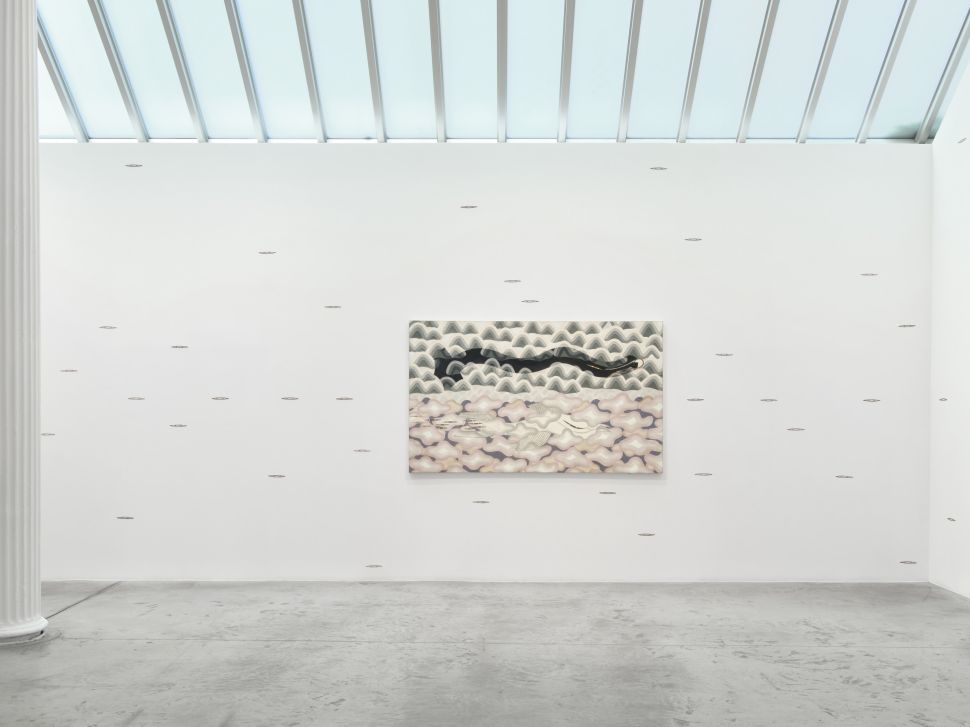
Those underwater impressions became deeply ingrained in his art and remain a constant thread in his work to this day. In early works, these underwater creatures, while visually stylized, remained recognizable as real-world aquatic life. Gradually, these forms became more minimalist, their essence integrated into the shared, abstract and fluid ecosystem they inhabited. From this, they progressively evolved into talismanic rhombuses resembling the eyes of a creature that, as a flock, populates, or better, infests, the gallery for this show. He often refers to them as “amoebas,” as they possess this aerodynamic quality.
They are creatures of adaptation and movement; they are meant to assimilate and be assimilated while remaining vigilant. They float on the created linear flow within the composition, suggesting a sense of breaking free, both beyond and within the confines of the canvas. Floating in the camouflage-like patterns of his compositions, they become elements that weave and anchor together the entanglement of everything surrounding us. To him, they also eventually function as a potent visual metaphor for the all-encompassing presence of Mother Nature within quantum space, or the holistic vision of Buddhism and any ancestral ancient wisdom.
For Tran, they also became a tool of subversion, participating in his own effort to shape a distinctive visual language, breaking free from the Western academic theories of form and composition he was taught at the Hanoi Fine Arts School, an institution established by the French in 1925 as the École des Beaux-Arts de l’Indochine, a colonial offshoot of the École nationale supérieure des beaux-arts in Paris, and which retained, both in form and content, much of that colonial heritage. “I seek to shatter the constraints of academic composition—with its rigid rules and structures, always bound by the framework and relationship to the four edges of the canvas or sheet of paper—and, naturally, my works are typically unframed,” he said. Even when they are stretched, Tran uses traditional techniques and materials, engaging with local heritage as a necessary starting point for shaping a new contemporary Vietnamese art lexicon.
Ink and natural colors, prized for their exceptional fineness, land gently on handmade Dó paper, a traditional Vietnamese paper usually made from the inner bark of the dó tree. Known for being light, soft, fibrous and extremely durable, it has historically been used for documents, calligraphy and folk painting, especially Đông Hồ paintings, and can resist high humidity. Tran also tried to break free from the inherent authority of the “brush action,” a standard mode of painting for centuries in the Asian aesthetic, which regards it as both an artistic and a philosophical gesture. “When you lay down a brushstroke, it automatically embodies the knowledge, skills, and theories you have acquired and internalized; this can conflict with emotion, individuality, or the subconscious,” Tran argued. The question for him became how to loosen up further in the act of painting; Abstract Expressionism partly inspired the gradual shift away from the distinct imprint of the brush.
In the works on view, we see this symbiotic collaboration with the flux of materials as they transition between states, where more fluid-soaked layers are punctuated by tactile, physical moments of direct action, including dotting, smearing, splashing and dripping. There is a rhythm and vibrancy that resonates with the circulation of matter and with everything in nature. Yet once the painting process begins, all Tran’s plans, theories and techniques recede into a blurred backdrop, serving, in essence, as an ecosystem and an atmosphere: “The inspiration is the vital element that generates energy; without it, the work becomes sterile and static.”
“Inspiration sparks action. I often begin with my current state of mind—whether joyful, sorrowful, somber, or optimistic—or find myself prompted by a spontaneous natural event,” Tran added. These behavioral impulses translate into visual elements: dots, smears, splashes, drips and so on. From there, a step-by-step dialogue unfolds, involving contrasts of light and dark, tonal variations, line weights and directional cues. What transcends the self, he observed, the “I” or the subject, is the intervention of environmental factors: humidity, wetness, the way ink permeates layers of paper, the specific patterns of sedimentation and the influence of wind. “This is the truly compelling ‘discussion’ or ‘negotiation’ within my process, I tentatively call it ‘painting.’ It challenges the artist’s absolute control, establishing a balanced relationship between the artist (Party 1) and the art materials with support from the natural forces (Party 2). It resembles a collaboration between the two parties, where Party 2 acts as a ‘character’ backed by supernatural power.”
As he explains, upon contact with the organic surface of the Dó paper, the ink or pigment may spread freely or remain fixed, depending on factors such as humidity, moisture levels and airflow. Varying degrees of diffusion and absorption create a spectrum of tones, allowing the color to evolve in fascinating ways, transforming significantly from its initial state upon impact. The height from which the medium is dripped also dictates the nature of its interaction with the substrate, ranging from dry to wet conditions.
This is what allows him to refer to tradition while pursuing something completely innovative and his own, avoiding the risks of producing work that feels monotonous, cliché or self-limiting in its potential for growth, which is his main concern. “This challenge has prompted me, through my own practice, to consciously avoid and strip away visual details that carry specific East Asian or Vietnamese cultural connotations,” he explained. “Instead, I focus solely on the inherent physical properties of the materials, provided they align with my personal aesthetic and the material’s technical qualities.”
Tran also pointed out that Eastern and Western traditions differ in their relationship to art materials. While the West tends to favor refined, ready-made supplies, Eastern traditions more often begin with basic materials that artists adapt, prepare or even create themselves. “It constitutes a pre-creative dialogue—a process that fosters a deeper, more intimate understanding between the artist and the materials,” he said. To him, this is the only way to tap into realms that lie beyond his conscious intent or prior experience. It is also an exercise in reattuning to vital entanglement, relearning respect for nature and its tempo, and engaging with objects that humans subjectively deem “inanimate.”
What emerges from this more abstract, intuitive dimension, however, is something apparently detached from reality: a rich symbolic lexicon of characters that stand for broader phenomena. Most often, beneath their surface of cartoonish figuration, these works are conceived as vehicles for heavier, politically and ethically charged messages, disguised behind the veil of humor and apparent playfulness. That “naive” code creates distance, allowing one to say things that would feel too direct, too violent or too didactic if stated plainly, or that would be censored.
“I am consistently interested in and seek to portray the intersection of socio-political events and the lives of ordinary people, myself included,” Tran reflected. As an artist rather than a politician or a dissident, he does not want to employ the languages of pop art, propaganda or violence as his own modes of expression. “I opt for metaphor and conceptual approaches.”
The image appears detached from reality because it is not realistic, but that detachment is the mechanism that lets it expose reality more brutally. Alongside it, Tran pursues an exercise in stepping back, in gaining a more transhistorical and universal perspective. “I strive to step back to gain a historical perspective and a distanced view of events, aiming to observe history with detachment and neutrality. I also attempt to strip away structures and details driven by an ‘explanatory’ logic, steering clear of literary-style narrative interpretations.”
This visual approach allows him to omit specific details that define the unique characteristics or personality of a particular individual or object. He might select a representative shape or color, one that is simple and neutral, as a way to filter that message, in a process that is both ambitious and challenging.
The socio-political landscape serves as a metaphor even in his works on paper, Flowing (1996-99) and its successor, Under the Flowing (2023-current). Inspired by the cyclical changes in the natural world, the amoeba-like forms drifting aimlessly across the canvas in the Flowing series reflect the world of the Cold War era and the decade that followed. “One could easily discern the poor and the marginalized, figures floating on the surface of society: at construction sites, in the fields, on the front lines, or drifting as refugees,” he said, pointing to the works from Tầm Tã (2017), which represent a symbolic epic of the different phases of the country, from the war to today’s persistent corruption. This exercise of stepping back, of putting his head underwater not to escape reality but to look at the world from another perspective, is something Tran learned as a child growing up in war, and it still helps him today find, in the power of mythical imagination, the possibility to confront the reality we are in and, at the same time, envision a more fluid, harmonious relation between all its elements.
The fact that Tran is not stepping away from the reality of his country is also evidenced by his active commitment to building and fostering a local art ecosystem. In 1998, Tran, who is today a mentor to younger generations of artists and a key figure in artistic development and dialogue within Hanoi and the Vietnamese diaspora, co-founded Nha San Studio, the country’s first artist-led, experimental art space, and curated most of its exhibitions during its first four years. Tran was also a founding director of the Hanoi Contemporary Art Center in 2000, but resigned in 2003 in protest of government corruption. In 2020, he co-founded the APD Center, a center focused on supporting the overlap between contemporary art and social development.
“I have been engaged in social development projects for 25 years,” he said. “Spanning four generations, my family has endured injustices inflicted by the communist regime; consequently, except works created before 1995, my paintings, video performances, installations and art projects have all been politically charged.”
Yet, in Vietnam’s authoritarian society, where censorship is stringent, the use of metaphor and conceptual art offers a viable way to evade scrutiny, and amorphousness is a strategy to maintain a countercurrent perspective. Still, the vast majority of Tran’s works have never been exhibited in Vietnam. The red scarves, military pith helmets, incense burners, submachine guns, corpses, hammer and sickle and dragons that appear in Tran’s series of five Tầm Tã paintings from 2017 examine the history of Vietnam in five chapters. They are all objects and symbols, iconic in both Vietnamese and global history. “They already carry their own established histories within the collective memory,” he noted. “I simply ‘process’ them into something approachable and ‘palatable,’ or perhaps inject a touch of humor. I present them like social science artifacts, subjecting them to the audience’s judgment.”
Particularly politically charged in the show is Up-to-Date Dragon, a revisitation of his 1998 installation, first shown at Nha San Studio, a space Tran co-founded in Hanoi, featuring a small red plastic dragon suspended in a transparent box. Tethering the dragon to the floor and ceiling with eight lengths of chain to symbolize each cardinal and ordinal direction, Tran plays with the multi-layered symbologies of dragons in Vietnamese culture, from the mythological figure of Lạc Long Quân, a water dragon known as the ancestral father of the Viet people, to the proclamations of 1990s communist leaders that Vietnam would become a “Dragon of Asia” as it industrialized. Yet the “up-to-date” dragon used here is just a cheap, mass-produced plastic toy, colored in the red hue typically associated with communist and Chinese propaganda. “The dragon is a mythical creature, yet it has endured longer and more prominently in the spiritual life of Asia than perhaps any other symbol. Consequently, it has also been the most frequently exploited—myself included,” he reflects, noting how, at the time, the hybrid, half-Asian, half-European dragon he created 28 years ago was deeply critical and satirical, serving as a metaphor for the authoritarian regimes of the Cold War era and its aftermath, a grotesque version of feudal history. “It is both surprising and disheartening that, three decades later, this ‘dragon’ has not vanished; instead, it has mutated into various forms across an even wider landscape,” Tran reflects. “While the world speaks increasingly of civilization, democracy, and sustainability, this dragon—burning with the heat of ‘red power’ and deaf to the voices of others—persists. One could name many specific incarnations of it, with the Chinese Communist Party being the most obvious example. Yet, its shadow can also be glimpsed here, within the United States—the world’s leading democracy.”
When, toward the end, we asked Tran to describe the state of the Vietnamese art scene today, he pointed out how it exists mainly thanks to the efforts of individuals, nonprofit organizations and collectives. “It has never received support—whether financial, legal, educational, or even basic recognition—from the authorities,” he explains. Consequently, the contemporary art landscape in Vietnam for now consists solely of artists and private nonprofit entities; there are no museums, and commercial galleries are unable to champion contemporary art due to censorship constraints. “Survival and growth are immensely challenging given the acute lack of financial backing, a supportive legal framework, and educational outreach, compounded by strict censorship,” he acknowledges.
Yet, by the natural order of things, art persists as an essential entity within the social ecosystem. To him, it is particularly in these challenging contexts that contemporary art can serve as a vehicle for perception, expression and critical inquiry, a versatile language for reflecting on reality, fostering connections, sharing ideas and shaping the future. “The complex socio-historical reality, marked by a succession of turbulent events, provides contemporary art with the raw material and energy needed to survive, maintain its independence and evolve,” Tran acknowledges. “Artists and organizations are actively developing their concepts and projects to engage with broader social development initiatives. This path offers learning opportunities, sharing and contributing, while simultaneously marking a departure from the ‘ivory tower’ and the confines of the ‘white cube’ gallery.”