
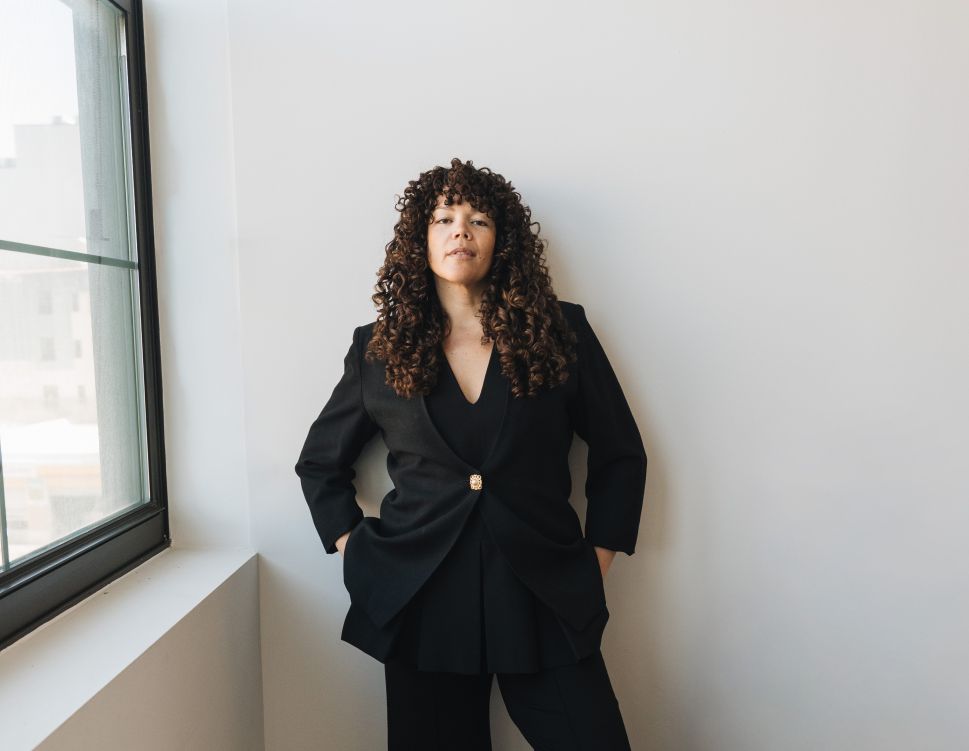
Several recent biennials around the world have focused on water and waterways to explore the complex entanglement of human histories and geological time that has led to the world we inhabit today. The upcoming 2026 Toronto Biennial of Art takes a similar approach on a more ambitious scale, extending for the first time beyond the Greater Toronto Area through a series of artist projects and institutional collaborations across North America—turning the event into a platform for fluid exchange at a sensitive moment in cross-border relations between the two countries.
Set to open on September 26 and running through December 20, the 2026 Toronto Biennial is curated by Allison Glenn, whose research-driven, site-responsive approach has defined a career that includes roles at The Shepherd in Detroit, the 2023 Counterpublic Triennial and New York’s Public Art Fund. The Art Museum at the University of Toronto serves as the main hub of the 2026 edition, with 18 artist projects across two gallery sites. Other projects have been developed in collaboration with institutional partners rather than in spaces dedicated exclusively to the Biennial. “The 2026 Toronto Biennial of Art is an invitation to view the Great Lakes, and global waterways, as a confluence,” Glenn said in an early announcement. Growing up in nearby Detroit, she noted, deeply informed her “understanding of how water, as both a physical resource and a historical witness, connects distant geographies through shared, fluid systems.”
Poetically titled “Things Fall Apart,” the Biennial is thematically centered on the notion of rupture—something Glenn has focused on for years. “I have actually been looking for about a decade now at artists who use rupture as an ontology, as a way of understanding,” she tells Observer. “It becomes a kind of throughline through which they understand their work.” That investigation first took shape in her essay “Notes on Rupture,” which considered a group of Caribbean artists and the ways they employed fractures conceptually, formally and materially. (That essay later became the curatorial proposition she submitted for the role.)
The Biennial’s artists treat rupture as a space of possibility—every new chapter must first pass through a breaking point from which things can be reimagined and communities can heal and rebuild. The title draws on several sources but overall resonates with today’s fractured political and cultural climate of sustained conflict. It traces back to Chinua Achebe’s landmark 1958 novel Things Fall Apart—whose title originates from W.B. Yeats’s 1921 poem “The Second Coming” and then resurfaced in The Roots’ fourth studio album, released amid the anxieties of Y2K, ongoing war and the social aftermath of the crack epidemic in the United States.
In using this title, Glenn wanted to enter an existing cultural dialogue around moments when political and social structures are breaking apart. She feels that we’re currently in such a moment and she wanted the Toronto Biennial to reflect that while also building upon its longstanding engagement with water. “I believe that these editions of the Biennial should be in dialogue under the umbrella of a larger project. I wanted to create a dialogue between our time and what came before.” The inaugural edition focused on Toronto’s waterways, hidden rivers and shoreline; Glenn has widened the lens to include global waterways, trade routes and voyages.
The 2026 edition of the Toronto Biennial will feature work by 30 artists and collectives, including 12 Canadian and 22 international participants from across the U.S., the Caribbean, South America, Europe, Africa, the SWANA region (Southwest Asia and North Africa) and South and Southeast Asia. Most of the projects are site-specific or responsively adapted to their contexts, including a constellation of 16 newly commissioned works installed in dialogue with Toronto’s urban fabric and the surrounding region. Several names on the list have become familiar presences in institutional and biennial circuits, including Antonio Obá, Charisse Pearlina Weston, Coco Fusco, Julien Creuzet, Kent Monkman and Naotaka Hiro.
The selection was based on how these artists’ practices engage rupture, waterways, trade routes and voyages, Glenn explains, citing as an example the Detroit-based “label for a movement,” Underground Resistance, which will present Drexciya, the legendary Detroit techno and electro duo formed by James Stinson and Gerald Donald in the late 1980s that built an Afrofuturist aquatic mythology around a water-breathing nation descended from pregnant, captive African women thrown overboard during the Middle Passage. “It is a sonic and visual orthography that imagines an underwater world for those who chose water on the journey,” according to Glenn. “There’s this really lovely way that the mythology, or this orthography, unfolds, and it also unfolds through the music. For me that was really resonant.” The Biennial project draws together and reflects back that sonic and visual mythology.
Glenn also mentions Dawit L. Petros and his iterative body of work examining a British imperial expedition along the Nile, which she has followed for almost a decade: “They were trying to navigate the river, and there were six cataracts that they couldn’t navigate without muscle from the empire. They needed support from people who were basically imperial subjects because they couldn’t navigate it themselves.” Indigenous people from Manitoba, alongside Indigenous Africans, participated in navigating the river because they had knowledge of the difficult landscapes and waterways. In Petros’s speculative treatment of this history, the six cataracts become six installations at the Aga Khan Museum. “In thinking through these connections to rupture and waterways, there is also this idea of the Nile itself as being anti-colonial in a sense,” she continues. “Through Dawit’s speculative project, he interrogates, questions, positions, repositions and reframes this moment.”
Waterways are not, however, literal subjects for every artist in the Biennial. Colombian artist Andrés Ramírez Gaviria focuses instead on astronomical data gathered through radio telescopes. He takes information originally produced for scientific research and translates it first into sound and then into light. His work addresses rupture through the loss and transformation of information as data passes from one system of representation into another. “His work maps the movement of quasars, pulsars and other celestial bodies in the sky, operating at a different temporality.”
For the Toronto Biennial, Ramírez Gaviria is developing a site-specific work involving a light installed in the University of Toronto galleries. The light will pulse slowly at particular intervals in response to data related to quasars, pulsars and other celestial bodies, giving visitors a bodily experience of another temporal scale. “We’re talking about deep time—the kind of time that we can’t necessarily understand in relation to our bodies,” Glenn explains, noting how, with her encouragement, the artist is extending the project to the CN Tower in what will be his first site-specific intervention of this kind.
The installation sites shaped many of the works, including Brendan Fernandes’. Born in Kenya with longstanding ties to Canada, including Mississauga, he will revisit a performance he first staged in Denmark in 2023, “The Calls,” adapting it for Toronto and bringing it into dialogue with water. The resulting work is not technically a new commission, but it becomes site-specific through its presentation as a choral performance with two dancers aboard a tall ship on the lake during opening weekend.
“So much of the work I’ve done is site-specific,” Glenn says. “I like to think about site and place and the conditions that need to be present to make the work as dynamic as possible.” She acknowledges that this can turn the role of curator into something more akin to producer. “With these new commissions and site-specific projects, it’s really about asking: how we can shape this work to make sense in this context.”
Cameron Harvey’s project is another example of how some works expand the Biennial’s concerns from individual cities toward the North American continent as an interconnected ecological space. Los Angeles, Anchorage and Toronto may be geographically distant, but fire, flooding and other climate conditions make their environments increasingly interdependent.
Harvey had a solo exhibition at Pepperdine University in Malibu in late 2024 when fires affected the area. While the museum’s architecture protected the artworks, the fires transformed the campus’s native chaparral vegetation. “Because it’s native, it’s resilient, and it is meant to change. It had the power to withstand those fires,” says Glenn. Soon after, during the devastating Los Angeles fires of early 2025, Harvey was evacuated from her home and temporarily lived in her studio. There, she developed a proposal examining how chaparral changes over time, connecting that ecological process to her own experiences. The resulting works will be shown simultaneously at the Art Museum at the University of Toronto and the Anchorage Museum in Alaska—”places that have burned or are dealing with the fallout.”
Public programming connects the Toronto Biennial of Art to its namesake city and its communities. Unlike in previous editions where the public programs had a separate curator, Glenn is responsible for both the exhibition and adjacent programming. She welcomes this structure because she does not see programming as secondary or hierarchically separate from exhibition-making. Performances—including Fernandes’s project and a procession by Rebecca Belmore that will open the Biennial—are all part of the same vision. Consequently, Glenn worked closely with Ilana Shamoon and the programs team to consider how visitors might experience Toronto differently during the Biennial’s run, whether they are residents or encountering the city for the first time.
As part of the public program, the team is developing a mobile arts curriculum in dialogue with Glenn and participating artists. The aim is to offer deeper engagements with individual practices and encourage multigenerational and multisensory forms of learning around the works presented. Asked how a temporary biennial can leave a longer-lasting trace, she pointed to the catalogue as well as a new collaboration with Bloomberg Connects. The digital platform will let audiences engage with the Biennial beyond its physical sites, adding another layer of accessibility, particularly for visitors who may not connect easily with traditional interpretive material in galleries.
Through these interconnected approaches—site-specific commissions, institutional collaborations, public performances, digital access and the Biennial’s expanded North American footprint—Glenn sees “Things Fall Apart” as operating not simply as an exhibition in a single city but as a network of relationships between artists, landscapes, histories and communities that carries a broader and longer-lasting impact extending geographically and durationally beyond the Biennial’s own structure.