
At the U.S. Open, the outfit has a track record of making a newsworthy entrance before the match even starts. Arthur Ashe Stadium seats nearly 24,000 people, many of whom have spent the afternoon looking at one another, and its concrete tunnel delivers each competitor onto a blue court lit with the unforgiving clarity of live television. Wimbledon gives players white and asks what they can do within it. New York has long been more invested in what the players might attempt once the lights come on.
The tournament was far less permissive when it began in Newport in 1881. Long skirts and flannel trousers upheld the appearance of a private club because that was exactly what tennis was about. As the field changed, its clothes began recording who had gained entry and how much of themselves players could bring along. The pioneers ran aplenty: Althea Gibson crossed the color line in regulation white; Billie Jean King helped secure equal prize money in 1973, wearing the same practical knits that allowed her male peers to move freely. And when night matches began in 1975, tennis acquired something it had never possessed at a major: a wardrobe designed for prime time.
The move to Flushing Meadows in 1978 enlarged that stage, and the switch to blue courts in 2005 made every color more vivid on camera. Logos grew, hemlines shifted and players learned that clothing could capture the audience with one glance, in person and on television. The photographs that follow track that change through the details that survived it: a visor turned signature, diamonds renamed by accident, a catsuit treated as controversy and a bow broad enough to delay discussion of the forehand. Together, they show how the tennis uniform stopped enforcing anonymity and became another part of the game that a player could control.
Evolution of U.S. Open On-Court Style
Billie Jean King, Forest Hills
John McEnroe, Flushing Meadows
Andre Agassi, Flushing Meadows
Venus Williams, Flushing Meadows
Serena Williams, Flushing Meadows
Ivo Karlovic and the Ralph Lauren Ball Crew, Flushing Meadows
Maria Sharapova, Flushing Meadows
Venus Williams, Flushing Meadows
Roger Federer, Flushing Meadows
Rafael Nadal, Flushing Meadows
Serena Williams, Flushing Meadows
Carlos Alcaraz, Flushing Meadows
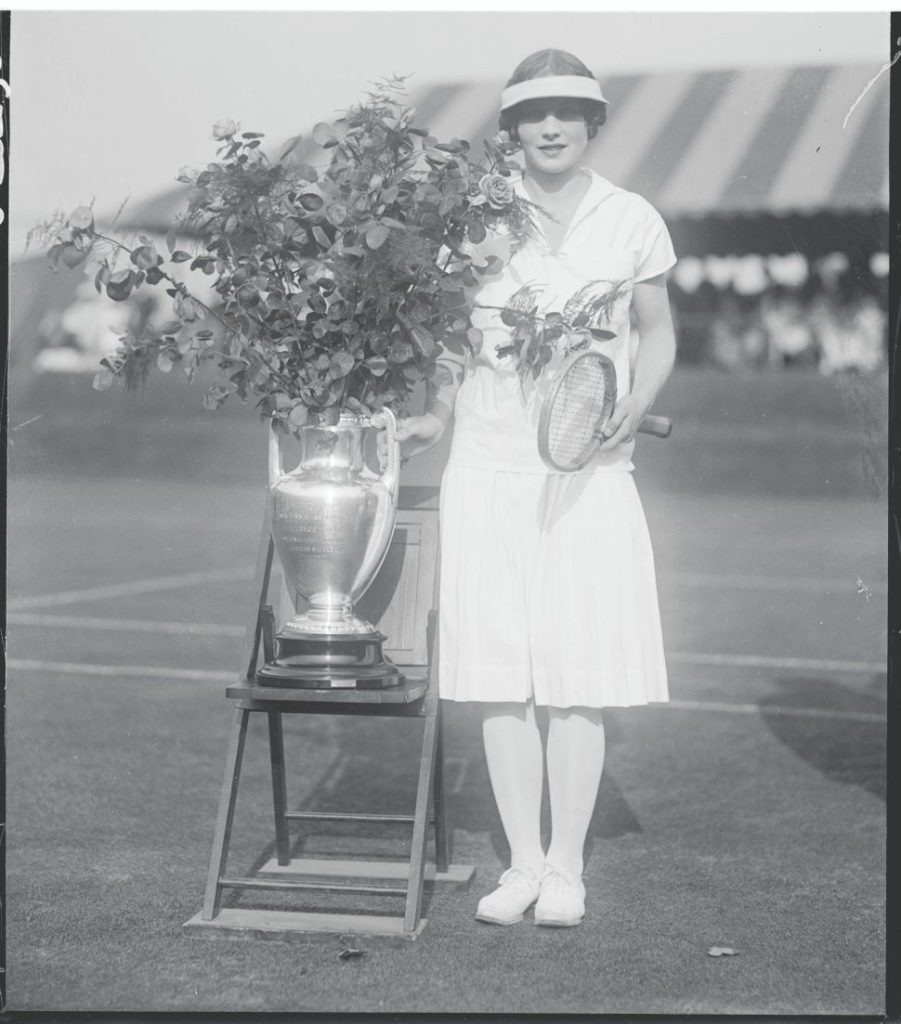
Helen Wills, Forest Hills
Aug. 24, 1925
Wills holds the silver cup as if she would rather be back at the baseline, wearing a sailor-collared blouse, knife-pleated skirt and the white visor that became her calling card. Contemporary reports dubbed it the “Californian eyeshade,” a practical bit of sun protection that soon functioned like a monogram. Tennis whites were supposed to make everyone look the same, yet spectators could identify Wills from the visor alone.
Helen Wills.
Bettmann/Getty Images
René Lacoste, Forest Hills
Sept. 12, 1927
Modern menswear is hiding in plain sight in this shot. Lacoste takes a forehand in an open-neck white knit, high-waisted flannels and a flat cap, noticeably less encumbered than players still wrestling with starched collars and rolled sleeves. He developed the short-sleeved shirt for easier movement, then put it into production with a crocodile at the chest.
René Lacoste in the 1927 U.S. Open Men’s Singles Championships.
Bettmann/Getty Images
Althea Gibson, Forest Hills
July 29, 1950
Gibson is dressed exactly as Forest Hills expected, in a white polo and skirt, and carries herself as if she has no interest in thanking the club for its approval. The practice photograph was taken weeks before she became the first Black player admitted to the U.S. Nationals.
Althea Gibson practicing before the 1950 U.S. Nationals.
Bettmann/Getty Images
Arthur Ashe, Forest Hills
Sept. 1968
Arthur Ashe drops almost to the grass for the return, horn-rimmed glasses still level and his white polo tucked with military neatness. The outfit follows every convention in the club book, yet by the time he left Forest Hills as the inaugural U.S. Open men’s champion and the first Black man to win a major, those tennis whites no longer belonged exclusively to the institution that prescribed them.
Arthur Ashe during a Men’s Doubles match at the 1968 US Open.
ix/Michael Ochs Archives/Getty Images
Billie Jean King, Forest Hills
Sept. 1977
Lemon-yellow buttons and embroidered trim warm up King’s sleeveless white minidress, while pale blue stripes on her Adidas shoes carry the color story down to the court. The broad collar and abbreviated skirt borrow from mod dressing, with her round glasses keeping the look unmistakably hers as she drives through the return.
Billie Jean King during the Women’s 1977 US Open Tennis Championship.
Focus on Sport/Getty Images
Chris Evert, Flushing Meadows
Sept. 10, 1978
The ultra-fitted bodice of Evert’s scalloped white dress barely shifts while the skirt lifts behind her. The diamonds at her wrist appear almost incidental, although a bracelet lost during that tournament stopped play and soon gave jewelry counters the term “tennis bracelet.” She beat Pam Shriver in the final wearing tennis white at its most exacting, with just enough shine to change what women wore beyond the baseline.
Chris Evert in the final of the 1978 US Open Women’s Singles Tennis Championship.
UPI/Bettmann Archive/Getty Images
John McEnroe, Flushing Meadows
Sept. 1, 1980
McEnroe’s Sergio Tacchini polo carries broad red and navy bands across the chest, the tidy geometry doing what it can beneath a white headband and a considerable amount of hair. Italian tennis clothes had become sharper and more graphic by 1980, and McEnroe gave them a particularly New York kind of agitation.
John McEnroe in the 1980 US Open Men’s Singles Tennis Championships.
UPI/Bettmann Archive/Getty Images
Andre Agassi, Flushing Meadows
Sept. 9, 1988
Agassi’s acid-wash Nike shorts announce themselves several rows before the mullet comes into focus. The white polo feels almost like a concession to tennis, while the denim-effect nylon belongs to late-1980s Las Vegas and MTV. Ivan Lendl won the semifinal, but the 18-year-old Agassi already grasped that a player could lose the match and still command Page Six.
Andre Agassi in the 1988 US Open Men’s Singles Semifinal.
Mike Powell/Allsport/Getty Images
Venus Williams, Flushing Meadows
Sept. 5, 1997
Williams meets the return in a spare white Reebok dress edged with dark piping, leaving the movement in the frame to her beaded braids. She was 17 and playing her first U.S. Open, yet the look already felt fully decided, closer to an athlete’s uniform than the girlish packaging usually imposed on a teenage prodigy. She beat Irina Spîrlea in the semifinal and reached the final without making herself more decorous for the occasion.
Venus Williams after the 1997 US Open Women’s Singles Semi-Finals.
Timothy A. Clary/AFP/Getty Images
Serena Williams, Flushing Meadows
Aug. 26, 2002
The black Puma catsuit leaves nothing to ruffle or conceal the mechanics of Williams’ movement, while a pink headband keeps the severity from becoming costume-villain literal. She helped design the faux-leather one-piece, won the tournament in it and made the tennis establishment discuss a muscular Black woman’s clothes at exhausting length.
Serena Williams after the 2002 US Open Women’s Singles Finals.
Timothy A. Clary/AFP/Getty Images
Ivo Karlovic and the Ralph Lauren Ball Crew, Flushing Meadows
Sept. 1, 2005
At 6-foot-10, Ivo Karlović has to fold himself toward the ball boy offering his towel, which brings the scale and crispness of the new Polo uniform neatly into view. Ralph Lauren had become the U.S. Open’s official outfitter that year, dressing ball crews, line judges and chair umpires instead of betting its visibility on a single player. The partnership placed navy piqué and the pony inside every match, even when the people wearing them were trained to disappear between points.
Ivo Karlovic gets a towel from a ball boy during the 2005 US Open Men’s Singles Tennis Championships.
Timothy A. Clary/AFP/Getty Images
Maria Sharapova, Flushing Meadows
Sept. 9, 2006
Sharapova plays the final in a black Nike dress with a crystal-trimmed collar, drop earrings and metallic silver shoes, evening clothes translated into stretch fabric. She had given Nike Audrey Hepburn as the reference, and the dress was developed specifically for night play, allowing Arthur Ashe Stadium’s lights to finish the design whenever she moved.
Maria Sharapova after winning the 2006 Women’s Singles US Open Tennis Championship.
Mike Ehrmann/Getty Images
Venus Williams, Flushing Meadows
Aug. 30, 2010
Under the lights, black lace replaces tennis mesh, while satin panels and an exposed metal zipper sharpen the EleVen minidress. Two rows of fringe pick up every stride, giving Williams’ “evening dress” the movement that conventional pleats normally supplied. Because the look came from her own label, the first-round victory also gave EleVen a prime-time campaign with its founder handling the modeling.
Venus Williams after winning the first round match at the 2010 US Open.
Emmanuel Dunand/AFP/Getty Images
Roger Federer, Flushing Meadows
Sept. 9, 2007
Black stretches from polo collar to Vapor shoe, interrupted only by the tuxedo stripe running down Federer’s Nike shorts. The press called the night kit “Darth Federer,” although the clothes are too polished for costume, with their interest coming from sheen, cut and the near absence of color. He wore them to defeat Novak Djokovic and collect a fourth consecutive U.S. Open title.
Roger Federer in 2007.
Timothy A. Clary/AFP/Getty Images
Rafael Nadal, Flushing Meadows
Sept. 13, 2010
A fluorescent V cuts through Nadal’s fitted black Nike shirt, with perforated shoulder panels keeping the color visible after the rain pushed the final deep into Monday night. The capri pants and sleeveless tops of his early career were gone by then, though that poisonous shade of green retained some of the old pirate energy. At 24, he beat Novak Djokovic in the custom shirt and became the youngest man of the Open era to complete the career Grand Slam.
Rafael Nadal during the 2010 US Open Men’s Singles final match.
Al Bello/Getty Images
Serena Williams, Flushing Meadows
Aug. 29, 2018
Lavender tulle circles Williams’ hips as she turns after match point, floating away from the one-sleeve Nike x Off-White dress beneath it. Virgil Abloh named the capsule “Queen,” pairing the ballet volume with matching high-tops so the reference remained athletic rather than precious, and Williams found the asymmetric construction surprisingly easy to play in. Days earlier, the French Tennis Federation had invoked her medically functional Roland Garros catsuit while promising a stricter dress code, which made her arrival in New York wearing a tutu an especially elegant answer.
Serena Williams during Day 3 of the 2018 US Open Women’s Singles match.
Don Emmert/AFP/Getty Images
Naomi Osaka, Flushing Meadows
Sept. 2, 2020
With the stands empty, little competes with the white letters spelling Elijah McClain across Osaka’s black mask. She entered seven matches carrying seven names of Black people killed in acts of racial violence, a sequence that could continue only as long as she remained in the draw. Osaka won the title, turning each walk from the tunnel into part of a message the vacant stadium made impossible to ignore.
Naomi Osaka before the 2020 US Open Women’s Singles second round match.
Matthew Stockman/Getty Images
Coco Gauff, Flushing Meadows
Sept. 9, 2023
Orange, oxblood and acid green meet without any particular interest in behaving like a set, which suits a 19-year-old holding her first major trophy. Gauff’s New Balance crop top and skirt keep the silhouette clean, leaving the serious fashion credentials at ground level. Her Coco CG1 “City Brights” made her the only active tennis player then competing in a signature shoe bearing her own name, a distinction far more substantial than another sponsor logo.
Coco Gauff celebrates after winning the 2023 US Open Women’s Singles Final match.
Elsa/Getty Images
Naomi Osaka, Flushing Meadows
Aug. 27, 2024
The entrance begins with an enormous white bow stretched across Osaka’s tennis-ball-green jacket, then repeats the motif across her bag, headphones and shoes. Developed by Nike with Ambush founder Yoon Ahn, the one-of-one look removes its walk-on skirt to reveal four tiers of ruffles, borrowing the transformation ritual of Japanese “magical girl” heroines without losing sight of the match underneath.
Naomi Osaka before the 2024 US Open Women’s Singles First Round match.
Mike Strobe/Getty Images
Carlos Alcaraz, Flushing Meadows
Sept. 7, 2025
Nike called the colors Playful Pink, Bordeaux and plum, names that sound sweeter than they appear on Alcaraz’s sleeveless frame. The NikeCourt tank, shorts and Vapor 12s work because the palette is tonal rather than timid, while his newly shorn hair and bare arms give the soft colors a tougher outline. He defeated Jannik Sinner for his second U.S. Open title and the No. 1 ranking, confirming the sleeveless tank as the defining men’s look of his early career.
Carlos Alcaraz celebrates after winning the US Open Men’s Singles Final match.
Clive Brunskill/Getty Images