
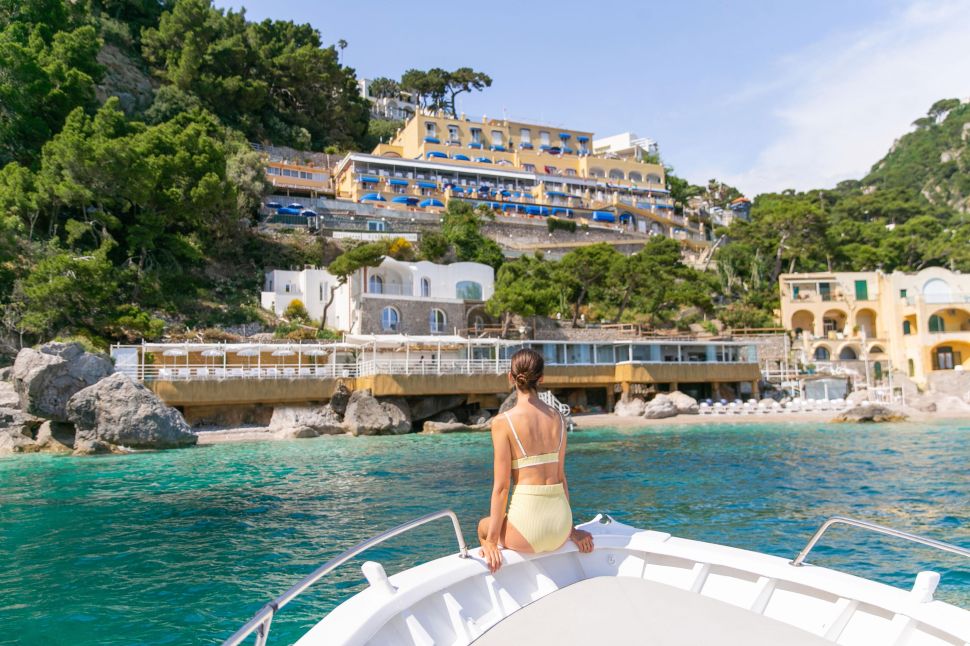
The beach club is one of the Mediterranean’s great exports, on par with the aperitivo, the convertible and the conviction that lunch should consume most of the afternoon. It began modestly enough, perhaps with a few fishermen’s cabanas on Pampelonne Beach, a seaside taverna in the Cyclades dragging mattresses onto the sand, or a rocky platform in Capri where someone realized the sea itself was ample entertainment. Then, as often happens on this coast, leisure became ritual, ritual became status and status became a full-blown industry.
The Mediterranean has always grasped that pleasure is a serious business—that a long, languid lunch is an achievement, that arriving by boat is for some the only way to arrive. The beach club distilled all of it into a single egalitarian afternoon: the right water, the right crowd, a chilled rosé and a plate of something just pulled from the sea. But as budget airlines, social media and superyacht charters made the Mediterranean more accessible than ever, the best beach clubs moved in the opposite direction. Reservations became harder to secure, with some clubs still preferring a phone call to an online booking platform. The fashion houses jumped on the bandwagon to further extol exclusivity. Dior has dressed the cabanas in Liguria. Chanel and Louis Vuitton continue their turf war on the sands of Mykonos. The beach club is no longer where success goes to relax. It is where success goes to be seen relaxing, which on this coast has always been the more demanding art.
Gathered here are 14 of the Mediterranean’s most compelling examples: institutions that earned their reputations decades ago and newcomers trying to accelerate the process. Some occupy legendary stretches of Riviera sand. Others cling to bare rock on the Amalfi Coast or hide on islands reached only by boat. Together, they offer a snapshot of what luxury looks like on the Mediterranean today, and why the most coveted seat in Europe is still the one closest to the water.
Best Mediterranean Beach Clubs
Via Mulo, 76, 80073 Capri NA, Italy
A Miami members’ club picked Capri for its first European outing, and it’s arriving in four acts: the restaurant back in April, the Fuoco rooftop and the Mare beach club in May, and The Club planned for later in the summer. Mare sits down at Marina Piccola, reached by boat or funicular, where guests swim straight off the deck into the Tyrrhenian. Above it stands Hotel La Palma—Capri’s first hotel, opened in 1822, now an Oetker property, sister to Le Bristol Paris and the Hôtel du Cap-Eden-Roc, with interiors by Francis Sultana. The mood is unmistakably Casa Tua: polished, international, discreetly well-connected, the curated boutiques and serious art program (an Avedon hangs in the Miami flagship) carried over from Florida. Capri has no shortage of beautiful spots to lose an afternoon.
Mare by Casa Tua.
Casa Tua
42 Bd Patch, 83350 Ramatuelle, France
When Pampelonne Beach was forced to rebuild from scratch in 2019, Hôtel Byblos Saint-Tropez finally claimed what had long been missing: its own stretch of sand. Designed by François Frossard, the Miami-based architect behind the legendary Les Caves du Roy nightclub, the club trades Riviera excess for something more gussied up, with rope-wrapped parasols, white timber and flashes of Byblos orange. Guests arrive by tender or shuttle from the hotel founded by Jean-Prosper Gay-Para in 1967 as a tribute to Brigitte Bardot. In a town obsessed with reinvention, Byblos remains one of the few names that never needed it.
Byblos Beach.
Alexandre Chaplier
2 Bd Alexandre Delabre, 13008 Marseille, France
The coastal road out of Marseille eventually gives up at Les Goudes, and Tuba Club occupies the rocks where civilization appears to end. Built inside a former diving club frequented by Jacques Cousteau’s circle, it replaces sand with stone platforms and ladders descending directly into the Mediterranean. Local designer Marion Mailaender reworked the century-old cabanon into 1970s glamour stripped to the bone: a Togo sofa, whitewashed walls, repurposed boat canvas, fishing buoys strung from the ceiling. After a dip, enjoy the menu of raw and seafood-led bites—tarama, oysters with celery-yuzu, whole fish over flame—and natural wine.
Tuba Club.
Tuba Club
Ftelia, Mykonos, Greece
Long before Mykonos became a luxury arms race, Alemãgou understood the appeal of leaving town behind. Set on the wind-whipped sands of Ftelia Bay, the beach club channels a more elemental version of the island through reed canopies, dry-stone walls and low-slung lounges designed by Athens-based K-Studio, the firm later responsible for Scorpios. The meltemi keeps the landscape wild, the soundtrack stays resolutely unhurried and the crowd skews more creative than conspicuous. Even in Mykonos, some people still prefer the rawer edges.
Alemãgou.
Alemãgou
Parque Natural de Ses Salines, Playa de Cavall d’en Borràs s/n, 07860, Illes Balears, Spain
The first hurdle is simply getting to Beso Beach. Formentera has no airport, which means everyone arrives by ferry, private boat or enough determination to justify lunch. Set inside the protected landscape of Ses Salines Natural Park, Beso wraps Balearic bohemia around one of the Mediterranean’s most reliable scenes, where yacht tenders line the shore and afternoons have a habit of becoming evenings. The secret is the kitchen: Basque-inflected cooking, formidable seafood and a carabinero rice that has become reason enough to cross from Ibiza.
Via Amerigo Vespucci, 30, 80061 Nerano NA, Italy
Seventy-five years is a long time to resist opening a beach club, which makes Le Sirenuse Mare feel less like an expansion than a carefully considered surrender. Rather than compete on Positano’s crowded waterfront, the Sersale family crossed the bay to Marina di Cantone, where guests arrive by boat and spend the day among olive groves, Aleppo pines and terraces landscaped by renowned Italian garden designer Paolo Pejrone. Handmade terracotta, embroidered linens, works by British painter Rose Wylie and Mexican artist Bosco Sodi and a scattering of Ducrot craftsmanship create the rare beach club where the landscape remains the main attraction.
Le Sirenuse Mare.
Courtesy Stefan Giftthaler
Stupe bb, 20260, Korčula, Croatia
This one you reach by boat or not at all. Moro Beach occupies the whole of Vela Stupe, a speck of an islet in a turquoise lagoon 2.6 miles off Korčula Town in southern Dalmatia—a 15-minute water taxi from the East Port, or a free berth if you sail in yourself. Blue-and-white loungers scatter across a boulder-strewn peninsula, a DJ works from a wooden hutch on the rocks, and the pebble beach drops into a sheltered, glass-clear bay built for snorkeling. The mood is a sailor’s secret rather than a party, a continent away from Hvar’s all-night reputation.
Moro Beach Stupe.
Moro Beach Stupe
Merkez Mah, Yalıkavak, Çökertme Cd., 48990 Bodrum/Muğla, Türkiye
Bodrum’s superyacht set has a new sunset perch, and it arrives with a pedigree. Aura Beach opened in July 2025 as the first Aegean outpost of Aura, the Dubai brand behind that city’s 360-degree Skypool, set inside the five-star Yalıkavak Marina Hotel at Çökertme Caddesi on the peninsula’s northwest tip. It sits at the edge of Yalıkavak Marina, so you arrive by car, about an hour from the airport, or simply step off the boat. A seawater pool anchors loungers and white cabanas oriented to the famous Yalıkavak sunset; the dishes are Mediterranean with a Japanese hand, heavy on sushi, seafood and caviar, opening with a Turkish breakfast spread.
Yalıkavak Marina Hotel.
Yalıkavak Marina Hotel
Via dei Faraglioni, 2, 80073 Capri NA, Italy
La Fontelina occupies the rocks directly beneath the Faraglioni stacks, reached by a 30-minute walk down a steep footpath, a private boat, or a taxi-boat from Marina Piccola. To spare your knees the climb home, the club runs its own shuttle boat back at day’s end; booking opens April 1 and is not optional. The Arcucci and Gargiulo families have held the place for more than 50 years and changed almost nothing, which is rather the idea. White linen mattresses lie straight on the natural reef at sea level, the umbrellas stripe blue and white, the staff wears shorts to match, and a pergola shades the terrace above. The kitchen sends out Caprese seafood, ravioli capresi and a house sangria pressed into your hand on arrival.
La Fontelina.
La Fontelina
Palm Beach, Pl. Franklin Roosevelt, 06400 Cannes, France
When the Croisette’s most-watched festival opened in 2024, the marquee debut wasn’t a film. Nammos Cannes soft-launched during the 77th Cannes Film Festival that May and opened fully in June, planting Mykonian maximalism on the historic tip of Palm Beach. You arrive by tender from an anchored yacht or on foot along the Croisette, sharing the 250,000-square-foot site with Zuma and La Petite Maison. Caprini Pellerin Architects rebuilt it for a reported 50 million euros—three times the cost of Nammos Dubai, the priciest the brand has ever built.
Nammos Cannes.
Nammos Cannes
Via Paraggi a mare, 1, 16038 Paraggi GE, Italy
Bagni Fiore has anchored the tiny Bay of Paraggi, between Santa Margherita Ligure and Portofino, for generations, but since Langosteria took over operations and Dior moved in, its upper terrace answers to a new name: The Dior Bagni Fiore. Boats are barred from the protected bay, so yachts anchor outside and tender in. The bones are rare for this coast—an actual sand beach, vintage pastel cabanas—now dressed in Dior’s green Toile de Jouy, with a Bayadère stripe added the following season; the staff wears Dior, and the mise-en-place is custom Dior ceramic. Two menus run in tandem: crudo on the sand and the full Langosteria seafood house upstairs, plating sole tempura, black grouper chateaubriand and its signature tower.
Bagni Fiore.
Bagni Fiore
43 Bd Patch, 83350 Ramatuelle, France
Le Club 55 has held the middle of Pampelonne since 1955, and the same family still owns it, taking reservations by phone only. Driftwood pergolas, sand underfoot, blue-checked tablecloths, baskets of crudités on every table—the look hasn’t chased a trend in decades, and when St-Tropez ordered Pampelonne’s clubs to demolish and rebuild, Club 55 was waved through. The guest book reads like a tabloid index, from Leonardo DiCaprio to Beyoncé, but the cooking stays plain: grilled fish, that raw-vegetable basket, rosé from the family’s own organic Château de Pampelonne.
Le Club 55.
Le Club 55
Plazhi i Dhërmiut, Dhërmi 9422, Albania
The ultra-low prices that defined the Albanian Riviera are officially over now that tourism has surged, and this is where the bargain started. Havana opened in 2001 on the white-pebble curve of Dhërmi, and the 2009 night when Tiësto played to 7,000 people on its sand still anchors every history of Albanian tourism. For years, the catch was the journey, two and a half hours from Tirana over a sketchy road. The 2025 debut of Vlorë International Airport rewrote all of it; Dhërmi now sits about an hour from a real runway. The look weds Mediterranean ease to old local architecture—low whitewashed structures opening onto the pebbles, Balinese beds, and hammocks.
Havana Beach Club.
Havana Beach Club
Sveti Stefan 85315, Montenegro
Aman Sveti Stefan reopens this summer after a five-year shutdown that followed a 2021 standoff with the government over public beach access. The settlement hands the state a profit share and returns two of three beaches to the public, which tells you how high the stakes ran. The 15th-century islet links to the Budva Riviera by a slim sand isthmus, 40 minutes from Tivat Airport, and holds 33 cottages inside restored stone village walls. Villa Miločer, a 1930s manse once home to Queen Marija Karađorđević, fronts a wisteria-draped pink-sand beach; the spa is cut into the rock above the guests-only Queen’s Beach lagoon.
Aman Sveti Stefan.
Aman Sveti Stefan