
The art of summering was perfected by the Gilded Age tycoons who built lavish summer cottages along Bellevue Avenue in Newport, Rhode Island. The term cottage is rather deceiving; in the same manner in which “camps” was used to describe sprawling timber estates in the Adirondacks, the cottages in question often featured enough bedrooms to house a staff and household of hundreds.
These Bellevue mansions—several of which were built to resemble Versailles—run entirely counter to the old-money aesthetic, despite their history. Instead of quiet luxury, they scream out over the tree-lined boulevards of Bellevue Avenue and across the Atlantic, their thunderous wealth announcing the prestige of their onetime owners.
During the Gilded Age, to spend a season in Newport was an act of competitive social climbing and party-throwing. A ballroom was as mandatory as an outhouse, and gala themes ranged from the decadent (like the Mother Goose Ball, where guests dressed as creatures from fairy tales) to the delightfully absurd (a Dogs’ Dinner, where canines wore diamond collars and dined on a fricassee of bones). If these walls could talk, they’d speak of murders and love affairs, excess and decay, and the lush interiors still serve as a portal into Newport, then and now. The opulent estates have also appeared on the silver screen: Rosecliff served as the backdrop for Tracy Samantha Lord’s (played by Grace Kelly) waterfront estate in High Society (1956), and Robert Redford’s Jay Gatsby danced with Mia Farrow’s Daisy Buchanan in the Gold Ballroom of Marble House in The Great Gatsby (1974).
These homes have been immortalized in the writing of Henry James and Dominick Dunne; the latter’s final novel, Too Much Money, features a fictionalized account of the notorious attempted murder involving Claus von Bülow and his heiress wife, Martha Sharp “Sunny” von Bülow, at their Bellevue estate, Clarendon Court. More recently, HBO’s The Gilded Age has brought these homes back into the spotlight. Created by Julian Fellowes, the upstairs-downstairs period drama has caused tourism in Newport to skyrocket to record-breaking numbers. The estates featured on the show have capitalized on their success, with guided Inside the Gilded Age tours and on-site displays in rooms where certain scenes were filmed.
Today, visitors to Newport don’t need a hand-delivered invitation to step within the hallowed walls of these storied mansions, as many of the buildings have been preserved and converted into museums. For the purposes of this list, we will be focusing on estates accessible to the public, which excludes Beechwood, the storied estate of high-society gatekeeper Caroline Astor. Today, that mansion belongs to Oracle co-founder Larry Ellison, who purchased it for $10.5 million in 2010 and then spent over $100 million more on renovations, and is reportedly transforming the first floor into a private museum for his 19th-century art collection. Down the road, another mansion, Miramar, was sold to Blackstone CEO Stephen Schwarzman for $27 million in 2021—he has pledged to turn the estate into a museum after his wife’s death. From old-money tycoons to tech billionaires, the times they are a-changin’.
These totems of American decadence can always be viewed from the Cliff Walk, a waterfront path winding along the edges of their manicured lawns, though you’re only getting half the story when seeing these properties from the outside, no matter how magnificent the exterior. From the over-the-top glamour of The Breakers and Marble House to the manicured grounds of The Elms and Rosecliff, read on for an insider’s guide to the Newport mansions.
A Guide to Newport’s Grandest Gilded Age Estates
The Breakers
44 Ochre Point Ave, Newport, RI 02840
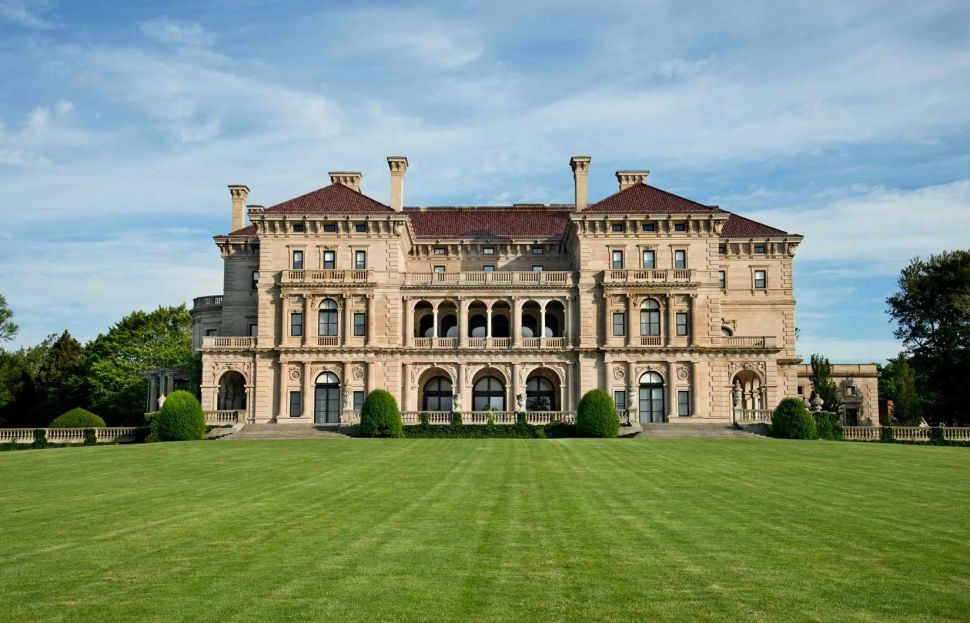
The grandest—and most popular—of the Newport Mansions, The Breakers is a 13-acre, 65,000-square-foot estate commissioned by Cornelius Vanderbilt II as a summer home for his family. Built by architect Richard Morris Hunt in 1895, it was inspired by 16th-century Italian palazzos, befitting one of the richest men in the world at the time. The interior design is equally ornate, with walls lined with Spanish leather, Circassian walnut and platinum-leaf foil. Though it’s perhaps difficult to comprehend that it was used as a private residence for so long, The Breakers only became a museum in 1972, when ownership was transferred to the Preservation Society of Newport County. If you see just one mansion on your Newport visit, make it the Breakers, if only for spectacle alone. This 70-room, Italian Renaissance-style estate includes 48 bedrooms, a 500-year-old stone fireplace imported from a chateau in France, and gilded bronze and cut-glass chandeliers. The Breakers was featured in the 1988 film Mr. North and in The Gilded Age.
The Breakers.
The Preservation Society of Newport County
Marble House
596 Bellevue Ave, Newport, RI, 02840
Though perhaps not quite as splendid as the Taj Mahal, this shimmering white marble palace was also erected in the name of love. It was built by William Kissam Vanderbilt (brother of the aforementioned Cornelius Vanderbilt II) as a gift for his wife, Alva Vanderbilt, for her 39th birthday. (This wasn’t the only Newport mansion Alva received from a husband, but more on that later.) Constructed in 1892, Marble House was inspired by the Petit Trianon in Versailles and required 500,000 cubic feet of marble (and an $11 million budget—roughly $300 million today) to match the owner’s romantic vision. Alas, the marriage didn’t last, and after the Vanderbilts’ divorce, Alva built a Chinese Tea House on the property to host women’s rallies. Ownership passed to the Preservation Society in 1963, and today, it is open for guided tours and paid walk-ins. The mansion has been featured in The Gilded Age, of course, but also the 1974 adaptation of The Great Gatsby—fitting for a love story gone awry.
Marble House.
The Preservation Society of Newport County
The Elms
367 Bellevue Ave, Newport, RI 02840
At a comparatively petite 48 rooms and 60,000 square feet, The Elms offers a more understated, refined luxury than the overt excess of the Vanderbilt mansions, whose references ranged from the Italian Renaissance to Versailles. Modeled after the Château d’Asnières in Paris, this French château was designed by architect Horace Trumbauer for the Berwind family and was completed in 1901. The Elms is all clean lines and classic symmetry, with a steel frame wrapped in limestone. One of the first houses in America to be wired with an electrical system, ownership was transferred to the Preservation Society in 1962. It was featured in the 1992 movie Wind and in The Gilded Age. Visitors can peruse the rooms that double as the show’s fictional ballroom and learn more about the upstairs-downstairs dynamic with a “Servant Life Tour at The Elms.” The estate temporarily closed on August 10 and will relaunch with a new interior tour concept, “The Elms Experience,” later this fall.
The Elms.
Discover Newport
Rosecliff
3548 Bellevue Ave, Newport, RI 02840
My personal favorite mansion of the lot, with arguably the most beautiful grounds, is Rosecliff, a romantic and refined estate on Bellevue. Modeled after the Grand Trianon at Versailles by famed architect Stanford White in 1902, the mansion was built for heiress Theresa Fair Oelrichs, and ownership passed to the Preservation Society in 1971. Rosecliff features an 80-foot ballroom (the largest private ballroom in Newport) with painted clouds on the ceiling and crystal chandeliers, and it was once used as an indoor skating rink for the eccentric heiress. Rosecliff is the most frequently used Newport Mansion for Hollywood productions, serving as the exterior for the 1974 adaptation of The Great Gatsby, the inspiration for the sets in High Society and a filming site for Amistad, The Gilded Age and True Lies. Like The Breakers and Marble House, Rosecliff is open daily for visitors—check out the “Revolution Reimagined” exhibit on the second floor, which runs through November 1. All of these mansions are fabulous for galas and weddings, in keeping with their entertaining roots. Rosecliff, in particular, has hosted gorgeous white-tie weddings, as well as the 2026 Preservation Gala, a summer dinner dance themed Midsummer Masquerade.
Rosecliff.
Visit Rhode Island
Chateau-sur-Mer
474 Bellevue Ave, Newport, RI 02840
This High Victorian estate, built for the Wetmore family by architect Seth Bradford in 1852, predates the Vanderbilt mansions. It was remodeled in the 1870s by the Vanderbilts’ go-to architect, Richard Morris Hunt. Featured in The Gilded Age (of course), Chateau-sur-Mer was also said to have inspired Henry James’s 1883 quote in Portraits of Places, as one of the mansions “built recently gives one some hope of the revival of the architectural art.” He felt no such fondness for the massive estates that were to follow along Bellevue. The interior design is akin to a grand European villa, featuring a dining room hand-carved by Luigi Frullini, a master Italian woodworker. Ownership was transferred to the Preservation Society in 1969, and, like the mansions above, Chateau-sur-Mer is open daily until September 30, and will then reopen in all its Christmas regalia for Holidays at the Newport Mansions from November 21 to January 1; the summer season resumes on June 1 next year. The holiday decor is a reason to visit in the off-season, as the mansions are accessorized with period-specific festive accouterments, Christmas trees and lavish ornaments.
Chateau-sur-Mer.
The Preservation Society of Newport County
Rough Point
680 Bellevue Ave, Newport, RI 02840
Doris Duke’s waterfront estate has been preserved just as she left it, and it is now open to the public Tuesdays through Sundays. Originally built in 1891 by Frederick William Vanderbilt and his wife, Louise, the Tudor-style manor house was later sold to tobacco heir James B. Duke. His daughter, Doris, used the estate as a playground for revelry and decadence until she died in 1993, leaving the mansion to the Newport Restoration Foundation, which she had founded in 1968. Doris Duke was famous for her parties, including a 600-person debutante ball in 1932, and her scandals—namely the notorious car crash in her Bellevue Avenue driveway, when Doris Duke fatally injured her interior designer, Eduardo Tirella. Though it was officially deemed an accident, rumors continued to swirl. Unlike the more formal properties on this list, Rough Point still feels like someone’s home. It’s filled with trinkets collected by the eccentric former owner and camel topiaries out on the lawn (Doris Duke famously kept live camels named Baby and Princess roaming her oceanfront grounds). Check out the world-class art collection of 18th-century British portraiture and peruse one of the museum’s annually rotating exhibits.
Rough Point.
Discover Newport
Belcourt Castle
657 Bellevue Ave, Newport, RI 02840
Some wives receive jewelry on special occasions; Alva Vanderbilt collected mansions. Just one year after her divorce from William K. Vanderbilt was finalized (and four years after she was gifted Marble House), she remarried Oliver Hazard Perry Belmont, who subsequently presented her with Belcourt, his sprawling, 56,000-square-foot Newport estate. Belcourt was constructed in 1895 to resemble the hunting lodge at Versailles and stands today in grand Louis XIII style, albeit with an eccentric equestrian twist. Belmont commissioned Richard Morris Hunt to create a “villa stable” that would include his racehorses in the daily rhythms of indoor life. (It’s fitting the horses would be treated like royalty, given that their winnings were what enabled the palatial estate to exist in the first place). In lieu of a ballroom, the first floor of Belcourt housed luxury stable accommodations for his 30 horses, including engraved nameplates. The house passed through multiple owners after Belmont’s death in 1908 and was once the locale for the Newport Jazz Festival. Today, it is privately owned by Carolyn Rafaelian, who purchased the property in 2012. It is, however, still accessible to the public—the mansion opens its doors on Fridays, Saturdays and Sundays for tours and art exhibitions.
Belcourt Castle.
Belcourt of Newport
Kingscote
253 Bellevue Ave, Newport, RI 02840
Take a turn for the Gothic with a visit to Kingscote, a pioneer of Bellevue Avenue’s summer estates. George Noble Jones commissioned architect Richard Upjohn to fulfill his vision of a Gothic Revival cottage, with porch roofs inspired by medieval tournament tents. The mansion, constructed between 1839 and 1841, was enlarged in 1881 by the architectural firm McKim, Mead & White, but still stands as one of the smaller Bellevue Avenue estates. Though grand when it was first built in the 1840s, it appears modest in comparison to the titanic Vanderbilt mansions built toward the end of the century—in The Gilded Age, Kingscote is referred to, witheringly, as a “rabbit hutch.” Ownership passed to the Preservation Society in 1972, and the mansion is open to the public on Sundays, Mondays and Tuesdays. Pay a visit to witness the true birth of Newport’s “summer cottage” culture and check out the famous sea-green Tiffany glass wall in the magnificent dining room.
Kingscote.
Discover Newport