
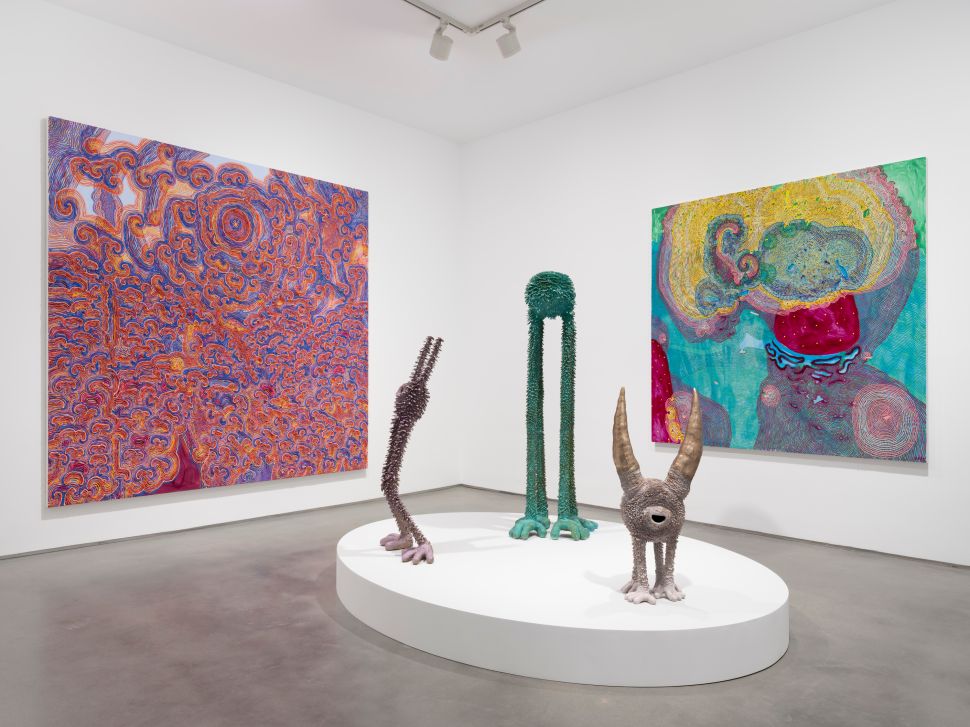
Whimsical and irresistibly cute, the Haas Brothers’ fantastical creatures are among the few ingeniously crafted characters to have captured audiences both in the art world and outside of it without becoming a commercial franchise. Their works move fluidly between art and design, often abandoning function altogether to become purely sculptural, engaging freely and imaginatively with materiality. Their latest exhibition, “Mathemagical” at Marianne Boesky Gallery, brings into focus two seemingly opposite but interdependent forces that have long animated their exuberant universe. On one side is the imaginative intuition that produces unlikely hybrids and fantastical forms; on the other, the engineering, repetition and mathematical systems that allow those forms to materialize.
The twin brothers have often described their work as a kind of Trojan horse, in which the ridiculous, sexual or cartoonish expression gets people laughing, which lowers their defenses and opens the door to a more serious exchange. When Observer catches up with the duo after the opening of “Mathemagical,” Simon Haas explains that the creatures in the show began to emerge after Niki returned from Iceland with some sheepskins he bought at a gas station. “We had this studio, and they were just sitting there,” Niki Haas recalls. “I was attracted to them, but we didn’t really know what to do with them for a long time.”
“Mathemagical“
Artists: The Haas Brothers
Venue: Marianne Boesky Gallery
Address: 509 W 24th St, New York, NY
Through: October 17, 2026
They initially imagined a beast chair. “It was supposed to be a joke version of one of those big, lion-footed chairs you might find in some royal hall,” Niki continues. Gradually, the forms shed their functional imperative and became characters. “We became interested in the idea that you can communicate so much personality with very little information. There’s beauty in that blank space, in the lack of information.” Viewers and collectors began projecting onto the works, treating them almost like pets—naming them and forming personal relationships with them. “We became very interested in that space where the collector or viewer decides what the object means to them,” Niki continues, adding that there was something beautiful and magical in that. “It’s amazing how removing features can make something more relatable. It gives the viewer an opportunity to project rather than force-feeding them all the information,” Simon adds.
Here he draws an intriguing parallel with robots and the so-called uncanny valley that inspired the title of their first major mid-career survey. “Uncanny Valley” debuted at Cranbrook Art Museum in Bloomfield Hills, Michigan, in 2025 before traveling to the Museum of Arts and Design in New York; it is on view at the Blanton Museum of Art in Austin through Jan. 17, 2027, and then travels to the Mint Museum in Charlotte, North Carolina.
The uncanny valley describes the point at which a humanlike object becomes unsettling. “When you make a robot look too much like a person, it gets scary. You have to make it cute for people to like it,” Simon says. “That’s something we play with. Making something cute, or simply removing some features, can actually make it more relatable.” The less information they include, the more the artistic gesture itself—Niki’s sculpting—comes to the fore. For “Mathemagical,” the Haas Brothers made the sculptures in this show entirely in bronze. “There’s no fluffy fur telling you that something is cute. It’s just bronze and gesture,” Simon continues. Without anything to signal softness or cuteness, personality must emerge through posture and attitude.
This exercise of animating the material world and restoring a sense of magic stirs the viewer’s curiosity, targeting the side of the brain that a society driven by reason and productivity often asks us to suppress. That matters all the more in a world where encounters of all kinds are increasingly mediated by screens, according to the Haas Brothers, who believe art can draw people back into tactile and imaginative encounters with objects. While social media encourages passive attention, their sculptures use implied humanity to elicit a response that originates within the viewer, in the uniquely human interplay between senses and mind, physical and psychological reaction. “I think using gesture and creating humanity around these objects is really important,” Niki says. “That’s part of the point of art: getting people to think and experience a little differently than they did before encountering the sculpture.”
The paintings in “Mathemagical” follow a related logic, though they invite engagement through thought, systems and philosophy rather than character. Simon ties them to the “math” side of the brothers’ practice. Beauty, he argues, emerges from complex systems. “If you look at the night sky and start thinking about everything involved in it—the infinite space, how many things might be there, how empty it is—it’s terrifying. But what we see is just beautiful stars, and it’s transfixing,” he says. “As humans, we have a tendency to take complicated things and process them as beauty.”
Their new Accretion paintings begin as nostalgic landscapes, but those scenes are gradually abstracted through layers of thickened acrylic applied according to a reaction-diffusion equation, the same kind of mathematical process used to describe cellular growth and the formation of stripes and spots in animal fur. These vibrant, kaleidoscopic surfaces feel naïve and playful, yet beneath them lies a rigorous order. “It’s all about self-organization and emergence,” Simon explains, describing how the brothers set their own rules for applying layers of color, an algorithm that is not digital. The rule itself is simple: each color can expand only over certain others, creating a competition for space that eventually generates spiraling forms.
The method fosters an almost meditative practice that lets them transcend the individual artistic gesture and connect with something broader. “It’s really process-based. You have to let go and stop trying to force an outcome. You almost become a tool for something bigger. It feels spiritual in that way,” Simon adds. “You’re able to turn off your brain and just follow it, almost to transcend yourself.” The resulting forms trigger unexpected associations. In their organic, almost psychedelic growth, they recall the intuitive, tactile channeling of Aboriginal abstraction, while other viewers have likened them to the viscerally tumultuous impasto of Van Gogh’s late period. This expansive capacity for imaginative and emotional projection links the paintings back to the sculptures.
Although painting appears as something of a departure for the brothers, Simon stresses that rules-based processes have been embedded in their work for years, both in their clay surfaces and their tree sculptures. Painting has simply offered a more immediate arena in which to explore those ideas, especially through color and a playfully structured approach to it, much as in music, where there are rules and then room for interpretation within the flow. What connects all the expressions of their practice is a strong emphasis on tactility and the senses through craft and handmaking, a human touch that remains visible and becomes a timely statement. In an age of the progressive dematerialization of human action, and now of human consciousness, the Haas Brothers’ work invites a re-embodiment of knowledge and perception.
“We use computers all the time and engage with them. I’m not against them. But when we’re experiencing the world, I think touch is so important,” Simon says, recalling how, growing up in Texas, they would play outdoors, swim in the river and then sit on sun-warmed rocks. “It felt amazing. You can’t replicate that any other way. It just is what it is, and that surface feels incredible.” He also remembers carving stone and feeling its surface change from rough and raw to polished and almost skin-like. “It’s a sensual experience that you can only get by touching materials.”
As for the brothers’ relationship as twins and collaborators, Simon asserts that there was never really a decision to work together; it felt inevitable. “We are connected. Working together was just going to happen no matter what, I think.” There is tension at times, he admits, but they have learned that what they make together is more interesting than anything either would make alone.
“If we disagree about something, whatever we find as common ground is going to be awesome, because we’re very different people: when two very different people have to make something in common, the result is strange and good,” Niki adds. “That’s where we’ve settled. We’ve had our big differences and we’ve really worked through them. Whatever those differences are, they’re a lot less important than taking care of each other and doing what we do with open hearts, trying to create some sort of positive effect.”
Asked how their different abilities and personalities complement each other, Simon loosely aligns himself with “math” and structure, casting Niki as the sculptor and the source of much of the practice’s recognizable spirit and aesthetic. Niki pushes back, stressing that each brother values the other’s input: “Simon could be considered more mathematical, and I’m more humorous, and I really feel a lot when I make the stuff. But if you go out into the world and experience beauty, it can be for myriad reasons, many of which fall under awe, and that often has a basis in math or systems. What’s really cool is that, as twin brothers, we have the ability to explore that entire spectrum. Our practice is wide open.”
That spirit of collaboration shapes their studio practice and opens it to other collaborations. At the center of the New York exhibition is The Peach Tree, their largest work and perhaps the clearest synthesis of their evolving practice. A carved base nods to their ongoing engagement with stone, and to an emotional link with their stonemason father, while the bronze trunk uses the same Accretion process developed for the Beasts. The Venetian glass-bead foliage was hand-beaded by the Haas Sisters of Lost Hills, a group of women from an agricultural community in Central California with whom the artists have collaborated for nearly a decade.
It is the fruit of a beadwork project the Haas Brothers developed over roughly 12 years. It began in South Africa, where they met women with established beadwork practices and collaborated with them on a project for the Cooper Hewitt Design Triennial. The women taught the brothers to bead, and they became increasingly absorbed in the medium and its potential as a collective, shared practice of creation.
In Cape Town, they found it difficult to fully develop this collective, distributed dimension, since their collaborators were established bead artists. When they introduced the practice to the women in Central California, who live in a community with little work available to women, the system evolved organically into a flexible form of piecework. At times, around 30 people take part, often beading at home or between classes, a distributed model that makes it possible to produce very large sculptures from many small parts while empowering individual makers. What emerged became a social practice, fostering a community and a shared bonding experience that extends the Haas Brothers’ work into a form of social sculpture. “When I look at one of these trees, I see that every leaf was made in someone’s house, in a different house. It’s a beautiful social thing—all these things coming together,” Simon reflects.
“Ultimately, Simon and I are searching for beauty. That’s really what we’re on a mission to do,” Niki concludes. “There are lots of different kinds of beauty. There’s aesthetic beauty. There’s the beauty of a perfectly designed chair that fits really well. There’s also the beauty of creating an economy in an economic vacuum and having this anthropological aspect to what we do. I’d say our crusade for beauty is what we’re after.”