Barcelona has taken to greeting cruise passengers with water pistols; Venice now charges day-trippers at the door. Across the Mediterranean, success arrives as crowding, and where it doesn’t, it arrives as construction—hotels and beach clubs proliferating until the coastline becomes a continuous commercial frontage. Sardinia’s Costa Smeralda somehow resisted both. More than six decades after developers arrived, 96 percent remains undeveloped by its keepers’ own count, a terrain of rose granite, juniper and water so green the coast took its name from it, even as local real estate fetches some of Europe’s highest prices. Scarcity, here, is not an accident of geography, but a thing someone decided to manufacture.
The Consorzio Costa Smeralda, a body few travelers have heard of, is the organization that operates as the planning authority and conservation trust. It vets every blueprint, maintains the roads, electrical grid and 22 beaches, and holds the trademark on the name itself. It performs much of the work of a town hall while answering to property owners rather than voters. Its writ extends across 34 miles of shoreline, administered less as a collection of settlements than as a single estate. The governing principle is simple: the coastline’s greatest luxury is not what gets built, but what never does.
The architect of that idea arrived by sea. In 1959, Prince Karim Aga Khan IV, aged 22 years old and newly installed as spiritual leader to millions of Ismaili Muslims, sailed from the Côte d’Azur and dropped anchor off a corner of Sardinia so remote that conquerors from Carthage to Aragon had barely bothered with it. The land was all myrtle, sheep tracks and hillside pasture, its worth not yet translated into premiums for the view. He judged it more valuable whole than divided. Through a Liechtenstein company, he acquired it with a collector’s patience, parcel by parcel, the sellers unaware of whom they were dealing with until December 1961. That month, a widow named Caterina Ragnedda signed over a hillside sheepfold near San Pantaleo, the first deed to carry the prince’s own name, and the disguise came off.
Buying the coastline was only the opening maneuver. The lasting innovation was an apparatus built to survive its founder. In 1962, in an Olbia notary’s office, the prince and five partners incorporated the Consorzio Costa Smeralda, an association of landowners formed to master plan and govern the roughly 4,400 acres they had assembled at the outset. The following year, it did something stranger than acquiring a coast. It trademarked one, not as a cosmetic exercise in branding but as an instrument of control. The name itself was an invention, and by creating the destination in law, the consortium could determine who belonged to it and who could trade on its reputation. “Costa Smeralda is a brand before it is a place, a mark certifying a standard,” Federico Casula, the consortium’s public relations executive, tells Observer. “The phrase appears on no map older than the paperwork. Locals knew it as Monti di Mola, and it is now as owned as the granite beneath it.”
Land ownership alone could not shield the landscape from its own popularity. That required an aesthetic regime. Rather than importing the modernist idiom spreading across Mediterranean resorts, the Aga Khan assembled architects who believed buildings should recede into the terrain. Jacques Couëlle molded his houses into the outcrops and called them “sculptures to be lived in”—a line that reads like brochure copy until you stand inside one. On a recent visit to Cala di Volpe, his hotel on the bay, I found the marks of his own hands still in the plaster, and one wall where fat glass jugs breach the stucco like sea glass the tide left behind. Luigi Vietti translated that philosophy into an entire town, Porto Cervo. Every project landed on their desks before reaching the municipality, and the architectural committee was the stricter tribunal of the two. From scratch, they devised a vernacular of wind-shaped volumes and pastel render, with nothing rising above two stories and villas sunk into the rock so that no house confiscated another’s view. They called it the stile smeraldino. The charter required two trees to be planted for every one felled.
That system now faces the test it was built for. Aga Khan IV died in February 2025, leaving the coast without the man whose taste and authority had stood above the charter since its inception. Its commercial core was already no longer family-held; Qatar’s sovereign wealth fund has owned it since 2012. Here, the succession dilemma is institutional rather than dynastic: whether a design code, trademark and dues structure can hold the same threshold for refusal once the founder who gave those instruments force is gone. A state investment fund answering to Doha must now keep rejecting development as reliably as a prince who lived to see the coastline he conceived. Preservation has long been the more profitable choice here. The system’s resilience will be measured the first time it is not.
The consortium owns little of what it protects. Today, the crown jewels belong to Smeralda Holding, the Qatar Investment Authority’s Italian company: Cala di Volpe and the Cervo, both under Marriott’s Luxury Collection flag; the Romazzino, a Belmond hotel since 2024; and the Pitrizza, now being renovated toward a 2027 reopening as a Cheval Blanc. The portfolio runs to the marina, the Pevero golf course and some 5,700 acres, and generated €168.4 million, about $180 million, in revenue in 2024. Nor are the holding company and consortium as separate as their names suggest. Smeralda Holding chief executive Mario Ferraro also serves as the consortium’s vice president, placing the same executive on either side of the line between managing the assets and governing the territory around them. Any New Yorker who has appeared before a co-op board will find the organizational logic familiar: the sponsor still runs the board. Inside the perimeter, membership arrives with the deed, accompanied by dues and a design code with opinions about everything visible from the road.
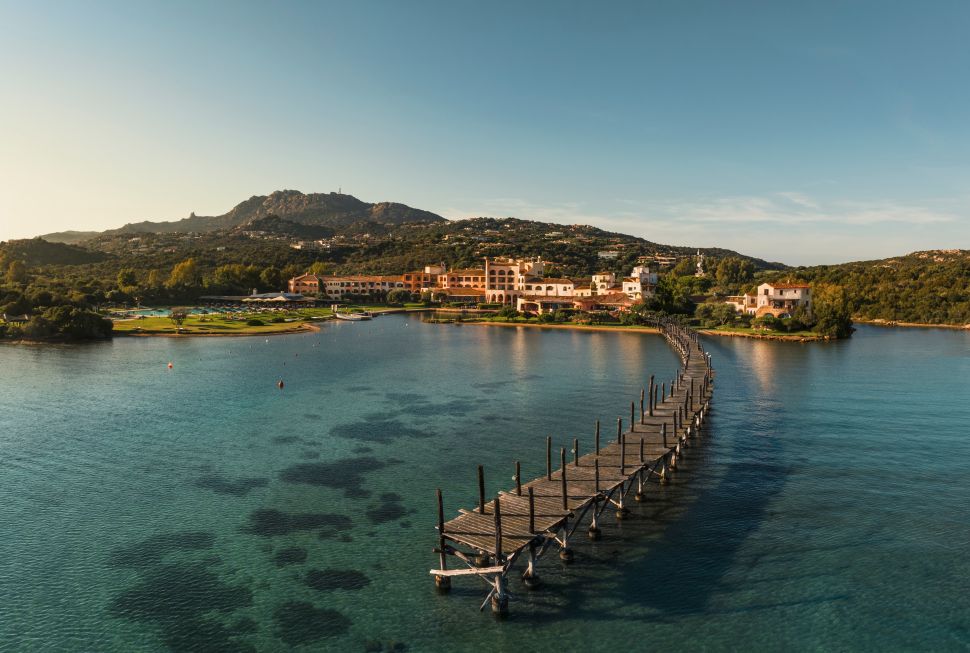
Still, under Italian law, nobody can own a stretch of sand—that belongs to the state and remains open to anyone carrying a towel. The consortium never needed title to the beach itself. It commands the approach: the land behind the dunes, the roads and the price of sleeping nearby. The fence was never physical. It is denominated in euros. The arrangement becomes tangible at Cala di Volpe, Couëlle’s fishing village that never fished, all crooked houses and a jetty where James Bond checked in during 1977’s The Spy Who Loved Me. The top suite has been listed at more than $40,000 a night.
The surest gauge of its gravitational pull sits at the water‘s edge, where Nobu Matsuhisa’s 2018 pop-up reportedly took in more than €1 million in under two months, earned permanence the following summer and has been edging toward the tideline ever since. “It was much smaller” when he first arrived, the chef tells Observer, and the operation keeps “getting better and better,” no small verdict from a man who counts more than 70 restaurants and some 20 hotels worldwide. The next tables, he confirms, go “by the shore” itself. His trajectory here distills the Costa Smeralda formula: growth measured in tables and quality, never in buildings.
Conservation has become another competitive advantage. Before the day’s heat settles over Razza di Juncu, a fire-surveillance helicopter lifts off to scan the maquis for the first filament of smoke. Along the shore, the consortium tends even the seasonal accumulation of Posidonia seagrass; inland, it grooms the Pevero Health Trail. The marina has won the Blue Marina Award, an Italian sustainability certification for tourist ports, three years running, while the resort packages longevity as a coastal amenity, pairing Harvard physicians with Sardinia’s Blue Zone pedigree. Having driven in from the airport, past the other resorts and the roads that thread between them, I can report the boundary is unmarked yet unmistakable: the verges turn barbered, the scrub resolves into something like a country club, its crowd running from Russian oligarchs to Texas oil money and reading, for all the passports, as a single tax bracket. The machine works so completely that the coast tips, at moments, toward a curated sameness, gorgeous the way any well-funded elsewhere is. Scarcity preserves beauty. Beauty preserves value.
Before the prince, this was one of Sardinia’s poorest corners, with more sheep than jobs. In the surrounding Gallura, residents will tell you, without irony, that he left them a future. It is a genuine inheritance, though hardly an evenly distributed one. Weeks after the Aga Khan’s death, a Vietti-designed compound at Romazzino, passed from Henry Ford II to Saudi oil minister Ahmed Zaki Yamani, sold for more than €160 million (about $183 million), reportedly to an American crypto billionaire. It was then the highest price ever paid for a home in Italy. The record lasted barely a year: in June 2026, Silvio Berlusconi’s Villa Certosa at Porto Rotondo, just beyond the consortium’s writ, went for a reported €350 million (about $400 million), to a sheikh of Qatar’s ruling Al Thani family. The people who make the season function, meanwhile, increasingly cannot afford to sleep within it, sharing rooms or commuting from the interior while apartments capable of earning €32,000 over the summer stand dark through winter.
The balance sheet changes once public law enters the frame. The coast’s survival was never simply the result of private virtue. When Colony Capital, the American fund run by Tom Barrack, and later the Qataris, proposed new hotels, dozens of villas, close to half a million cubic meters of fresh concrete and a water park behind one of the shoreline’s loveliest beaches, it was not the consortium’s self-restraint that stopped them. The hard limit came from Renato Soru’s 2006 salva-coste plan and a regional court, which blocked an expansion of the Romazzino because it stood too close to the water. More than once, the party pressing hardest to build has been the ownership itself.
The demand is hardly theoretical. This May, Delta inaugurated the first nonstop service between New York and Olbia, flying four times a week and covering the distance in a little over eight hours to an airport bearing the coast’s name. In the airline’s first Route Race, nearly 150,000 SkyMiles members and employees voted on where Delta should fly next; the members chose Sardinia, effectively voting the island onto the airline’s map. The route confirmed a shift regional officials were already tracking: Sardinia’s tourism councilor, Franco Cuccureddu, told an industry fair in Milan in February that American arrivals are growing 30 percent a year.
So the owners will keep changing. Sovereign wealth funds replace princes, tech fortunes replace industrial dynasties, and easier access delivers the next generation of buyers before the last has finished cashing out. The question inherited by the Aga Khan’s successors is not whether the coastline can be protected. It plainly can. More than six decades on, his most enduring creation was not the enclave for the jet set, but a system that made refusal lucrative. Sardinia is still deciding who shares in the value of that “no,” and who is ever permitted to hear “yes.”