
Vintage-watch shopping offers one of luxury’s stranger bargains. Pay extra for history, then ask whether the luminous paint is radioactive and the movement contains parts from three donors. A good old watch keeps the case, dial and provenance that made it worth collecting in the first place. It may also have polished lugs, a replacement crown and a service interval last observed when fax machines seemed advanced. The strongest examples return to a documented reference, proportion or function, then update the parts age did not improve. Sapphire can replace acrylic, current movements can extend the power reserve and better seals make the sport models usable in water. Beige lume is horology’s exposed brick, applied wherever instant atmosphere is required.
European makers built much of the 20th-century military and sporting canon by solving specific problems for pilots, naval crews, drivers, doctors and executives who needed an alarm before phones began doing everything at once. Military aviation advanced chronographs and flyback mechanisms before World War II, while postwar leisure sent the rotating dive bezel beyond professional crews. Modernism took another route, reducing the dial to typography, proportion and whatever information earned the space.
That history has been making a convenient comeback. Smaller cases sit naturally with softer tailoring, while a strong archival design supplies personality without coaxing the owner to embrace novelty. The 15 watches below trace their shapes or functions to real European predecessors, then use modern movements, crystals and water resistance where they help. The nostalgic oddities remain, leaving the donor movements and brittle gaskets at the vintage counter.
The Heritage Watches That Stand the Test of Time
Breguet Type XX Chronographe 2067
Vacheron Constantin Historiques American 1921
Panerai Radiomir Tre Giorni PAM01335
Blancpain Fifty Fathoms Automatique 42mm
Hanhart 417 ES 1954 Panda Flyback
TAG Heuer Monaco Chronograph Titanium
Junghans Max Bill Automatic Bauhaus
Fears Brunswick 38 Charcoal Rose
Vulcain Cricket Tradition Alarm 39
Oris Big Crown Pointer Date Bullseye
Alpina Alpiner Heritage Carrée Automatic 140 Years
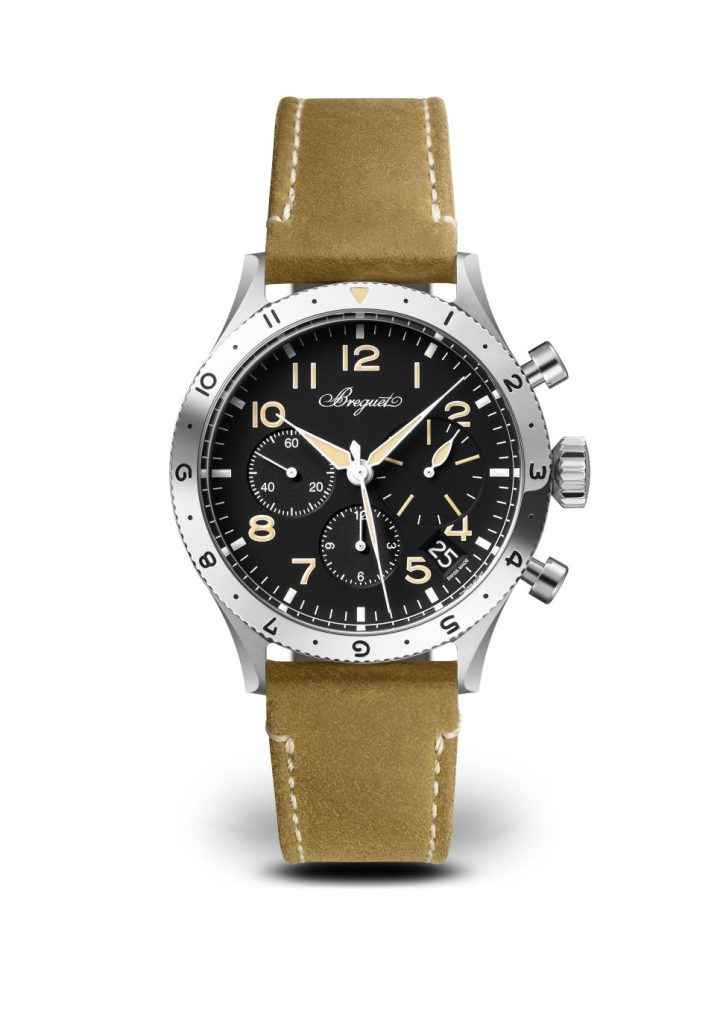
Breguet Type XX Chronographe 2067
French Air Force requirements established the Type 20 brief in the early 1950s. The 2067 follows Breguet’s civilian Type XX line, most directly to a 1957 watch numbered 2988. That lineage explains the graduated bidirectional bezel and enlarged 15-minute register, useful when consecutive flight legs were measured without a screen in the seatback.
Breguet.
Breguet
Vacheron Constantin Historiques American 1921
Vacheron Constantin conceived the 1921 original for the American market, rotating the display so that a driver could read the time without turning the wrist. This new blue-accented reference retains the established 40-by-40-millimeter format in 18-karat pink gold, with the crown at 1:30 and small seconds at three. The hand-wound Caliber 4400 AS supplies 65 hours of reserve inside an unusually thin 8.06-millimeter case.
Vacheron Constantin.
Vacheron Constantin
Panerai Radiomir Tre Giorni PAM01335
Panerai developed Radiomir luminous material for instruments before supplying oversized cushion watches to Italian naval commandos in the 1930s. The PAM01335 keeps the wire lugs, sandwich dial and 45-millimeter case, while modern luminous paint removes the part of the history that required radiation warnings. Its hand-wound P.6000 movement runs for three days and the case is rated to 100 meters, useful reassurance for a watch born near water.
Panerai.
Panerai
Blancpain Fifty Fathoms Automatique 42mm
Blancpain’s chief executive, Jean-Jacques “J.J.” Fiechter, was a diver, which helped make the 1953 Fifty Fathoms unusually serious equipment rather than simply a deskbound fantasy of the sea. This permanent 42.3-millimeter edition is more manageable than the long-running 45-millimeter case, while Grade 23 titanium keeps it light. The blue dial, sail-canvas strap and domed sapphire bezel move beyond the original military palette.
Blancpain.
Blancpain
Longines Legend Diver 39
Longines based the Legend Diver on a 1959 compressor-style watch whose rotating timing bezel sat beneath the crystal. Two crowns still control the current version, one for time and the other for that internal scale. The 39-millimeter case is the sweet spot, large enough to keep the long markers legible and compact enough for a jacket cuff. A COSC-certified automatic movement runs for roughly 72 hours, while 300 meters of water resistance makes the retro layout fully useful.
Longines.
Longines
Hanhart 417 ES 1954 Panda Flyback
Hanhart traces the 417 ES to the 417 pilot’s chronograph it developed in the 1950s for the newly formed West German armed forces. The modern Panda retains the original 39-millimeter diameter, fluted bezel and red position marker, then trades the period bund strap for a quick-adjust bracelet. That change matters after an hour at a desk or a long flight, when wrists tend to make their own sizing decisions.
Hanhart.
Hanhart
TAG Heuer Monaco Chronograph Titanium
The Monaco arrived in 1969 as a square automatic chronograph and became a screen icon two years later, when Steve McQueen wore the midnight-blue reference 1133B in Le Mans. The 2026 edition brings the left-side crown and blue dial into a 39-millimeter Grade 5 titanium case, shedding weight without sanding off the oddness. Its automatic TH20-11 movement extends the power reserve to 80 hours.
Tag Heuer.
Tag Heuer
Junghans Max Bill Automatic Bauhaus
Max Bill studied at the Bauhaus before designing kitchen clocks for Junghans in 1956 and moving on to wristwatches a few years later. His dial has no interest in decorative nostalgia. The minute track, thin hands and Arabic numerals exist to make time immediately clear. This 38-millimeter automatic adds a red date and sapphire crystal while staying only 9.7 millimeters thick. The caseback depicts the Bauhaus building in Dessau, a history lesson visible mainly to the owner.
Junghans.
Junghans
Fears Brunswick 38 Charcoal Rose
Fears began in Bristol in 1846, closed in 1976 and returned 40 years later under a sixth-generation descendant of the founder. The Brunswick’s rounded-square case draws from a 1924 watch in the family archive, though the Charcoal Rose dial refuses sepia. Its granular center, rose-gold minute track and applied numerals reward a closer look without requiring a loupe at lunch.
Fears.
Fears
Vulcain Cricket Tradition Alarm 39
The Cricket announces itself before the 39-millimeter case comes into view. Vulcain launched the mechanical alarm in 1947, and the company links its presidential reputation to Truman, Eisenhower, Nixon and Johnson. The Tradition keeps the single crown, separate alarm pusher and hand-wound V-10 movement, whose two barrels provide a 52-hour power reserve and roughly 20 seconds of ringing. The sound is closer to an urgent metallic buzz than a polite chime.
Vulcain.
Vulcain
DOXA SUB 300 Professional
DOXA launched the orange SUB 300 in 1967 after testing dial colors for underwater visibility, then reached American divers through Jacques Cousteau’s U.S. Divers company. The modern Professional preserves that startling orange, the beads-of-rice bracelet and a bezel calibrated with the U.S. Navy’s no-decompression table. A COSC-certified automatic movement sits inside the 42.5-millimeter tonneau case, which is rated to 300 meters.
DOXA.
DOXA
Oris Big Crown Pointer Date Bullseye
Oris introduced the Big Crown Pointer Date in 1938 for pilots who needed to operate a watch while wearing gloves. The enlarged crown remains, along with a central hand that reaches to the date around the dial’s edge. This Bullseye version uses concentric black and silver rings, a 38-millimeter steel case and an automatic movement with a 41-hour power reserve.
Oris.
Oris
Glashütte Original Sixties
The Sixties draws from Spezimatic watches made in Glashütte during East Germany’s state-run era, a more complicated lineage than the usual founder portrait above a workbench. Its domed silver dial, curved numerals and slender markers preserve that midcentury character. The modern case is 39 millimeters wide and only 9.4 millimeters thick, with the manufacture Calibre 39-52 visible through the back and running for 40 hours.
Glashütte.
Glashütte
Mido Multifort TV Big Date
Television-shaped watches had a busy 1970s, when rounded rectangles suggested the future rather than a streaming login screen. Mido first used the form in 1973 and revisited it several times before the current Multifort TV arrived. This green-dial version measures 39.2 by 40 millimeters, sets a large date at 12 and runs for 80 hours on its automatic Caliber 80.
Mido.
Mido
Alpina Alpiner Heritage Carrée Automatic 140 Years
Alpina traces the Carrée’s design to a rectangular 1938 watch, then enlarges those proportions to 32.5 by 39 millimeters for the current automatic. The silver sector dial, small seconds and compact Art Deco numerals keep the period aesthetics intact. An AL-530 movement now supplies 38 hours of reserve beneath a case only 9.7 millimeters thick.
Alpina.
Alpina