
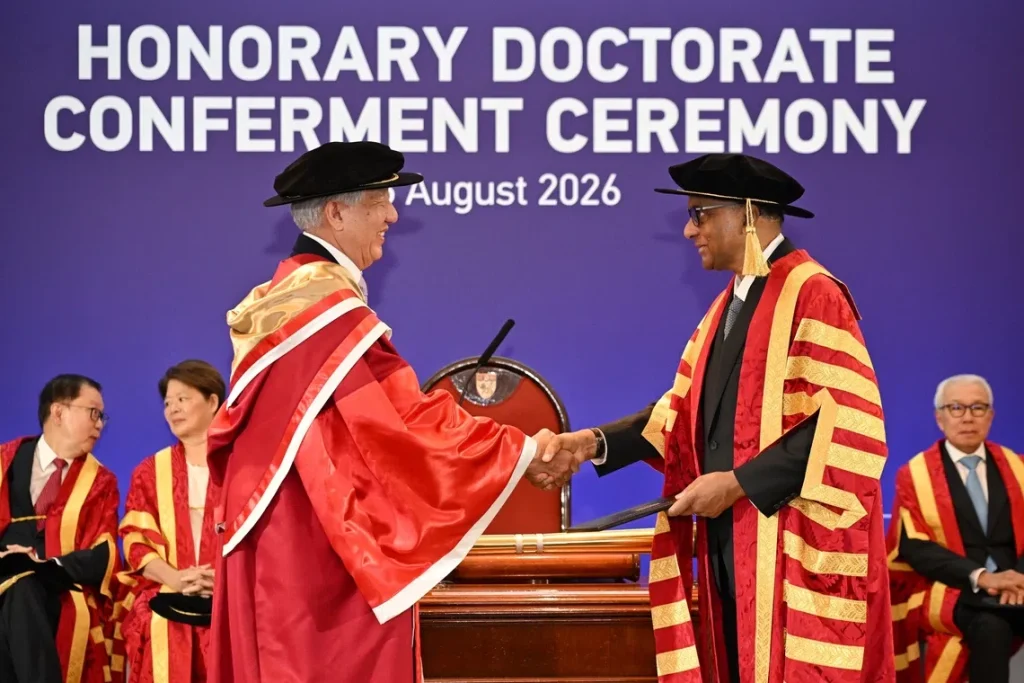
SINGAPORE – Senior adviser in the Prime Minister’s Office Teo Chee Hean received an honorary degree from Nanyang Technological University on Aug 26, recognising his contributions to Singapore across several roles over the decades.
After entering politics in December 1992, Teo went on to hold several Cabinet positions, including minister for home affairs, defence and education. He also served as deputy prime minister, coordinating minister for national security and senior minister before retiring in 2025.
The conferment also marked a return to the institution’s early history for Teo, whose ties to the university date back to its formative years.
As a council member at Nanyang Technological Institute from 1988 to 1991, he had overseen its reconstitution to NTU, as well as the integration of the National Institute of Education (NIE) with the university in July 1991.
Teo, who is Temasek chairman, received the honorary degree of Doctor of Letters from President Tharman Shanmugaratnam, who is NTU chancellor, during a ceremony at NTU.
Teo Chee Hean (left) received the honorary degree of Doctor of Letters from President Tharman Shanmugaratnam (right), who is NTU chancellor, during a ceremony at NTU on Aug 26.
ST PHOTO: AZMI ATHNI
In his speech, Teo said that over the years, he has had many other opportunities to engage NTU staff and students on matters relating to education and research, including as chairman of the National Research Foundation.
“Through the vision and patient efforts of successive generations, NTU has steadily gained recognition and earned high international standing for its teaching and research,” he said, adding that he accepted the honorary degree with gratitude and pride in how far NTU had grown.
NTU president Ho Teck Hua said Teo helped shape NTU’s beginnings and transformed teaching into a rewarding and flexible lifelong career.
He noted that in the 1980s, then-minister of education Tony Tan called Teo to ask whether the University of Manchester Institute of Science and Technology, where Teo had studied, could serve as a model for NTI.
Teo, then a mid-level Navy officer, had seen how a specialised institution of science and technology could be structured. His perspective helped shape the early development of the institution that would become NTU, Ho said in his speech.
The decision to transform NTU into a comprehensive university was made in 2003, when Teo was minister for education.
He knew that the quality of an education system depends on the quality of its teachers, Ho said. Teo increased teachers’ pay and created three distinct career progressions: teaching, school leadership and senior specialist tracks.
Today, an NIE-trained teacher starts on a monthly salary of $5,000, comparable to that of an engineering graduate, and the three career tracks allow teachers to progress according to their strengths and aspirations.
“Mr Teo understood that teaching is a calling. But a calling should not require people to sacrifice too much,” said Ho.
Teo also created broader educational routes for Singaporeans and established technical education as a recognised pathway to success.
When he was minister of education, Nitec became the new benchmark for Institute of Technical Education training. This gave employers a clear understanding and confidence in ITE graduates’ skill, Ho added.
Looking to the future, Teo said while artificial intelligence may allow every learner to have a personalised tutor, the role of the human teacher will remain essential – not simply to transmit content, but to challenge, guide and inspire, and to help learners exercise discernment and judgement.
“Technologies, however powerful, cannot exercise judgement, build trust or take responsibility for the consequences,” he noted.
Teo said a university is not only a place to acquire skills, but also a community in which people learn to work with others and to disagree without becoming divided.
Values, well-being, sport, culture and service are also not peripheral to education, but they shape how people use what they know, how they respond to setbacks, and how they strengthen and contribute to society, he added.
“AI can help us optimise towards a goal. But people must still decide what goals are worth pursuing, and accept responsibility for the consequences,” Teo added.