
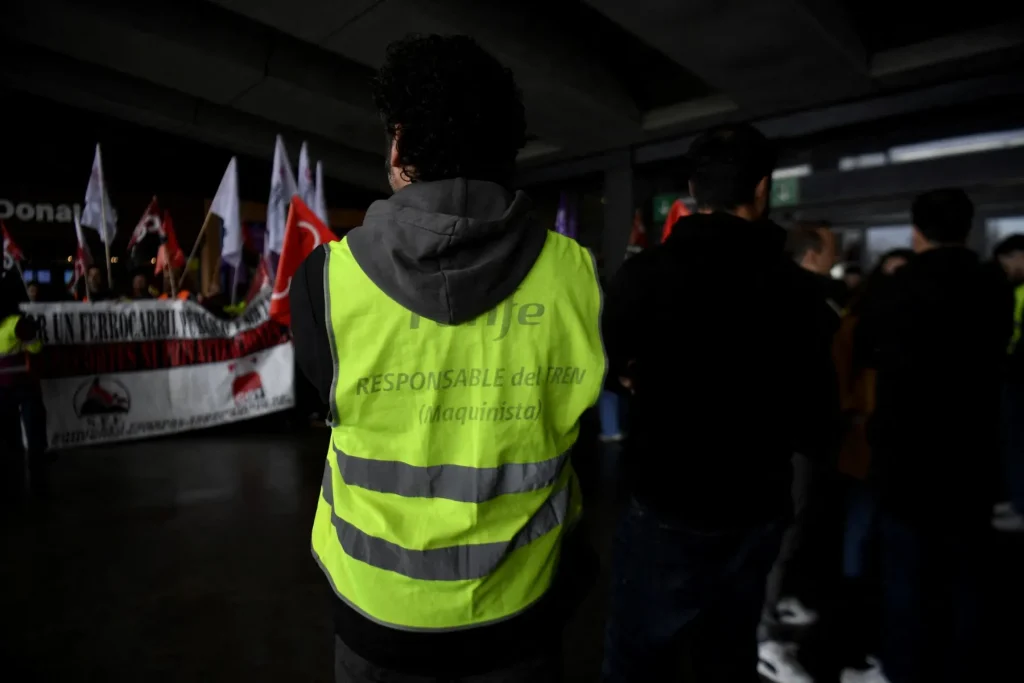
Spanish Renfe train drivers, who had called a nationwide strike before the Toledo crash precisely over concerns over unmet safety standards, announced on Wednesday that they will go ahead with their stoppage on Thursday October 29th.
Spanish train drivers’ union Semaf has decided to maintain the strike called for this Thursday at Renfe in defence of railway safety, after the serious accident that occurred on Wednesday in Toledo that cost at least 68 people their lives led them to question whether to carry out the stoppage.
READ ALSO: What we know so far about the deadly train crash in central Spain
The union warned that, apart from tomorrow’s stoppage, it is studying new measures in defence of railway safety, urging all drivers “to take extreme precautions in the performance of their duties.”
Semaf added that their organisation is deeply saddened by the accident that occurred on the Madrid-Seville high-speed line between a Renfe train and an Iryo train, adding that it still had no information about their colleagues on the state-run train.
The union said in a statement that it wants to remain cautious about the reasons for the accident until it knows all the details of what really happened, so as not to engage in speculation, since it believes that the first priority is to help the victims and support their families.
READ ALSO: Spain’s transport minister blames rail crash on ‘inexplicable human error’
All 6,000 driving staff at state-run train operator Renfe are called to a 24-hour strike starting at midnight on Wednesday.
There are minimum services in place which guarantees the circulation of some high-speed, commuter and mid-distance trains operated by Renfe, but following Wednesday’s crash the impact of the strike could be even greater.
READ MORE: What to know about the train drivers’ strike in Spain on Thursday
The stoppage was called due to the lack of implementation of several agreements signed several months ago, in the aftermath of the first high-speed train collision in Adamuz which killed 46 people.
As if by design, the deadly collision in Urda (Toledo province) occurred one day before Semaf’s planned strike, which demands better railway safety, improved protocols for weather emergencies and the hiring of new train drivers.
Semaf called the strike on October 16th after negotiations with the Ministry of Transport, rail infrastructure manager Adif, the State Railway Safety Agency (AESF) and train operator Renfe remained “unsuccessful” and “paralysed” for months.
Following the rail strike last February due to the Adamuz train accident, working groups were created to carry out each commitment that had been set in the agreements reached with the Ministry of Transport and Renfe.
Renfe has maintained that the demands recently cited by Semaf are not part of their remit, and that it’s “incoherent to call a strike against its service for issues outside the company’s control, such as driving time regulations, or certain actions by the Labour Inspectorate, which are also outside its decision-making capacity.”
Regarding the agreement signed in February in which promises were made to reinforce the railway system after the Adamuz accident, Renfe claims that all the obligations of that deal have been fully met.