
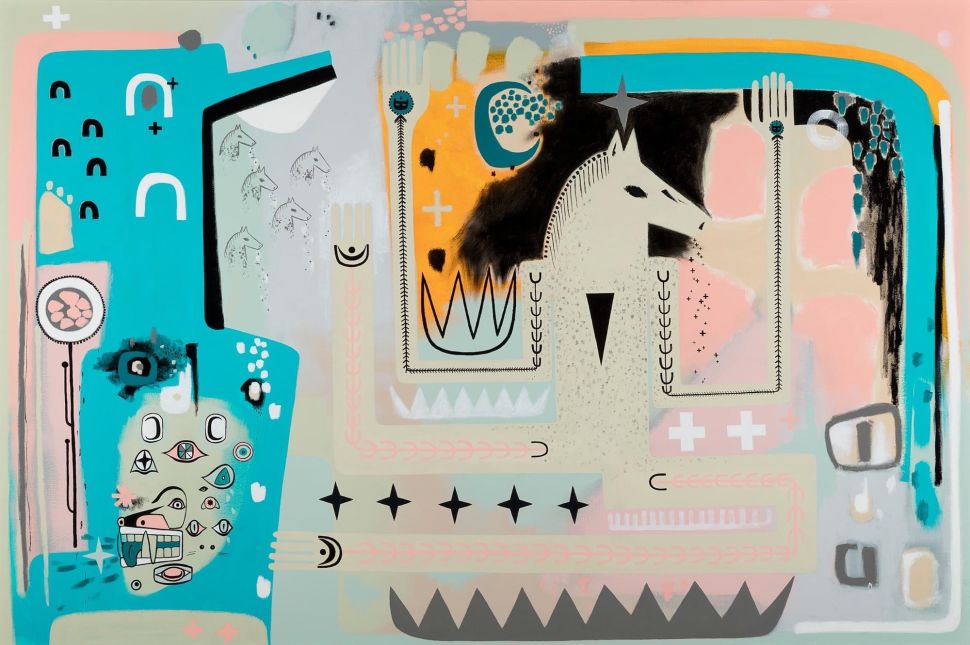
The Santa Fe Indian Market is arguably the country’s most historic and significant event devoted entirely to Native American art, bringing generations of artists into direct contact with collectors and broader audiences while fostering greater awareness of Indigenous artistic practices. The 104th edition, held just a few weeks ago in Santa Fe, New Mexico, brought together nearly 1,000 artists from more than 200 tribal nations. The Southwestern Association for Indian Arts (SWAIA) describes it as the largest and most prestigious Native art market in the world.
Yet even amid a recent reawakening that has brought contemporary Indigenous practices greater international recognition, coupled with renewed interest in ancestral knowledge and alternative systems of understanding, Native American art remains comparatively underrepresented in the mainstream art world, particularly outside the United States. Compared with other historically marginalized communities that have gained greater visibility through the ongoing reassessment of institutional and market canons, the number of contemporary Native American artists achieving broad international recognition remains relatively limited, as does the rediscovery of established and pioneering figures long overlooked by art history. The same is true of galleries representing Native artists beyond those specializing in the field.
Native American artists may have begun appearing more frequently in biennials and broader institutional exhibitions, particularly as contemporary curatorial discourse increasingly engages ecological questions, land and alternative relationships between humans and the natural world—areas in which Indigenous knowledge systems have long offered compelling models and perspectives. Yet major historical surveys devoted to individual Native artists remain relatively rare, and rarer still are ambitious exhibitions attempting to trace the breadth, diversity and historical continuity of Native American art within the larger story of American art.
In 2023, the National Gallery of Art in Washington, D.C., staged “The Land Carries Our Ancestors: Contemporary Art by Native Americans,” which gathered work by nearly 50 living Native artists from across the United States. The show was curated by Jaune Quick-to-See Smith, who became the first artist ever invited to curate an exhibition at the museum. (Despite being one of the most notable Native American artists to emerge in the postwar period, it took until 2020 for the museum to acquire a painting by Quick-to-See Smith: I See Red: Target, the first painting by a Native American artist to enter the National Gallery’s collection.) In December 2024, the museum announced the acquisition of works by eight other contemporary Native artists: Jeffrey Gibson, Sky Hopinka, Cannupa Hanska Luger, Dakota Mace, Eric-Paul Riege, Cara Romero, Kay WalkingStick and Will Wilson. But it took until 2025 for the National Gallery to appoint a curator dedicated specifically to work by Native artists, when Dakota Hoska (Oglála Lakȟóta Nation, Pine Ridge, Wounded Knee) became its inaugural curator of Native American and Global Indigenous Art.
Last year, the Zimmerli Art Museum at Rutgers University staged “Indigenous Identities: Here, Now & Always,” also curated by Quick-to-See Smith, which featured work by 97 living artists representing more than 74 Indigenous nations and communities across North America—the largest museum survey of contemporary Native American art of its kind to date. Meanwhile, “An Indigenous Present” at the ICA Boston, which closed in March, took a more focused look at the past century of contemporary Indigenous art. Co-organized by Jeffrey Gibson and independent curator Jenelle Porter, it brought together 15 Native North American artists, including George Morrison, Mary Sully, Jaune Quick-to-See Smith, Kay WalkingStick, Raven Chacon, Sky Hopinka and Dakota Mace.
Clearly progress is being made, but institutions are undoubtedly running late, and there is still much to do. The main problem remains persistent entry barriers and the lack of a broader infrastructure capable of supporting Native American artists, art collector Reid Walker tells Observer. A citizen of the Mandan, Hidatsa and Arikara Nation, Walker has stepped up to advocate for greater representation of his community, serving on the National Gallery of Art’s Collectors Committee, Tate’s North American Acquisitions Committee and the Phillips Collection board. After realizing that collecting would never do enough to support emerging Native talent, he has also directed resources toward grants, mentorship and curatorial introductions for Native artists through the Walker Youngbird Foundation.
“A lot happens in those communities that is shown in Santa Fe, but then it has to rise up from there,” he explains. “That’s where the infrastructure kind of breaks down, because it has to reach institutions either through galleries, museums or collections, and then market valuation decides how much to pay for it.” Those pathways are less developed than they are for other communities, he adds. “You’re not surprised now to see Australian Aboriginal art in the Tate and a National Gallery retrospective at the same time, but it’s rare to see a Native collection shown at that scale.”
He points to the belated pace of institutional recognition, alongside scholarship that is still far from developed. Returning to the Jaune Quick-to-See Smith acquisition, he notes how remarkable it is that such a basic milestone arrived only in 2020, particularly compared with the institutional reassessments that followed other civil rights and social justice movements.
After surviving tribes endured profound cultural erasure and forced assimilation, many Native artists in the past preferred, or felt compelled, to identify simply as American artists. Walker points to Ojibwe abstract artist George Morrison, who recently had a show at the Met, as an example. When he was working in New York, much of his art was not considered Native art at all; instead, he became associated with Abstract Expressionism and the broader artistic circles of his generation.
Walker also acknowledges the enormous breadth of the category itself. It is reductive to treat Native American art as a single, homogeneous field: there are 574 tribal nations, each with distinct customs, languages and artistic traditions. Yet Native communities and tribes ultimately define their own artists and practices, and Walker sees growing awareness and pride among younger generations in identifying with those communities. The difficulty begins when the work moves outward into the institutional and commercial art system, which often lacks knowledge of the conversations already taking place within these communities, particularly through platforms for exchange across tribal nations such as the Santa Fe Indian Market.
This is why representation inside decision-making structures is crucial. “You have to be in the museums when they’re deciding the budget and when they’re deciding what curators are going to have allowances to purchase,” Walker argues. “The Native community is smaller—it was decimated and driven to near extinction for hundreds of years—so it has been a challenge to get Native people into these positions.”
Walker agrees that the institutional gap cannot be separated from broader economic and social barriers. Native communities historically had less access to the kinds of education, wealth, professional networks and collecting cultures that help people serve on museum boards, work in curatorial departments and enter the commercial art world. Yet when he finally entered those rooms, Walker did not encounter specific resistance to Native art so much as a surprising lack of awareness: “I don’t think I found a challenge in the sense of people not being open to it. What was eye-opening was that they had no understanding of contemporary Native art.” In many cases, those artists simply were not on the radar. When acquisition budgets were limited, work that was already marginal to institutional awareness could easily be cut from consideration. “That’s when I learned that you really have to be an advocate for your community and be out there. There aren’t that many Native trustees. I’m hoping there will be more.”
Walker has used his own influence to create concrete change. As a board member at the Phillips Collection, for example, he donated a work by George Morrison that he felt fit naturally within the museum’s collection. He has also helped encourage the National Gallery to bring works by artists such as Kay WalkingStick and Jeffrey Gibson into the collection—and to display them prominently. He joined Tate’s North American Acquisitions Committee in part to build an international bridge for Native artists.
At the most recent Santa Fe Indian Market, Walker brought groups connected to the National Gallery and the Phillips Collection to the market. “It was so gratifying to see them watching these artists firsthand, walking through the market and listening to presentations or having dinner and Q&A with some of the artists,” he recounts. “A lot of them had no exposure to this before. It was gratifying to see them in front of young and established artists and watch their interest expand. You have to have the experience of being with the tribes and seeing the work firsthand to really understand its importance.”
While there are still relatively few Native trustees in museum administration, Walker finds encouragement in the growing number of Native curators who have joined institutions in recent years. He points to the hiring of Native curators at institutions including the National Gallery, the Denver Art Museum and Crystal Bridges. Denver, he notes, built an especially deep contemporary Native collection in part because it recognized early on that it could distinguish itself by focusing on an area other museums had overlooked. “It was great to be in Santa Fe and see people from Crystal Bridges, the Hood Museum at Dartmouth and other institutions,” he says. “Some really talented Native curators are coming up through the ranks, but I think there’s still a way to go.”
Native curators are essential, particularly because some works require cultural and historical context that cannot always be responsibly provided through a generic contemporary-art framework. This also speaks to the ways Native art has historically been interpreted in museums. Walker agrees that ethnographic frameworks still linger far more than many people realize. Objects and artworks have often been narrated by people outside the communities that produced them, while contemporary Native work can still be placed uncomfortably close to pre-Columbian material, anthropology or ethnographic collections.
Walker sees the U.S. as lagging in this regard. First Nations artists and communities in Canada often have stronger institutional access, and he has encountered galleries there whose directors possessed deep knowledge not only of the art but also of the traditions behind it. “They have stronger museum infrastructure and museum support than we have,” he explains, “as well as galleries that specialize in and understand the work better than many here in the United States.”
For Walker, the institutional, and ultimately international, bridge remains one of the largest gaps. A small number of artists have gained representation with major global galleries—Jeffrey Gibson and Dyani White Hawk, for instance, are both represented by megagalleries today—but such examples remain rare. Accessing that level of the market has been difficult because there is no consistent infrastructure carrying Native artists from community recognition or regional visibility into the international gallery and museum system.
Jeffrey Gibson’s Venice Biennale pavilion in 2024 helped bring Native American art further into the spotlight, generating renewed attention and appreciation, Walker says, but the talent itself shouldn’t be treated as a novelty. “The work has always been there, but the understanding and visibility were never there. Jeffrey, Nicholas Galanin, Emmi Whitehorse, Marie Watt—a lot of them have created much more visibility and understanding of that work. And that allows a whole new generation of Native American artists to make a living wage, to survive in this sector.”
These artists often not only provide an aspirational model but also try to give back to their communities. “Many of the new wave of successful artists might have come from those challenging conditions, and they’re now giving back, too,” Walker says. “That’s the great thing about Indian Country: it’s small, but we help each other, and that recognition is getting there slowly but surely.”
It is in the same spirit that Walker carries forward the mission of the Walker Youngbird Foundation, supporting early and emerging Native artists through direct funding, mentorship and institutional partnerships. His current focus is supporting artists at critical moments of development, transition and institutional engagement, with an emphasis on infrastructure, access and long-term positioning rather than early-career support alone.
There are important collectors of Native art today, but a collector buying a work, or eventually donating it to a museum, does not necessarily create a sustainable career structure around the artist, he argues. “When we founded the organization, we realized that the disconnect between younger emerging artists and the galleries in major metropolitan cities, museum curators and others was severe. It was a large gap. There was no bridge.”
Because there are already many strong Native arts organizations operating in the United States, including First Peoples Fund, Walker’s foundation did not want to duplicate their work. Instead, it chose to focus specifically on commercial and institutional infrastructure, ensuring that artists become visible not only to collectors but to museums and galleries as well. A significant part of Walker’s work today involves facilitating conversations that bring these artists into contact with the international art-world circuit at the level he believes their work deserves.
“Even if you graduate from IAIA, they don’t necessarily tell you how to negotiate with a gallery, how to work with a curator when they want to position you somewhere you don’t want to be or about conservation techniques when your art is placed in a different climate. We try to fill that gap,” he explains. “As you open up the infrastructure, you see all of the pieces that are not there for Native artists but are there for others.” It’s difficult, he adds, for Native artists who remain in places such as Gallup, New Mexico or Bismarck, North Dakota, to understand and connect with the broader art world, where those networks are far less accessible. Relationships to community and place, at the same time, may be fundamental to their work, so simply relocating to New York is not always a meaningful or desirable solution.
The foundation relies on a council made up of curators and gallery directors to review applications—a process that provides further exposure for the artists applying. The foundation now receives roughly 300 applications per cycle and narrows them down according to established criteria. “Part of what we try to do is to work with galleries that both can find artists, and help us mentor newer artists,” Walker says.
Many grantees begin without gallery representation, and so the mentorship includes practical guidance on the market, how to communicate with galleries, how to work with museums and how to build a professional trajectory. Hales Gallery, Garth Greenan Gallery, Jessica Silverman and others have major artists in their programs, but they have also been helping mentor and support younger, emerging artists coming up in the field.
The foundation has since expanded beyond its original emerging-artist focus. An initiative called “Nááhíí,” meaning “uplift,” supports artists focused on developing projects with particular impact for their tribe or community rather than primarily for the market. It provides a $50,000 grant and residency for Native artists working with neon for the first time. The first grantee is Sarah Rowe, a Ponca artist from Nebraska, who is developing the project in conjunction with a Hudson Valley residency and technical support. “We wanted to give someone completely new access to the medium, an opportunity to experiment, grow and see where it could lead,” Walker explains.
Looking ahead, he says the foundation will be increasingly focused on the period after “emerging.” The art world often concentrates grants and visibility on younger artists, while mid-career artists can face a different set of challenges, particularly amid cuts to museum budgets and arts funding. The foundation is considering ways to support exhibitions for mid-career Native artists and is working with institutions and organizations on new commissions and installations. Walker mentions a collaboration with Counterpublic in St. Louis that will support four new installations by Native artists, as well as a partnership with the Fine Arts Work Center in Provincetown.
The foundation, meanwhile, is beginning to work more seriously on publishing. “The academic and other publications aren’t there yet. We’re looking at how we can help push and promote those, too,” Walker says, describing scholarship and publishing as another significant gap in the infrastructure. The foundation has also sponsored Native curatorial groups to expand programming and help cultivate the next generation of curators who will eventually work in major museums and shape institutional decisions from within.
Recently, Walker has been critical of land acknowledgments when they are not accompanied by action. His New York Times opinion essay, “I’m Native American. Land Acknowledgments Are Infuriating.,” published July 24, 2026, raised an important point: the problem is not acknowledgment, but acknowledgment without infrastructure, relationships or action. “You want people to recognize the tribes who are here. You don’t want to forget about the nations, so there is value in that recognition,” he says. “But if it’s a hollow recognition that is simply said to forgive ourselves and move on, then what’s the point? It has to go beyond the words.”
For him, acknowledgment should lead to a relationship with the tribal nation, scholarship about the community, education initiatives, curatorial programs for Native students, acquisitions, commissions or other forms of sustained engagement: “It becomes frustrating when museums display an acknowledgment while doing little to incorporate Native histories, artists or communities into the institution itself.”
But Walker remains optimistic. To him, recognition of Native American art is finally reaching an inflection point, at least in the United States. A group of prominent artists, including Gibson, Whitehorse and others, has opened doors, while international interest in Indigenous practices has also increased. At the same time, important collections are being donated, and more museums are beginning to acquire, exhibit and contextualize Native work. “There are a lot of pieces of the puzzle coming together at the same time, and we’re happy to be a Native-run organization playing a small part in that,” he says. “We’re going to continue pushing on the institutional side and the gallery side to elevate these voices.”