
Prep is the only American dress code that arrives with extracurriculars and a recommendation letter. Yet for all its American self-confidence, most of the kit arrived from overseas. Button-down collars came from English polo and striped jerseys from British rugby. Repp ties carried regimental stripes. The slip-on shoe arrived by way of Norway. On early-20th-century northeastern campuses, students mixed those imports with soft tailoring and chinos. “Preppy” pointed to the private preparatory schools feeding those colleges. By the 1930s, the Ivy League Look had cohered. After World War II, it went national.
For a wardrobe born behind gates, prep traveled far once postwar enrollment widened the audience and sent the clothes beyond the old admissions map. Miles Davis gave the Oxford and penny loafer more voltage than any class photo. JFK carried that ease to Hyannis Port, while women wore the same pieces without the campus stiffness. In Japan, the 1965 book Take Ivy inspected rumpled American undergraduates with the attention usually reserved for more ceremonial dress. By 1980, The Official Preppy Handbook could sell the code and skewer it in the same breath, proof that Americans tolerate satire when it includes a shopping list.
And now, prep has returned as a middle ground after years of menswear divided between shapeless comfort and constricted business casual. Collegiate references returned in looser proportions on the spring 2026 runways. TikTok calls the result “old money,” giving a cable knit more financial responsibility than it can possibly bear. The practical appeal extends beyond the social media trend, since softer jackets and fuller trousers move easily from the office into a weekend away. The edit below favors enduring American originals alongside a few European pieces with genuine sporting lineage, chosen because they have gathered cultural meaning without losing usefulness. Worn one or two at a time, the references add context without turning the wearer into a reenactor.
Men’s Prep Style Guide
American-Made Oxford Cloth Button-Down Dress Shirt
O’Connell’s Authentic India Madras Long-Sleeve Shirt
Lacoste Men’s Classic Fit Original L.12.12 Polo
Polo Ralph Lauren Cable-Knit Cotton Sweater
Thom Browne Milano Stitch Merino Wool 4-Bar V Neck Cardigan
Rowing Blazers Men’s Ripley Blazer
Barbour Classic Bedale Waxed Jacket
Drake’s Navy and Green Bar Stripe Repp Silk Tipped Tie
Alden 986 Leisure Handsewn Loafer in Color 8 Shell Cordovan
Sperry Authentic Original 2-Eye Boat Shoe
L.L.Bean Boat and Tote, Open-Top
Smathers & Branson Dark n’ Stormy Belt
American Optical Saratoga Sunglasses
Jaeger-LeCoultre Reverso Classic Monoface Small Seconds
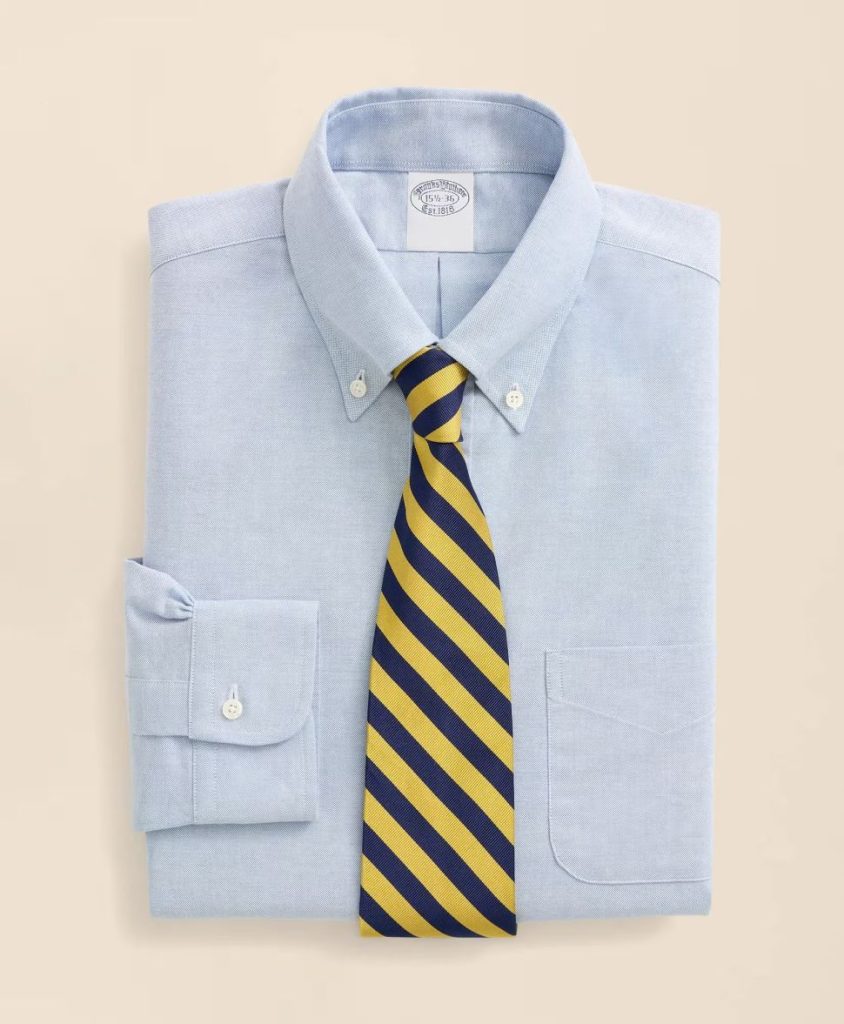
American-Made Oxford Cloth Button-Down Dress Shirt
Brooks Brothers’ origin story gives the OCBD one of fashion’s better travel anecdotes: John E. Brooks saw polo players fasten their collars during an English match, then turned the fix into a shirt in 1900. This American-made version restores the collar roll that lesser button-downs press flat. Pair it with a navy hopsack over the shoulders, open over a white T-shirt or with a tie whose knot has not been torqued into a Windsor.
Brooks Brothers.
Brooks Brothers
O’Connell’s Authentic India Madras Long-Sleeve Shirt
Real madras should look as though color might migrate in the wash. O’Connell’s sources this hand-loomed cotton from southeastern India near the Bay of Bengal, then cuts the shirt in the United States with a full body and mother-of-pearl buttons. The unwashed cloth begins bright and slightly crisp. Repeated cold washes soften the weave and blur the check into something more personal.
O’Connell’s.
O’Connell’s
Lacoste Men’s Classic Fit Original L.12.12 Polo
René Lacoste introduced the L.12.12 Polo in 1933, replacing restrictive court whites with breathable cotton petit piqué and a short placket. The original still has the compact collar and enough body to tuck into high-rise chinos. A thin performance polo under the same blazer can suggest a conference outing. White remains the reference color, especially for dinner after a late match.
Lacoste.
Lacoste
Gant Classic Heavy Rugger
A rugby shirt should retain some memory of equipment. Gant’s heavy organic cotton gives the Evening Blue Rugger enough structure to earn the name, while its chambray collar softens after washing. The brand’s campus credentials are unusually literal: Gant was founded in New Haven in 1949, and the Yale Co-op became an early stockist before its shirts spread through the Ivy League.
Gant.
Gant
Polo Ralph Lauren Cable-Knit Cotton Sweater
Ralph Lauren’s version of prep has always owed as much to cinema as campus. In 1974, the year’s Polo collection supplied most of Robert Redford’s menswear in The Great Gatsby, with a custom pink suit made for the title role. The cable-knit sweater condenses that world into something considerably easier to wear, with roving cotton yarn that gives the cables depth without the heat of wool.
Ralph Lauren.
Ralph Lauren
Thom Browne Milano Stitch Merino Wool 4-Bar V Neck Cardigan
Thom Browne began in 2001 with five suits and a by-appointment shop in the West Village. His contracted gray uniform eventually changed American tailoring, exposing wrists and ankles that conventional suits had kept covered. This Italian-made navy cardigan translates the idea into dense Milano-stitch merino. Treat it as a jacket with charcoal trousers or use it to give washed denim jeans some refinement.
Thom Browne.
Thom Browne
Rowing Blazers Men’s Ripley Blazer
Jack Carlson knows the source material from inside the boat. The archaeologist and former U.S. national team coxswain founded Rowing Blazers in 2017, with its signature club blazer boasting wool flannel, patch pockets and a 3-roll-2 front, all useful on an Ivy League mood board, but its unlined body wears closer to a cardigan.
Rowing Blazers.
Rowing Blazers
Barbour Classic Bedale Waxed Jacket
Dame Margaret Barbour purposely designed this jacket in 1980 with shorter proportions for riding, with rear vents and a hem that cleared the saddle. Those proportions now work just as well on a bicycle or squeezed into a restaurant banquette. The Classic version uses 6-ounce olive Sylkoil, a waxed cotton that arrives slightly tacky and grows more pliable where the shoulders and elbows move. Its relaxed cut fits over a blazer, though a gray sweatshirt will be the more frequent companion.
Barbour.
Barbour
J.Crew Giant-Fit Chino Pant
J.Crew’s Giant Fit features a higher rise and wide leg pull; an Oxford or rugby away from 2010s business casual and toward the generous chinos in old campus photographs and 1990s catalogs. Substantial cotton twill helps them fall cleanly, provided the hem meets the shoe instead of collecting around it. Navy is more useful than khaki here, particularly with white socks and penny loafers.
J.Crew.
J.Crew
Drake’s Navy and Green Bar Stripe Repp Silk Tipped Tie
Striped repp ties migrated from British regiments to American campuses, where the colors became less about military service than club affiliation. Drake’s version borrows the grammar without claiming a regiment. Handmade in London, the 8-centimeter silk has enough width for a soft-shouldered blazer without turning into a full-blown power tie.
Drake’s.
Drake’s
Alden 986 Leisure Handsewn Loafer in Color 8 Shell Cordovan
Shell cordovan earns its cult by aging differently than calfskin. Instead of forming fine creases, the dense horsehide develops broad rolls, then shifts from glossy burgundy toward oxblood with wear. Alden builds the 986 from Horween Color 8 on its roomy Van last, with the apron handsewn in New England. That low vamp is pure Ivy League, reminiscent of the black and white midcentury photographs hanging in Admissions Hall.
O’Connell’s.
O’Connell’s
Sperry Authentic Original 2-Eye Boat Shoe
Sperry’s deck-shoe story began after Paul Sperry slipped aboard his boat in 1934 and studied the grooved paws of his cocker spaniel, Prince. By 1935, he had cut siping into rubber soles for traction on wet decks. The Authentic Original carries that solution into 19 colorways, though brown leather is still the most convincing and versatile choice. Wear it sockless with loose chinos or faded shorts.
Sperry.
Sperry
New Balance Made in USA 990v6
The first 990 arrived in 1982 with a then-astonishing three-figure price. The v6 carries that original understatement into a softer sneaker, with FuelCell cushioning beneath navy mesh and pigskin overlays. Its entry into prep came through the back door, fueled by New England dads and the insatiable Japanese appetite for well-made American basics.
New Balance.
New Balance
L.L.Bean Boat and Tote, Open-Top
The Boat and Tote entered L.L.Bean’s catalog in 1944 as an ice carrier, which explains why the 24-ounce canvas can handle everything from tennis gear to an irresponsibly heavy farmers’ market haul, all without losing its shape. It is also the rare prep emblem that improves through ordinary abuse. Choose natural canvas with navy or dark green trim, regular handles if it will ride in your hand and long handles if it must clear a puffer sleeve. A monogrammed house nickname or deadpan two-word phrase gives the bag some life.
L.L.Bean.
L.L.Bean
Smathers & Branson Dark n’ Stormy Belt
Prep has always permitted one item to misbehave, and for summer, that job often falls to the needlepoint belt. Smathers & Branson hand-stitches this Dark n’ Stormy pattern, then backs it with Italian leather and a brass buckle, so the joke is better made than most of the trousers around it. Wear it to a harbor dinner, lawn party or wedding weekend with plain navy chinos and a blue Oxford.
Smathers & Branson.
Smathers & Branson
American Optical Saratoga Sunglasses
American Optical’s Saratoga belongs to the small group of presidential objects that still look better outside a museum archive. JFK wore the original, and the revived frame retains its keyhole bridge, substantial brow and Calobar green lenses. It’s available in three sizes, which is a godsend for some since thick acetate can look patrician or simply too wide, depending on where the temples land.
American Optical.
American Optical
Jaeger-LeCoultre Reverso Classic Monoface Small Seconds
The Reverso’s preppy credentials predate the term. Jaeger-LeCoultre developed the swiveling case in 1931 for polo players in British India, who could turn the dial inward before a match and spare the crystal. This steel Monoface keeps the proportions lean at 40.1 by 24.4 millimeters, with a hand-wound movement, small seconds and a reverse left blank for engraving. It slips beneath an Oxford cuff where a larger sports watch tends to snag, then holds its own with black tie. Initials or a private date suit the back.
Jaeger-LeCoultre.
Jaeger-LeCoultre