
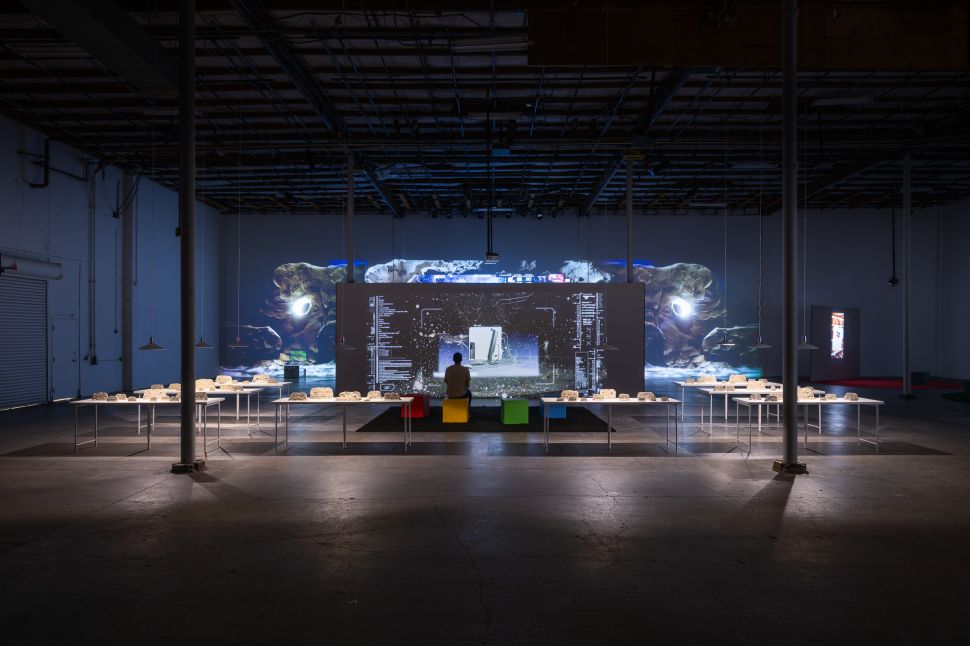
Portland’s Converge 45 Triennial is one of those art happenings conceived for its community: a hyperlocal event designed to empower the local creative ecosystem while activating new connections with the broader international art world. Founded in 2016 by gallerist Elizabeth Leach and a coalition of arts professionals and business leaders, its original aim was to strengthen the Pacific Northwest’s contemporary art scene. This year, the triennial returns with the title “Here, To You, Now” (inspired by Portland literary icon Ursula K. Le Guin) and a focus on experiences that bring people together, here and now, while celebrating the meaningful, temporary communities that form around art.
Converge 45 2026, which opens tomorrow (Aug. 27) and runs through the fall, features 28 artists and 17 new commissions across 16 venues, including Barn Radio, the Hoffman Gallery at Lewis & Clark College, the Native Arts and Cultures Foundation, Oregon Contemporary, the Pacific Northwest College of Art, Open Signal Community Access Network, Paragon Gallery at Portland Community College Cascade, Patricia Reser Center for the Arts, PLACE, North View Gallery at Portland Community College Sylvania, Portland Institute for Contemporary Art, Portland International Airport, Portland State University Schnitzer School of Art + Art History + Design and SE Cooper Contemporary. It’s curated by Lumi Tan, a New York-based independent curator and writer who has curated Frieze’s Focus section two years in a row, served as curatorial director of Luna Luna, the revived art amusement park, and organized more than 100 exhibitions and performances as senior curator at The Kitchen.
Ahead of the opening, Tan told Observer that an important point of reference in curating this edition of the triennial was the 2003 exhibition “Core Sample,” a self-organized response by Portland artists to the exclusion of any artist from the city from the survey “Baja to Vancouver,” which traveled across West Coast institutions. Portland artists responded by organizing their own large-scale exhibition and inviting outside writers and curators to see what the city’s art community was making. “It addressed this feeling of being somewhat neglected in the Pacific Northwest,” she said. Many of the themes and artists in that show are present in Converge 45, with the majority of artists in the current edition coming from Portland or the region, with a few exceptions (Trisha Baga, Lex Brown, Gerald Clarke, Amy Ruhl with Sophia Cleary and Lu Yim, and Rose Salane, among them).
Le Guin, who lived in Portland from the 1960s until her death in 2008, offered an important bridge between the local and the national. “We’re in a moment that feels close to apocalyptic, in a permanent state of crisis, and so many artists and curators have turned to Ursula,” Tan noted. “Le Guin is such a core figure in Portland, but she’s also a huge influence for artists coming from outside Portland.”
Converge has existed for roughly a decade but only settled into a formal triennial model in 2023, making the current edition only its second in that format. From its earliest iteration, it adopted a radically site-specific and context-based approach, operating through partnerships with museums, university galleries, commercial galleries, artist-run organizations and alternative spaces across Portland. The goal was first and foremost to activate the local art ecosystem, bringing it into the spotlight while creating a citywide event that would be accessible to a broad range of communities. “We are a spaceless organization, so we function through partnerships with arts organizations in town, as well as non-traditional spaces, fitting the ideas to the spaces as needed,” Amanda Donnan, Converge’s executive director, told Observer. “It’s really about amplifying what is happening here, what our partners are doing and what Oregon artists are doing, while creating an exchange between Portland and the rest of the world.” She confirmed that the art community in the Northwest can sometimes feel isolated, positioned on the margins and far from the country’s major art centers.
The goal, according to Donnan, is not only to strengthen the ecosystem through partnerships and create a moment for the whole city to experience together, but also to foster exchange with the outside world, connecting artists with peers beyond the region and bringing in curators from elsewhere who can offer new perspectives while also nurturing local talent. This edition of the triennial is an opportunity to bring ambitious exhibitions into those spaces, pairing Portland artists with artists from New York, Los Angeles and elsewhere.
“I think it’s definitely a platform of connection, and the term ‘network’ is very important,” Tan said. Asked how she would describe the local art ecosystem after months of research and on-site work, she pointed to a key contrast between Portland and New York, where commercial galleries play a central role in identifying, promoting and circulating artists. By contrast, relatively few artists in the triennial have gallery representation, and that absence of a gallery-driven structure made her research more dependent on groundwork, conversations and local networks.
One guide was Derek Franklin, Converge’s former artistic director, who is deeply representative of Portland’s art scene: a fluidly hybrid figure who is at once an artist, an arts administrator and the organizer of SE Cooper Contemporary, a gallery run out of his home. Franklin helped Tan connect with artists and think through practices that aligned with her curatorial interests, especially interdisciplinary, process-based and experimental work that is not necessarily object-centered.
A key curatorial focus informing this edition was the notion of impermanence and the forms of knowledge temporary communities create together. Before proceeding, Tan wanted to see whether those ideas resonated locally before moving further into the selection process, so she sent a short questionnaire to artists before conducting studio visits. “That was really helpful,” she explained, “because I didn’t feel like I had to go into a studio visit cold. I could come in thinking, ‘This is how you answered this question,’ and start getting to know the person from there.”
Weaving conversation after conversation, relationship after relationship, between people, places and the broader context, is how Converge 45 2026 took shape. “This iteration is much more focused on commissioning ambitious new projects, including time-based work, durational performance and video. We’re seeing all of it being built before our eyes,” Donnan said.
Yet even as Converge aims to attract curators, journalists and, ultimately, attention from outside the city, the local audience remains firmly at the center. Despite being geographically more isolated, Portland is far from unfamiliar with experimental contemporary art. “It’s a very progressive place, and it’s not anti-intellectual. It’s a smaller city than some of the more cosmopolitan hubs where big biennials and triennials happen, but it is a very experimental town. There is a lot of interest in literature and music, and there are many creative people here across all different mediums and disciplines,” Donnan argued, pointing to PICA’s long-running Time-Based Art Festival, which dates back to the 1990s. Converge is, at the same time, designed to reach a broad public. “The primary way we do that through the triennial is by bringing art to different neighborhoods across the city and making it free, so we remove the financial barrier. We’re in university galleries, so we’re really trying to make it accessible to young people through the exhibitions and also through programming throughout the run of the show.”
The opening weekend spans four days and includes receptions, artist talks, a workshop and community picnics. Donnan noted the diversity of formats and how these moments of sharing food in connection with art further contribute to the triennial becoming a citywide celebration, making it feel accessible to all. “That was really part of what interested me. It felt very much for Portland, and people were excited and very welcoming of an outsider coming in,” Tan recalled, describing an atmosphere closer to a large group of friends coming together, and very different from that of any other jet-set art-world event.
But perhaps that is the real role citywide, context-based art events such as biennials and triennials can play today: much like the festivals of the past, they can become moments when communities come together through shared rituals, aesthetic experiences and convivial encounters, creating opportunities for exchange, reinforcing common values and nurturing a sense of belonging. Yet Converge received no local government funding for the current edition. Instead, the triennial is being sustained primarily by a strong base of individual donors and family foundations in Portland—evidence, perhaps, that the community recognizes its value and sees it as something worth preserving and particularly significant at a moment when slashed public funding is making the triennial model increasingly difficult to sustain in the United States.