Galleries have been having a tough time, in the primary art market and in the press. How my colleagues report on their closures with such glee! In defense of these reporters, many of these galleries wrote their own ends by overextending themselves, opening far-flung branches to stage exhibitions that they knew to be retrograde. But in their purest form galleries are a necessary part of the avant-garde. They’re private businesses that take a risk on artists because they believe their voices will resonate with those rare collectors who are able to see the future.
Peggy Guggenheim (1898-1979) was one such collector, and was briefly also a dealer, this period of her life covered for the first time in large-scale exhibition format through “The Making of a Collector,” which I happened to catch in person at the Peggy Guggenheim Collection in Venice. The show is dedicated to Guggenheim’s British years and to Guggenheim Jeune, the gallery she ran at 30 Cork Street from January 1938 to June 1939. Organized by Gražina Subelytė, curator at the Peggy Guggenheim Collection, with guest curator Simon Grant, it assembles roughly 100 works—paintings, sculpture, works on paper, photographs, puppets and archival material—many reunited for the first time since they hung at Cork Street, with work by Jean (Hans) Arp, Barbara Hepworth, Vasily Kandinsky, Piet Mondrian, Henry Moore, Sophie Taeuber-Arp, Yves Tanguy and others.
“Peggy Guggenheim in London: The Making of a Collector“
Artists: Various
Venue: The Peggy Guggenheim Collection
Address: Dorsoduro, 701, 30123 Venice, Italy
Through: October 19, 2026
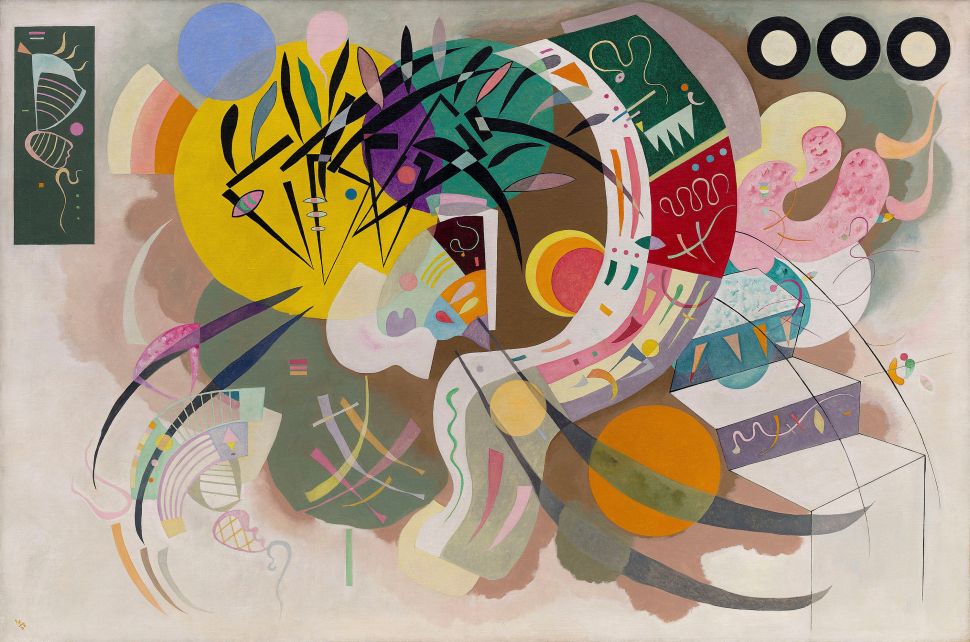
The gallery boasted 21 exhibitions in 18 months with no commercial success. It did, however, offer Kandinsky his first U.K. solo show, a fact advertised at the entry with Dominant Curve (Courbe dominante) (1936), a triumph of color and movement with that perfect level of overstimulation that one sometimes achieves when playing a video game. A few people at parties told me this was their favorite work in Venice this year and I doubted them, not being a Kandinsky guy. Exiled by the Nazis, Kandinsky created this work of curious perspective in Paris. Guggenheim’s friend and advisor Marcel Duchamp encouraged her to show him.
Her taste had to be her own, however, because how else to explain the puppets by Marie Vassilieff? These waist-high figures date to 1928 but through little more than fabric and cardboard display an inventiveness in facial construction that recalls the much later innovations of Thomas Schütte. How alien and empathetic they are! My favorite is Saint Clare of Assisi, who has a hilarious bug-eyed expression. The show came about in part through Vassilieff’s long friendship with Jean Cocteau, but these are so strange that only a visionary would show them.
She was also a supporter of Moore, whose Reclining Figure (1938, cast 1946) is a cute preview of the monumental works we’d later come to associate with him. As with all great artists, the whole thing is there in metonymic form in everything he does, and this little guy is even smaller than the puppets. Shiny and precious, he could be mistaken for her jewelry, which is shown in a nearby room. He was in good company: the sculpture show Guggenheim mounted in the spring of 1938 gathered 36 works by eight artists, Brancusi and Calder and Arp among them, and before it opened the whole thing was stuck in customs. Imported sculpture was taxable under the Import Duty Act of 1932 unless certified as art, and the director of the Tate declined to certify it. The row was reported widely and debated in Parliament. Guggenheim and the exhibition had record attendance but nothing sold. Guggenheim bought the Moore herself.