Along the border between Tribeca and Soho, there is a wave of young Japanese fashion brands, many appearing only temporarily in some of the neighborhood’s most expensive storefronts. Meanwhile, Issey Miyake has just unveiled an expansive new flagship near Madison Square Park, launching with a collaboration with Brooklyn-based Japanese artist Tomokazu Matsuyama as the first chapter of the New York store’s art program. (All this just as the yen reaches its lowest level in more than 40 years.) The takeaway is that there’s a new generation of young creators with very international backgrounds helping open Japan to the world while promoting the richness of its creative culture abroad.
It’s happening not only in fashion but also in art, as Japan attempts to catch up with its neighbors, particularly South Korea, where government support has helped drive the global prominence of its cultural and creative industries, including contemporary art. More Japanese artists are now finding international representation after years in which only a handful of megastars, Takashi Murakami and artists connected to his Kaikai Kiki studio, Mariko Mori and, of course, Yayoi Kusama, managed to reach the global stage. Even then, you could count them on one hand, particularly when limiting the selection to artists based in Japan.
The most prominent recent example is Yu Nishimura, whose market and institutional profile has risen dramatically in just a few years, culminating in representation by David Zwirner and a new auction record this May at Sotheby’s. His Leaves Carpet (2017) sold for $998,400, more than eight times its low estimate and surpassing the previous record set only a few months earlier, in November, when Thicket (2020) sold for $711,200.
Even so, Japanese artists remain significantly underrepresented in the art world’s major hubs, particularly New York. Only recently have Japanese galleries begun appearing more regularly at fairs across the city, especially on the younger end of the market. New York has very few Japanese galleries specializing in Japanese art and almost none devoted exclusively to championing contemporary Japanese talent. One of the exceptions is NowHere, which relocated this June from Soho to a larger space at 40 Lispenard Street in Tribeca.
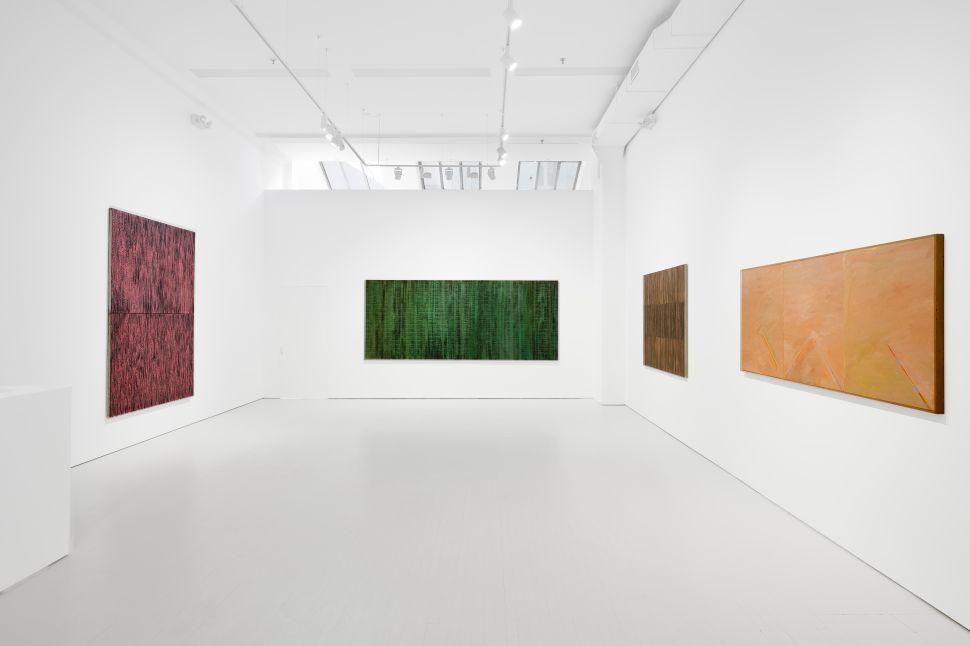
The inaugural show is a two-part exhibition dedicated to Toshihisa Yoda, a Soho-based Japanese abstract artist who has worked and exhibited institutionally in the United States, Japan and internationally for more than six decades, despite never securing gallery representation capable of building his market. The first chapter, presented in June, featured works from the 1960s through the 1990s: early geometric abstractions that reveal how Yoda adapted the disciplined, meditative mark-making of Japanese tradition into a contemporary language close to the optical abstraction or hard-edged paintings explored by artists working at the same time. Echoes and affinities one could identify span Frank Stella to Carlos Cruz-Diez or, later, even Peter Halley. The repetition of his rigorously constructed abstract forms, repeated lines, carefully controlled intervals and masking-tape techniques produces optical vibration, rhythm and a restrained sense of movement, while the hand remains visible in the accumulated brushwork. Yoda landed in New York in the 1960s, studying at the Brooklyn Museum Art School and the Art Students League at a time when Minimalism, geometric abstraction and Conceptual art were reshaping the city’s artistic language. His style clearly sits between the urge to expand the painting field shared by postwar Japanese abstraction and the Gutai movement and the influences he absorbed in New York’s downtown art scene.
His work also absorbs New York itself. Yoda draws inspiration from the city’s grid, while other paintings evoke peeling bridge paint, cast-iron facades and the weathered colors of downtown through dense vertical bands of brown and black crossed by repeated, scratch-like marks. At the same time, his disciplined mark-making and sensitivity to natural rhythms remain deeply connected to his Japanese upbringing. The result is not simply a fusion of “East” and “West” but an abstract language shaped equally by the constructed geometry of the Western metropolis and the timeless, meditative atmosphere associated with traditional Japanese mark-making.
In his more recent works from 2000 to the present, Yoda has developed an intriguing, almost cosmic sensibility, expanding the motif of origami into entangled galaxies of multiplying stellar forms or containing them within meticulously layered painted structures. Yoda’s work is held in the collections of major Japanese museums, including the National Museum of Modern Art, Tokyo; the National Museum of Art, Osaka; the Hiroshima City Museum of Contemporary Art; and the Ohara Museum of Art, as well as IBM in New York, and he has been exhibited institutionally here, including shows at the Aldrich Contemporary Art Museum.
As we walked through the show, NowHere founder Kentaro Totsuka shared with Observer how the limited international visibility of Japanese artists reflects both the dominance of Western art history and Japan’s relatively recent engagement with contemporary art as an institutional field. “In Japan, the idea of contemporary art is relatively new—perhaps only since World War II, about 80 years—compared with the much longer history in Europe and the United States,” he says.
The country’s accelerated postwar economic growth, he argues, encouraged a focus on productivity rather than culture, while corporations and wealthy collectors tended to approach art primarily as an investment. This speculative appetite helped fuel the Japanese market boom of the 1980s, but buyers mostly acquired major European names, from the Impressionists to Van Gogh, while often overlooking local artists. “Art existed, but many people saw it mainly as an investment or as something associated with wealth. For most people, it even acquired an image of being suspicious or somehow fishy—something for wealthy people, or even something connected to money laundering,” he recounts.
Even established Tokyo galleries have long operated in discreet upper-floor spaces, prioritizing privacy rather than public foot traffic, Totsuka notes. The model reflects how Japan’s gallery system has traditionally maintained a more insular and elitist character, one that has only recently begun to change.
Over the past several years, the internet, social media and a more internationally oriented generation of collectors have started to erode that insularity, Totsuka says. “Information coming from Europe, the United States and the broader Western art world became much more accessible. Younger collectors are also more international.”
Yet Japan’s shrinking younger population could limit the scale of this emerging audience. Now in his 50s, Totsuka belongs to the large cohort born around Japan’s second baby boom of 1971-1973. “My generation, or perhaps the generation just older than mine, represents one of the largest segments of the Japanese population. Since then, the population has continued to shrink. There are far fewer people now in their teens and twenties,” he says.
According to the most recent data, Japan’s population fell by more than 3 million, to 123 million in 2025, from 126.1 million in 2020. As of October 2025, Japan had approximately 9.8 million people aged 50-54, compared with 6.25 million aged 20-24 and 5.47 million aged 15-19. That year, children under 15 accounted for a record-low 11.1 percent of the population, while people aged 65 and older represented a record-high 29.4 percent.
Kentaro Totsuka’s path to founding NowHere began with his own attempt to become an artist. He moved to New York in 1997 to pursue sculpture after studying metalwork at the same university as Toshihisa Yoda. By the age of 30, however, he had abandoned the idea of sustaining himself as an artist and joined the Japanese fashion company H.P. France, which sent him back to Tokyo. Totsuka was never fully drawn to fashion and persuaded the company’s art-loving owner to establish an independent art department. Nearly 20 years ago, they opened a small commercial gallery in Tokyo, hpgrp GALLERY, focused largely on emerging Japanese artists. Although funded by H.P. France, the gallery operated autonomously, allowing Totsuka to shape its program independently. It also participated in smaller fairs across Taiwan, Hong Kong and Singapore, giving him his first sustained experience as a dealer.
The economic downturn that followed Japan’s devastating 2011 earthquake and tsunami convinced Totsuka that the gallery needed a base outside the country. After several years of preparation, he returned to New York in 2016 and opened a Tribeca branch. The venture initially performed well, but financial difficulties at the parent company forced the New York gallery to close around 2019.
<img decoding="async" class="lazyload wp-image-1684714 size-full-width" src="data:image/gif;base64,R0lGODlhAQABAAAAACH5BAEKAAEALAAAAAABAAEAAAICTAEAOw==" data-src="https://observer.com/wp-content/uploads/sites/2/2026/07/Yoda_Part1_1.jpg?quality=80&w=970" alt="A gallery entrance displays wall text for Toshihisa Yodaâs âContinuum, 1967âToday,â alongside a red-and-blue geometric painting and shelves of books and objects." width="970" height="647" data-caption='<p>NowHere <span class="lazyload iNqyIf" data-sfc-cp="" data-sfc-root="ep" data-complete="true" data-copy-service-computed-style="font-family: Google Sans, Arial, sans-serif; font-size: 16px; font-weight: 400; margin: 0px; text-decoration: none; border-bottom: 0px rgb(10, 10, 10);"> hosts exhibitions, retrospectives and multidisciplinary projects featuring Japanese artists—particularly those building practices in New York.<noscript><img decoding=”async” class=”lazyload wp-image-1684714 size-full-width” src=”https://observer.com/wp-content/uploads/sites/2/2026/07/Yoda_Part1_1.jpg?quality=80&w=970″ alt=”A gallery entrance displays wall text for Toshihisa Yodaâs âContinuum, 1967âToday,â alongside a red-and-blue geometric painting and shelves of books and objects.” width=”970″ height=”647″ data-caption=’ data-sfc-cp=”” data-sfc-root=”ep” data-complete=”true” data-copy-service-computed-style=”font-family: Google Sans, Arial, sans-serif; font-size: 16px; font-weight: 400; margin: 0px; text-decoration: none; border-bottom: 0px rgb(10, 10, 10);” hosts exhibitions retrospectives and multidisciplinary projects featuring japanese artists those building practices in new york.></span> <span class=”media-credit”>Photo: Go Sugimoto</span>’>NowHere emerged from Totsuka’s friendship with a New York-based Japanese businessman who wanted to support young creators but lacked a structure for doing so. Together, they eventually developed a gallery and café dedicated to New York-based Japanese artists. The name captures the gallery’s mission. “They were ‘nowhere’ yet—they had not reached anywhere. But when they had a show with us, they were here now. We were offering a place, a venue and an opportunity.”At NowHere, the collector base is largely local and not necessarily Japanese, with neighborhood visitors occasionally purchasing works in the $8,000-10,000 range, Totsuka says. The gallery is still seeking deeper relationships with major collectors and museums, particularly after pandemic closures and a year-long relocation interrupted its early development.
Totsuka sees the current exhibition of Toshihisa Yoda as emblematic of the market’s structural gaps. “I believe his work is of museum quality, and more museums in Japan and the United States should collect it,” he says, noting that, despite Yoda’s career of roughly 60 years, his market value must effectively be built from zero. “That is difficult. Major national museums in Japan have his work in their collections but there is a huge gap, and figuring out how to bridge it is one of my current challenges.”
Younger Japanese artists may be easier to introduce to the American market. To support them, Totsuka also founded Aware Works LLC, a New York- and Tokyo-based art management office specializing in promoting and managing emerging Japanese artists. NowHere also operates a Brooklyn studio program that gives one artist free workspace for part of the year in exchange for a later presentation at the gallery.
The new generation of Japanese artists is particularly adept in fields such as digital and new-media art, combining technology with conceptual thinking, Totsuka argues. At Future Fair in May, the gallery presented an ambitious solo booth featuring technological assemblages by the Japanese duo exonemo, extending their research into generative systems and randomness, understood not as noise or disorder but as a fundamental condition of existence.
In Hach/et., a group of computers performed the real-world task of randomly guessing passcodes. The moment a code was solved, a hatchet mounted above the system destroyed the computer in a single irreversible act. The Sisyphean, paradoxical labor exposed technological systems as living structures of entropy, where function, failure and transformation become part of the same vital cycle. The duo will present a more complex, monumental installation in an exhibition opening at NowHere in September.
According to Totsuka, these emerging technological and media-oriented aesthetics, so far removed from the country’s centuries-old artistic traditions, reflect Japan’s repeated historical ruptures. “Japan has a very long history—around 2,000 years—and a rich tradition of craft, painting, materials and making. But that history can feel so old that we do not necessarily experience it as our own,” he reflects, noting that Japan closed itself off from much of the outside world for centuries before American ships forced the country to open and Westernization transformed its culture. “Each time our culture and history were interrupted and renewed, Japanese people were, in a sense, reborn into a new society.”
Even when younger Japanese artists appear to outsiders to be drawing on ancient traditions, they may experience themselves as entirely contemporary and disconnected from that lineage. When asked to identify other tendencies, Totsuka points to a broader return among Japanese contemporary artists to physical materials, craft and technique. Artists may use A.I., computers and 3-D modeling during development, yet ultimately produce tactile, material objects, revitalizing acts of making without simply reproducing tradition.
The gallery’s current resident at its Dumbo studio, for instance, is performance artist and puppeteer Maiko Kikuchi, who creates masks, costumes and stage environments while working through storytelling and acting. She will present at NowHere next year and is currently using the studio to prepare a major theater project for Japan Society in October, marking an early institutional collaboration for the gallery.
With NowHere, Totsuka is intentionally focusing on Japanese artists who have committed to building their lives in New York, and by reducing the gallery’s program to approximately four exhibitions a year, he can devote more sustained attention to building and supporting each artist’s career while bringing greater American and international attention to their practices. There are artists across several generations living in the city, he says, but the challenge is identifying those with the body of work, maturity and readiness required for a full exhibition. “I committed to New York, and the owner of NowHere committed to New York, so we want to support artists who have made the same commitment.”