
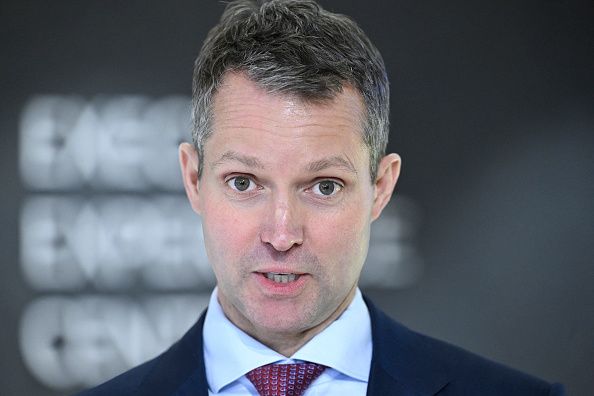
Nokia CEO Justin Hotard facing the camera in a navy suit, light blue shirt and burgundy patterned tie, with blurred lettering behind him.” width=”594″ height=”396″ data-caption=’Nokia CEO Justin Hotard at the company’s Executive Experience Centre in Espoo, Finland, during an Oct. 27 visit by Sophie, Duchess of Edinburgh. On Nov. 18, VodafoneThree announced plans to test whether the wireless equipment Nokia is developing with Nvidia can carry more traffic over the same airwaves. <span class=”lazyload media-credit”>Photo by Heikki Saukkomaa / Lehtikuva / AFP via Getty Images/Finland OUT</span>’>
Nokia CEO Justin Hotard has another carrier willing to test the network equipment he is developing with Nvidia. VodafoneThree announced on Nov. 18 that it would start in a U.K. lab, then move to selected sites. About 20 carriers are working with Nokia and Nvidia on the technology, Nokia finance chief Marco Wirén told investors in Barcelona on Nov. 19. Hotard still has to turn that interest into an order.
Hotard took over Nokia in April 2025 and announced the agreement with Nvidia in October 2025. The chipmaker’s $1 billion equity investment was completed on Nov. 13, 2025, giving it a 2.9 percent stake in Nokia at the time. The partnership covers A.I.-enabled radio networks and data center networking.
VodafoneThree will benchmark the results against its existing network, looking for gains in capacity, reliability and how efficiently it uses its spectrum. The trial will also explore running radio-network and A.I. workloads on shared computing hardware.
At the Oct. 28, 2025, announcement, Hotard said the partnership would “put an AI data center into everyone’s pocket,” with the next leap in telecom not simply a move from 5G to 6G but a fundamental redesign of the network to deliver A.I.-powered connectivity, processing intelligence from the data center to the edge.
This year, Nvidia and Nokia are applying A.I. within the part of a 5G network that manages the wireless connection between phones and the rest of the network. Their A.I.-enabled radio access network, or A.I.-RAN, uses Nokia’s anyRAN software running on Nvidia’s Aerial RAN Computer. It is designed to help operators carry more traffic over existing airwaves.
On Oct. 21, Nokia announced what it called the world’s first A.I.-RAN call at a commercial cell site. The call was made over T-Mobile’s live production network using Nokia Massive MIMO radio, Nokia 5G anyRAN software and server infrastructure built on the Nvidia Aerial RAN Computer platform.
“AI-RAN represents a fundamental shift in what our network can do. Beyond making it smarter and more efficient and unlocking greater capacity from our existing spectrum, we’re exploring how AI and connectivity can come together on shared infrastructure, creating a platform for distributed intelligence that can power new applications like Physical AI and lay the groundwork for AI-native 6G,” Grant Castle, T-Mobile’s senior vice president of radio access network engineering and emerging technologies, tells Observer in an email.
What carriers are testing
One selling point for Hotard’s team is more capacity from spectrum operators already own. Deutsche Telekom, Nokia and Nvidia reported typical uplink throughput gains of 10 to 15 percent in initial lab measurements using A.I.-based channel estimation, with field validation planned next. In the U.S., Nokia said the next T-Mobile phase would extend field trials to more A.I. radio functions and workloads.
The pair have also seen wider customer interest this year. Finnish telecommunications provider Elisa ran voice, mobile data and video analytics simultaneously over an A.I.-RAN platform on its 5G network in Helsinki. Nokia said it expected to evaluate commercial A.I.-RAN services in 2027. Hotard’s team has also agreed with SoftBank Corp. to conduct an A.I.-RAN field trial on the Japanese operator’s commercial network in 2027.
BT is preparing a live-network trial in Birmingham, England, in 2027, while Orange plans to test the technology in both lab and real network conditions.
Jensen Huang, then Nvidia’s CEO, called telecommunications “the digital nervous system of our economy and security” in the Oct. 28, 2025, announcement.
Huang resigned on Nov. 12, and Colette Kress took over as Nvidia’s interim CEO. The board said it expected customer commitments and the product roadmap to continue without interruption. Nokia said its strategic partnership with Nvidia “continues as planned” in a Nov. 16 statement to Fierce Network. Nvidia also highlighted the Nokia alliance and T-Mobile call in its Nov. 17 earnings release.
The first 6G specifications are targeted for early 2029, Ericsson’s standardization specialists wrote in June, describing the schedule agreed by the Third Generation Partnership Project, the standards group known as 3GPP. Wirén said Nokia aims to launch the equipment commercially at the end of 2027 and sell it to carriers from 2028. For Hotard, the nearer test is whether the planned 2027 trials can give operators a reason to buy the equipment for wider use.