
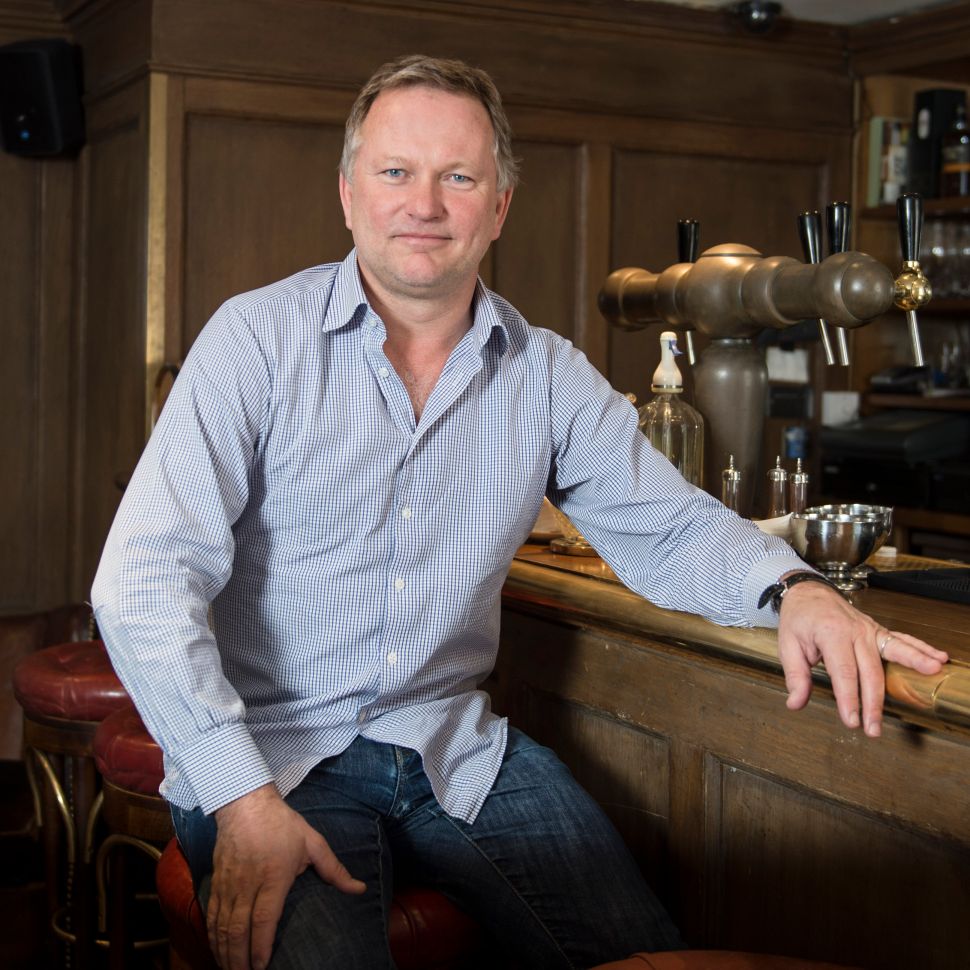
Nick Jones. ” width=”970″ height=”970″ data-caption=’Nick Jones is drawing on longstanding property and design partnerships for a smaller venture after building Soho House into a global business. <span class=”lazyload media-credit”>Courtesy Cecconi's</span>’>
Nick Jones, founder and former CEO of Soho House, is bringing the relationships and reputation he built over three decades to a smaller London venture, St. Clement. He made his name capturing places imbued with a cool sense of understated refinement. Now he is applying that instinct to a hotel—clubby, but without the clubcard.
Jones opened the first Soho House club outpost in 1995 in London’s Greek Street, which combined fine bistro food and Georgian townhouse surroundings with an easy, collegial atmosphere. What followed across the next 20 years was a successive unfolding of more Soho House clubs and a succession of brand extensions that included spas, health clubs, workspaces, the homewares business Soho Home, and a litany of collaborations with designers and contemporary artists.
Soho House returned to private ownership in January 2026, following an agreement valuing the company at about $2.7 billion including debt. Jones had already stepped back from his role at Soho House in 2022 when he was diagnosed with prostate cancer, so his return to the hospitality business is not only significant in a personal sense (he has said he is cancer-free), but also from a business perspective in such a competitive sector. Brian Clivaz, the chairman of L’Escargot restaurant and the eminence grise of many elite London hospitality venues and companies, sums up Jones’ decision to return. “Running a global group is a world away from running your own place. St. Clement lets Nick stamp his own personality on a building and a business, from the decor to the food.”
The challenge of creating something recognizably Jones, yet separate from Soho House, is perhaps inevitable. His influence on today’s hospitality scene has been considerable, with a deft combination of eclectic interiors, informality and cultivated exclusivity that’s all pervasive and much sought after. There is, however, another ingredient in his success that’s difficult to replicate: his reputation. In the hospitality sector, personal relationships and the loyalty of guests are just as valuable as the properties themselves, especially in the disappearance or closure of an established company, as Clivaz describes.
The partners behind the venture
St. Clement forms part of the wider 180 Quarter development. The hotel is at 180 The Thames, distinct from 180 The Strand, the sizable Brutalist property that has birthed a creative and cultural quarter in its own right. The latter houses a Soho House outpost, alongside offices, studios, event spaces, cafés and restaurants. Like the media types of Soho in 1995, Jones has identified and tapped into a community that already exists.
Much of this transformation has been down to property developer and entrepreneur Mark Wadhwa, who bought 180 The Strand around a decade ago and has overseen its gradual transformation. Tellingly, Jones and Wadhwa have previously worked together on Soho House Berlin and the building’s 180 Studios, so their shared understanding of hospitality and sense of place has complemented Jones’s vision.
Such close relationships also extend to the hotel’s interiors. Eagle + Hodges, the design studio charged with creating St. Clement’s distinctive look and feel, was founded by Sophie Hodges and Alex Eagle, who is married to Wadhwa. The brief was simple: Not to reproduce the Soho House formula, but to create something that felt both familiar and new. The Savoy without the stiff collars.
“Nick is a maximalist at heart, and Sophie and I are much more minimal,” says Eagle. “The balance between the two is what makes it special. If there was a ‘North Star’ for the design and feel, it was keeping Nick’s generous spirit while making everything more distilled.” That balance is evident throughout the hotel. In the lobby, a large Richard Horwood map of London from 1799, sourced by Eagle, sits alongside a mix of midcentury Eames-style tables and Mario Bellini-designed Cab chairs. Coffee-table books run from Jean-Michel Basquiat to Helmut Newton, with a touch of rock ’n’ roll in the Epiphone EB3 SG-style bass guitar propped up by the marble fireplace. Excess isn’t really on the menu here, though.
“We wanted a hotel that could only be here, on this stretch of the Thames, in this building,” explains Eagle. “Sophie and I have always believed in letting the furniture speak for itself, giving beautiful things room to breathe. It’s about understanding the bones of a building, respecting its architecture and allowing its character and soul to come through, rather than trying to impose something on it.”
A following that travels
“Some people can spend years building a business and creating a great brand, only to lose it and start again, but often the second act trumps the first,” Clivaz says. He points to Robin Birley’s later businesses, including 5 Hertford Street and Oswald’s. “His success shows that the appeal of a hospitality business can reside as much in the individual behind it as in the name that’s above the door.”
Restaurateur Jeremy King is another example of someone whose career has included the successes of The Ivy, The Wolseley and The Beaumont, but who has faced well-publicized business challenges, including being forced out by shareholders or disputes with landlords.
“King is perhaps the greatest example of tenacity. His career has had more than its share of setbacks,” says Clivaz. “Yet over all those years his personal capital, his own brand, kept growing. What unites these two, and Nick, is the men themselves, their charm and good taste, their good judgment and the loyalty of their staff. They work in a profession where guests follow people, and that is one thing that can’t be taken away from them.”
Jones told Mr Porter in June that he had no plans for a second St. Clement, although The Times reported in October that he had joined a separate Horseshoe pub venture with Daniel Craig and other partners. For Jones, though, the hotel seems more personal, telegraphing and encapsulating his instincts for good design, great company, and the purest of fun times, where the inherent pleasure of hospitality trumps expansion. If the careers of Robin Birley and Jeremy King are anything to go by, then the most valuable asset isn’t just the name above the door, but the person who put it up there—even in one of the most culturally savvy cities in the world.