
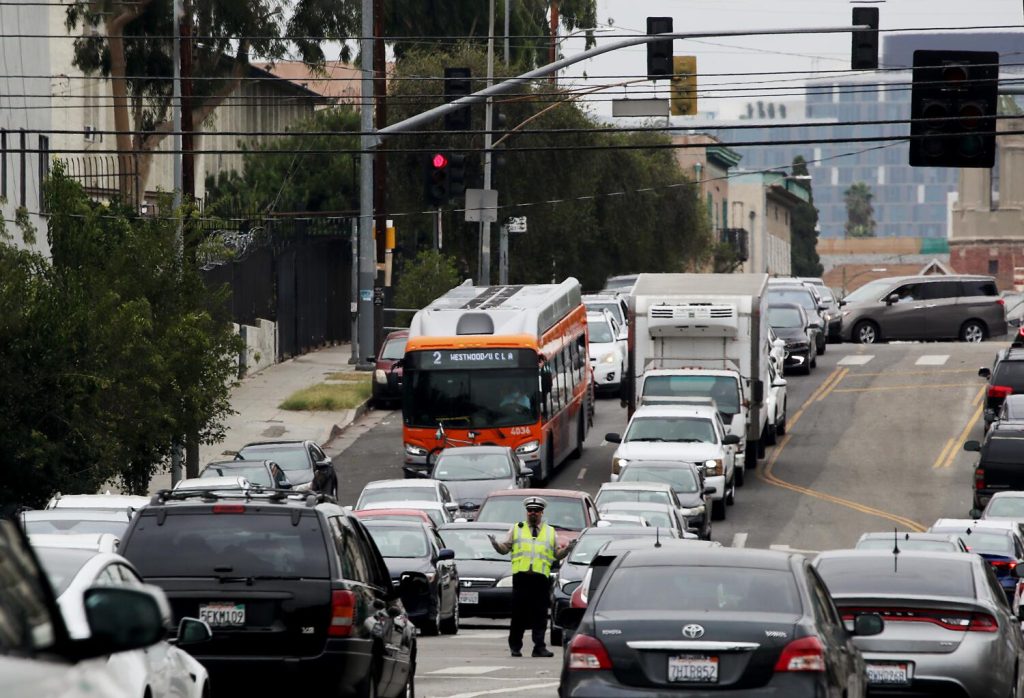
On a recent weekday afternoon, cars were already parked bumper to bumper along the residential streets near Pico Boulevard. On the boulevard itself, parking spots were filling up as drivers hurtled down the busy roadway.
The corridor is lined with small businesses: neighborhood markets as well as nail salons, repair shops, sign makers and restaurants.
Business owners say they recognize that Pico Boulevard has a speeding problem and can be dangerous for pedestrians.
The Los Angeles Department of Transportation wants to make the corridor safer for pedestrians, bicyclists and drivers. But that will come at the expense of 228 parking spots, which are already hard to come by in the neighborhood.
LADOT is set to overhaul 3.5 miles of Pico Boulevard between Crenshaw Boulevard and Figueroa Street to reduce speeding and unsafe turns and lane changes. The agency says the project is intended to improve safety by adding a center turn lane for left turns and emergency vehicles, protected bike lanes and new “two can cross” traffic signals at Manhattan Place and New Hampshire Avenue. The transportation department also will repair sidewalks and curb ramps.
To make room, the city will remove parking on the north side of the street and reduce travel lanes from two to one in each direction. Construction is set to begin by the end of the year.
City officials say the changes are needed after years of serious crashes. Between 2014 and 2023, 75 crashes on this stretch of Pico resulted in severe injury or death. Nearly three-quarters involved people walking or riding bicycles, and all 11 people killed were pedestrians, according to LADOT.
Jose Gonzalez, owner of Jagarhaus, a gallery and event space that has been in the neighborhood for six years, supports most of the city’s proposed improvements. But removing a full side of curb parking from a narrow commercial street does not make sense to him
Joey Bang, who has run Sign Art on Pico for two decades, said parking is already difficult for both businesses and residents nearby.
“There already isn’t enough parking,” Bang said. “Even residents of this neighborhood park here in front because there isn’t enough parking. If they get rid of the parking out front, business will go down so much.”
Bang said he had not received any communication from LADOT before a visit last month from department representatives who told him about the project.
Bang said he’d be on board if Pico were a wider street. He’s also concerned about how construction will affect his business.
“Small businesses are already struggling,” he said. “If this goes through, Pico as we know it will come to an end.”
The city Department of Transportation began outreach in May 2025 and spent about a year gathering feedback from businesses and residents, according to spokesperson Colin Sweeney. The agency said it went door to door, mailed notices to 1,842 nearby addresses, distributed door hangers, met with the Byzantine Latino Quarter Business Improvement District, emailed stakeholders, conducted surveys and shared information online. Outreach materials were available in English, Spanish, Korean and K’iche’.
LADOT said it reached more than 2,500 people, with 75% of survey respondents favoring a design that includes protected bike lanes.
Construction will be completed in phases over about a year. Sweeney said the city would notify residents and businesses before work begins, and LADOT will provide traffic control and detour assistance during construction.
The project is one of the major street redesigns moving forward as Los Angeles implements Measure HLA.
Lorenzo Martinez, owner of Olympic Tools, learned about the project in June when someone brought him a flier. Martinez has a few parking spaces behind his business, but said trucks still need to stop in front for deliveries.
“If trucks cannot park in the front, that will affect me,” Martinez said. “I like how it is now. I don’t really see a lot of bikes out here. I want it to stay as it is.”
Sweeney said LADOT is still making adjustments to the project, including adding loading zones, creating more parking on the south side of Pico and nearby streets, relocating some bus stops and identifying additional ADA-accessible parking. Peak-hour parking restrictions will also be removed.
Fashion designer Galadriel Mattei owns a brick-and-mortar clothing store on the same long block between Union Avenue and Bonnie Brae Street.
She said the lack of alleys and limited places to cross the street already make it difficult for customers to reach her business, particularly older adults and people with disabilities who need to park nearby.
She also worries customers will end up parking deeper in the neighborhood, adding pressure to already crowded residential streets.
“With neighborhoods like this that are so densely populated, it is really always a fine line with how the businesses interact with the people who live here,” Mattei said.
A cyclist herself, Mattei said she doesn’t oppose bike lanes or other safety improvements. She agrees that drivers often speed along Pico and that the street can be dangerous for pedestrians. But her concern is that the city’s design doesn’t account for how the block actually functions.
During the school year, parking on the north side of Pico is restricted for several hours each day for student drop-offs at a nearby school, she said, forcing drivers onto her side of the street.
Hanna Kang writes for the L.A. Local, a nonprofit newsroom serving Los Angeles communities.