Arles has established itself as an essential summer destination for art lovers touring the South of France. What makes it an unmissable stop is not only the annual Les Rencontres d’Arles, one of the world’s most important international photography festivals, but also the growing number of foundations and institutions that have opened in the city in recent years. While the Fondation Vincent van Gogh has long anchored Arles’s contemporary art scene, bringing international artists into dialogue with the French master, the arrival of Maja Hoffmann’s LUMA Foundation in 2013 expanded the city’s offerings to include more new media art, with ambitious exhibitions and installations unfolding inside Frank Gehry’s spaceship-like, fractured-metal Tower and throughout the surrounding park. In 2022, South Korean artist Lee Ufan also opened his own foundation in the Hôtel Vernon, a historic mansion in central Arles.
This summer, another foundation is further enriching Arles’s rapidly expanding art scene, as renowned French artist Jean-Marc Bustamante opens Fonds Bustamante in the 12th-century Église Sainte-Croix in the city center, newly adapted to serve as an exhibition space and cultural hub under the direction of architect and designer Charles Zana.
At the core of its programming are three principal aims. The first is to preserve Bustamante’s prolific body of work, library and archives by bringing them together under one roof and making them accessible to a wider public. Bustamante, however, did not want to create a mausoleum for his own oeuvre. Instead, he envisioned a space open to other artists, foregrounding creative practices across disciplines and media, highlighting untold stories and reassessing historical narratives. The foundation will also mark the culmination of his 30-year commitment to education, functioning as a year-round cultural and educational hub through a series of master classes, conferences and symposia bringing together artists, academics and the public.
“As an artist, I saw this as a good opportunity because I am an artist, but I also like organizing exhibitions,” Bustamante told Observer ahead of the opening. “Given today’s global situation, it is important for artists to find ways to support one another. There are so many artists coming from so many different countries, and it is important to create connections among them.”
“En Miroirs“
Artists: Various
Venue: Fonds Bustamante Arles
Address: 27 Rue de Chartrouse, 13200 Arles
Through: October 30, 2026
For Bustamante, the project extends naturally from his parallel history as an artist, educator and exhibition organizer. He has been a pioneering presence in the French and international art scenes since the 1970s, with a multilayered practice spanning photography, sculpture and painting. He represented France at the São Paulo Biennial in 1994 and the Venice Biennale in 2003, and participated in three editions of Documenta in Kassel, in 1987, 1992 and 1997. He has also exhibited at major institutions worldwide, including the Yokohama Museum of Art in Japan, the Van Abbemuseum in Eindhoven and the Musée d’Art Moderne de la Ville de Paris. There’s a retrospective of his work planned at the Ludwig Museum Koblenz for November 2026.
Bustamante is represented by Thaddaeus Ropac, Galerie Bärbel Grässlin, Galerie Vera Munro and Galleri Susanne Ottesen. Having directed the prestigious École Nationale Supérieure des Beaux-Arts in Paris from 2015 to 2018 and served as artistic director of both the Toulouse International Art Festival and the Printemps de Septembre festival from 2004 to 2006 and again from 2012 to 2014, he sees the foundation not simply as a repository for his own work but as an active platform where artists from different countries and generations can meet, exhibit and exchange ideas.
“It is not entirely an ego trip,” he said, emphasizing that the foundation was never intended as a self-enclosed monument or a posthumous exercise but rather as a way of preparing for the future. In an art world where galleries represent increasingly large rosters, he believes artists must take a more active role in defending and contextualizing their own work. “With a group of friends, we found this place and imagined something independent and autonomous, where we could present art we like in relation to my own work.” He compares his oeuvre to a fourth child alongside his three daughters: something that requires care if it is to survive.
Arles was an especially meaningful choice for Bustamante. His early work was rooted in photography, which he learned in Provence. He was also among the first artists to participate in the Rencontres d’Arles, at a time when the medium was still struggling to gain full recognition as art. In more recent years, the city has developed into a dense cultural hub through the continued growth of the photography festival, the arrival of LUMA Arles and the emergence of a successful drawing festival associated with Vera Michalski. “It has created something like the Bilbao effect associated with Frank Gehry,” Bustamante asserted. Within this extraordinary context, he decided to open an institution that would operate not only during the summer season but throughout the year. “We want to establish a real foundation with many activities connected to the city and the region, expanding the city’s international cultural reach.”
The building connects with the city’s history and atmosphere, preserving different layers of its past. Deconsecrated during the French Revolution, the Église Sainte-Croix gradually lost its architectural harmony and spatial flow through a succession of transformations. Zana’s project restored its balance by drawing on the collective memory of the generations that inhabited the building. The renovation revived traditional techniques, including limewash, terrazzo flooring and the use of Arles stone, while introducing shades of beige, yellow and pink that echo the landscape of the Camargue.
The façade is adorned with a frieze by Bustamante himself, composed of unique yellow tiles made from enameled lava and produced in Salernes by a family of master ceramicists whose practice dates to the 1880s. The radiant yellow tones are intended as a tribute to Van Gogh’s iconic palette. Bustamante has also invited internationally renowned artist Cristina Iglesias to create a monumental cast-aluminum and glass sculpture: soaring over four meters high across the double-height walls of the first floor, it furthers the dialogue between art, architecture and Arles’s rich cultural legacy.
The supervisory board and scientific committee include leading figures from the French and international art worlds: Camille Morineau, co-founder and director of AWARE (Archives of Women Artists, Research and Exhibitions); Olivier Gabet, director of the Department of Decorative Arts at the Musée du Louvre; Katia Baudin, director of the Kunstmuseen Krefeld; Éric de Chassey, director of the École Nationale Supérieure des Beaux-Arts de Paris; Jean-Pierre Criqui, curator of contemporary art at the Centre Pompidou; Penelope Curtis, art historian and former director of Tate Britain; and Thierry Leviez, director of Pavillon Bosio, Monaco’s École Supérieure d’Arts Plastiques.
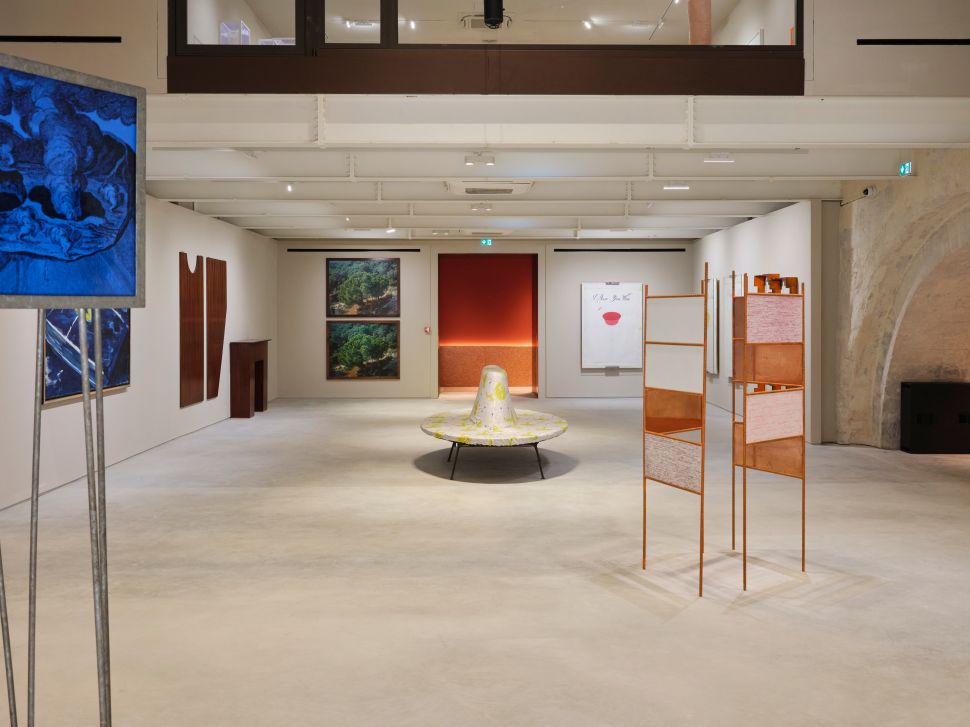
For the inaugural exhibition, Bustamante deliberately rejected a solo presentation and instead invited artists from different generations who have played an important role throughout his life and career, particularly figures connected to the artistic networks he developed in Germany, the Netherlands and Belgium. “The exhibition is conceived as a confrontation between different generations and among affinities I have shared throughout my life: movements, exhibitions, ideas and particular ways of thinking about what art is today,” he explained.
On through October 30, “En Miroirs” brings together artists spanning the end of the avant-garde movements to the present day, including Cristina Iglesias, Alice Anderson, Gerhard Merz, Rémy Zaugg, Rodney Graham, Reinhard Mucha, Jan Vercruysse, Franz West, Thomas Schütte, Michael Buthe, René Daniëls and Mariella Simoni. “We decided to mix disciplines—painting, photography, video and sound,” Bustamante added. “I want to open up a landscape of my affinities and my taste, a view of what art means to me today.”
One of his concerns was that Arles remains more strongly associated with photography, and that its photography audience does not always have the same relationship to contemporary art. “It’s a different public, in some ways broader and more popular,” he noted, pointing to the success of the drawing festival now taking place in the city. “Drawing and photography speak directly to people today, perhaps because their tools seem relatively simple or familiar.”
Fonds Bustamante Arles is backed by a circle of friends and partners, but the artist acknowledged it will still require a balanced operating model. Renting the building for events may form part of that strategy. They will have to see how audiences respond, Bustamante said, but he expects to attract a large and varied public, and the program will be developed with that diversity in mind. He also recognizes the city’s intense seasonality: attracting visitors in summer is one thing, but the greater challenge will be building a returning local and regional community year-round.
Most important to him is preventing the foundation from becoming a place people visit once and forget. Its success, he argued, will depend on keeping the space active and continually producing exhibitions, encounters and programs that give audiences a reason to return. “It is important for the place to remain vivid and active, and to keep producing things that people want to encounter.”