
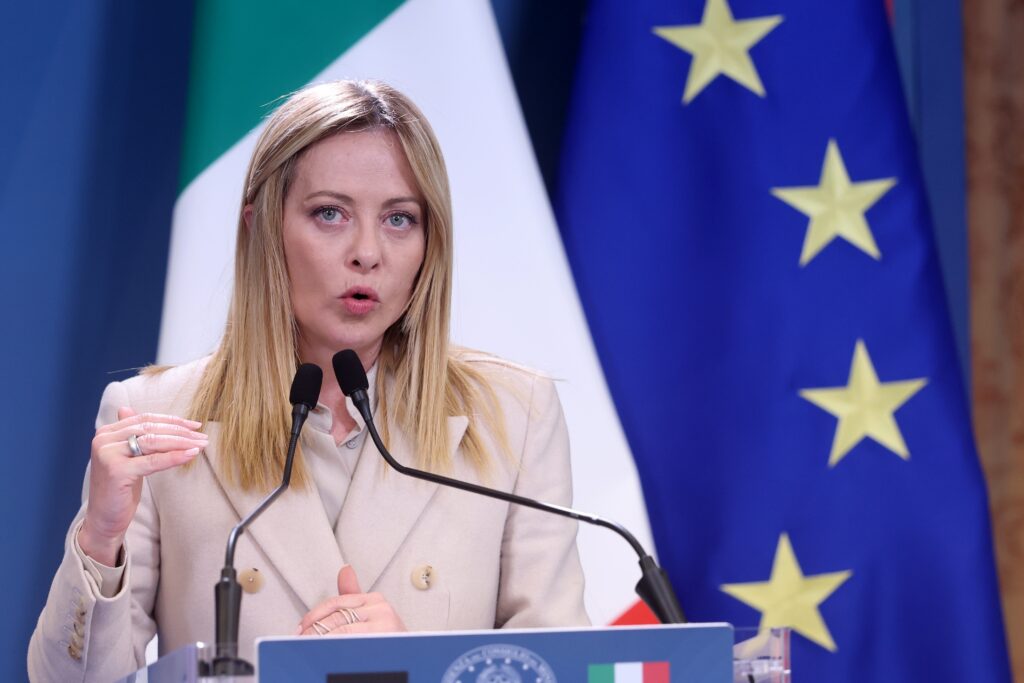
Italian Prime Minister Giorgia Meloni announced the plans on Sunday. Photo credit: Marco Iacobucci Epp/Shutterstock
If you have children at school in Spain, you may soon find yourself watching what happens in Italy rather closely, particularly if your local classroom already has pupils from several different countries. Italy is preparing a new measure that would put a legal limit on the number of foreign students in each class, raising the question of whether Spain could eventually consider something similar.
Italian Prime Minister Giorgia Meloni announced the plans on Sunday, September 20, saying the measure would soon go before the Council of Ministers. The proposed package would also require parents of foreign pupils experiencing serious difficulties integrating into the Italian school system to learn Italian.
Italy already has a 30 per cent limit
The government has not yet said exactly how many foreign pupils would be allowed in a single classroom. Meloni said the intention was to prevent Italian children from becoming a minority in their own classrooms and argued that integration becomes more difficult when large numbers of pupils do not speak Italian but the proposal is not starting from a completely new idea.
Most Read on Euro Weekly News
Italy already has a rule dating from a ministerial circular which set a 30 per cent ceiling for pupils who are not Italian nationals in ordinary classes. However, the existing limit has not been consistently implemented, with Education Minister Giuseppe Valditara saying earlier this month that legislation was needed to make the limit effective.
The new proposal would therefore move the issue from a largely administrative guideline towards a legal requirement. There is an important distinction, though. Being a foreign national does not necessarily mean a child cannot speak Italian. Equally, a child born in Italy to foreign parents may speak Italian perfectly well. That makes the exact details of any future law particularly significant.
Spain already has its own classroom debate
Spain is not currently proposing an Italian-style nationality quota. Instead, the Spanish Government is progressing legislation aimed at reducing the overall number of pupils in classrooms. The proposed law would establish maximum class sizes of 22 pupils in Primary education and 25 in compulsory secondary education, with the changes due to be introduced gradually from the 2027-28 school year and fully implemented by 2031-32. Spain also has a substantial foreign-pupil population.
According to Spain’s Ministry of Education, 1,125,860 foreign students were enrolled in the non-university education system during the 2024-25 school year, representing 12.9 per cent of all pupils. The proportion varies considerably between regions, reaching 19 per cent in the Balearic Islands and 18.5 per cent in the Valencian Community. Those figures do not mean that foreign pupils are concentrated in individual classrooms, but they show why classroom composition can be a particularly relevant issue in some parts of Spain.
Could Spain introduce a similar limit?
There is currently no indication in the Spanish Government’s classroom-ratio legislation that it intends to introduce a maximum number of foreign pupils per class. The proposal currently before Parliament deals with the total number of pupils, regardless of nationality. That could change in the future if Spain decided to examine the Italian approach, but there is no announced Spanish measure equivalent to Meloni’s proposal at present.
For parents, teachers and schools, the practical question will be what Italy actually puts into law. Until the Italian Government publishes the legislation, there is no confirmed number for the proposed cap and no way of knowing exactly how schools would be expected to distribute pupils between classes. The Italian proposal therefore remains just that for now: a measure announced by Meloni, rather than a new classroom rule already in force.