
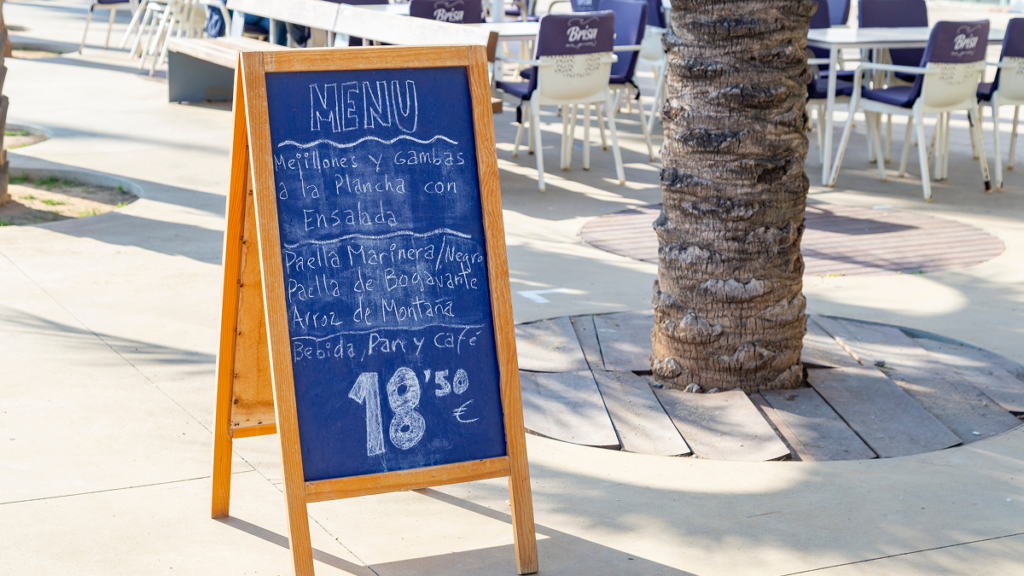
A chalkboard set lunch is a familiar sight outside restaurants across Spain, but could be slowly disappearing. Credit: Kauka Jarvi / Shutterstock
Diners tucking into the menú del día, Spain’s famous and well loved weekday lunch, are now paying 50 cents more than a year ago, with the average at €14.70 across the country. However, prices still run from €13.50 in Murcia and the Canary Islands to €16.30 in the Basque Country, and almost half of restaurants also offer a smaller ‘medio menú’ that’s meant to keep the bill down.
The average menú del día is up 50 cents in a year
Spain’s favourite weekday lunch has been slowly creeping up across the country to an average of €14.70, according to the latest survey from the national hospitality association and meal-voucher firm Edenred. That’s up from €14.20 last year, a rise of 3.5 per cent.
Fifty cents may not seem like a massive rise or ruin anyone’s day on a single visit, but it soon adds up for regulars. If you’re a Spanish worker or someone that likes to indulge in the pleasure of a menú del día at least once a week, the new rise would add about 52€ to your yearly bill, assuming the national average and a regular weekly visit.
Most Read on Euro Weekly News
Edenred Spain’s managing director, Antoine Blanc, said the study shows eating out during the working day “costs more today than it did a few years ago”. Hostelería de España president José Luis Álvarez Almeida described the menú as still being “a practical, healthy and varied solution” born in Spain.
Where the menú del día still costs less
From the survey, it was found that diners in Murcia and the Canary Islands get the best deal, with an average of €13.50, while Andalucía, Extremadura and Asturias come in at around €14.
At the other end, the Basque Country is dearest at €16.30, followed by the Balearic Islands at €16 and Cataluña at €15.70. Prices in the Balearics and the Valencia region held steady over the past year though.
Those gaps don’t necessarily show a huge difference, but over the period of a year, as we saw before, the amount can rise quickly. Someone having a weekly menú in the Balearics instead of Murcia would pay about €130 more over a year.
Four million menús are still served every weekday
The tradition is far from finished though, with about four million menús still served each weekday, although recent trends show many Spaniards now grab a quicker lunch, whether that’s food brought from home or a supermarket ready meal. Rising energy and food prices are also making it harder for small, family-run restaurants to offer a rotating daily choice.
Food journalist Lakshmi Aguirre, who has written a new book on the menú, said Spaniards “feel a sense of nostalgia as we realise it’s fading away”. It’s an unlikely ritual in many ways, as it began as a tourist menu dreamed up in the mid-1960s by Manuel Fraga, the information and tourism minister under the dictator Francisco Franco, before being rebranded for Spaniards themselves in the early 1970s.
Nearly half of restaurants now offer a ‘medio menú’
Restaurants are adapting too. The survey found 47.1 per cent offer a medio menú (a half menu), giving customers a way to trim portions and spending without giving up the habit. Some are also turning to a cheaper ‘dish of the day’ (plato del día) instead of the traditional choice of three or four courses.
Takeaway is catching on as well, with 68.7 per cent of those businesses who answered that question saying they offer a menú to take away, while 84.9 per cent serve traditional cooking at least one day a week.
It doesn’t seem like the menú del día will be completely disappearing anytime soon, but with rising prices and people becoming more and more used to ordering online and watching their wallets during the week, it begs the question: how long will it last?