
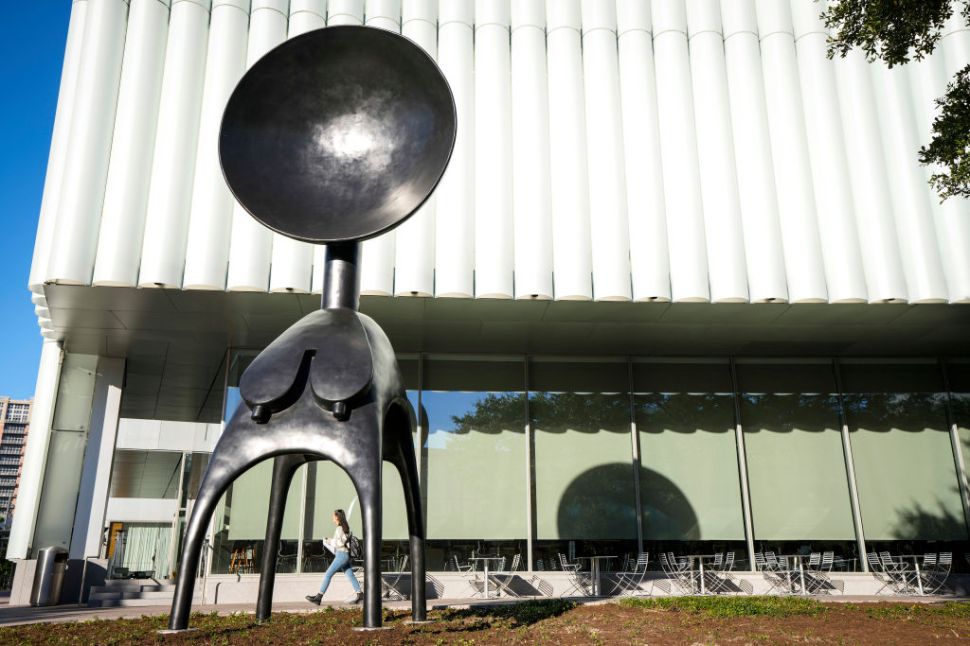
One of the newest acquisitions for the Cullen Sculpture Garden at the Museum of Fine Arts, Houston, is Simone Leigh’s 24-foot-tall bronze semi-figurative work Satellite, likely titled for the head of this four-legged Ashanti-influenced female figure that resembles a satellite dish. That dish-shaped head could easily catch the wind and get knocked over, especially during tornado and hurricane season, which traditionally extends from May through November, “and the intensity and frequency of these have been getting worse every year,” Per Knutas, the museum’s head of conservation, told Observer. “Climate change has brought more destructive heat and tropical storms.”
Man-made climate change, the result of ever-increasing emissions of carbon dioxide and other greenhouse gases that warm the earth’s atmosphere, will impact life all over the planet, according to scientists. The Intergovernmental Panel on Climate Change predicts increasing heat waves, longer warm seasons and shorter cold seasons across the globe, bringing more intense rainfall and associated flooding, as well as more intense drought in many regions, sea level rise in coastal areas, increased acidification and reduced oxygen levels in the oceans.
Outdoor-sited public artworks are expected to suffer along with the rest of us. At Grounds for Sculpture, a nonprofit sculpture park and arboretum in Hamilton, New Jersey, the largest environmental concerns are heat and insufficient rain. “Hotter summers mean our team may not be able to properly apply wax which provides a protective barrier on bronzes,” director of collections and exhibitions Faith McClellan told Observer. “Last summer we also had drought restrictions on water usage, which limits our ability to tap into the irrigation system to clean sculptures. Cleaning is not just so visitors have a better experience in the park but it’s also our first line of defense in the prevention of larger issues.”
Figuring out what to do in the face of a changing climate is a major concern for stewards of public art. The Houston Museum of Fine Arts has a disaster mitigation committee that meets annually before hurricane season to discuss what happened the previous year—what worked and what didn’t—and how better to protect the outdoor artworks this year, but the best solution so far for the Simone Leigh sculpture is to simply take the head off and bring it inside. “We’re in the forefront of dealing with environmental threats to outdoor sculpture,” Knutas said. “We’re used to it, sadly.”
That front line is, unfortunately, quite long. Hurricane Ida, a Category 4 storm that made landfall in 2021, caused chaos more than damage at the New Orleans Museum of Art, knocking over Ida Kohlmeyer’s 17-foot-tall painted aluminum sculpture Box of Flowers #6 and making a tangled mess of George Rickey’s 20-foot-tall stainless steel kinetic sculpture Four Lines Oblique, but there wasn’t much they could do about that Rickey. “Knowing what was in store,” said Lisa Rotondo-McCord, deputy director at the museum, “we recommended [to the George Rickey estate] wrapping the sculpture so that the wind wouldn’t tear it apart, but they said ‘please don’t wrap the sculpture. It is intended to move.’ They discovered through their own research that if you wrap the sculpture and then it is exposed to really high winds, it causes stress and strain on all the internal parts. They told us, ‘just let it fly,’ and we said ‘Oh, okay.’”
Most of the sculptures can tough out the storms, but a few do get brought inside based on weather reports, including Audrey Flack’s patinated and gilded bronze with cast glass flame and attached marble base Civitas. “We do take that out, because it’s so vulnerable,” Rotondo-McCord said, “but most everything else we leave where they are.”
In place of a disaster mitigation committee, according to Rotondo-McCord, the New Orleans Museum of Art has been working with architects who use computer models to test the 100 sculptures that the museum has in its 12-acre sculpture park to determine “if they can be stable in up to 150-, 175 mile-an-hour winds. You have to be proactive in order for the sculpture to do what it’s designed to do.”
It’s impossible to plan for every weather-related contingency. While the New Orleans Museum’s research focused primarily on the effects of heat, sun and hurricanes, an out-of-the-blue snowstorm in January 2025 created its own problems, causing some welding joints on sculptures to come undone. “While the damage was ultimately minor, this storm underscored our need to plan for future weather extremes on both ends of the spectrum, both hot and cold,” Rotondo-McCord said.
Along the southern tier of the United States, hurricanes and the potential for flooding are central concerns but, in other areas, tornadoes, wildfires, landslides and hotter conditions that are associated with manmade climate change pose challenges for outdoor artworks and almost everything else. “In the Midwest, the primary impact of climate change is the increased risk of severe flooding,” said Julia Muney Moore, director of public art at the private not-for-profit Indy Arts Council in Indiana, which has led the organization to refuse to consider outdoor art projects that are sited in a flood plain and to “require—not just recommend—that sculptors hire a licensed engineer to design their foundation” so that the depth, concrete specifications and reinforcements counter the effects of any flooding going forward. She herself is “very sensitive to this, because central Indiana experienced record flooding this past August and, in fact, I myself was affected and lost the entire lower level of my home. And, yes, half my property is in a flood plain.”
Nowhere in the country is immune. “Sculpture parks wrestle with entropy in a more visceral way than a conventional museum,” Bryce Robinson, chief preparator at the Laumeier Sculpture Park in Missouri, told Observer. “Our collection is outdoors on display through all four seasons and subject to extreme temperature variation, since summers in St. Louis are hot and humid, while winters can be bitter cold. Many of the most beloved works in our collection are one-of-a-kind earthworks and site-specific installations. Mary Miss’s Pool Complex: Orchard Valley, Beverly Pepper’s Cromlech Glen and Jackie Ferrara’s Laumeier Project are inherently difficult to care for, but climate change has made their maintenance and preservation especially challenging and costly.”
The extremes of heat and cold, which repeatedly expand and contract certain materials that artists have used, cause damage that leaves these artworks needing extensive conservation, Dana Turkovic, curator at Laumeier, told Observer. These include Donald Judd’s Untitled and Sol LeWitt’s Intricate Wall, both of which are made of concrete and both have undergone repairs, including “a complete rebuild in the case of ‘Intricate Wall’ and a partial rebuild” of Untitled. They and other works on the site need “constant attention.”
As a result, she noted, new works that come to the sculpture park arrive as temporary placements, “on a two-year loan cycle so that we can assess the condition over time and how the work is withstanding the elements over two, four or even six years.” After that, “we will extend the loan or consider it for permanent acquisition if it is a work that we can care for and maintain with minimal intervention.”
Over the past half century, there has been a growing amount of artwork sited outside. The term “public art” dates from the 1960s and refers to artistic creations that had previously only been exhibited indoors, in commercial art galleries and museums, but were now placed in public spaces, replacing monuments and statues that commemorated famous individuals and deeds with works of art that much of the public, which didn’t visit museums or art galleries, never saw.
Charlotte Cohen, executive director of the Philadelphia-based Association for Public Art, told Observer that there are “probably at least” 300 public art programs across the country, which are managed on the municipal, county, state and federal levels and authorize a percentage (between one-half of one percent to 2 percent) of the construction cost of new public buildings to be directed toward the acquisition of works of public art for the site. Additionally, all over the country there are private nonprofit sculpture parks or gardens (such as Laumeier and Storm King Art Center in Mountainville, New York), as well as museum sculpture gardens (such as the Museum of Fine Arts, Houston and the New Orleans Museum of Art), that commission the creation of new pieces.
Some public artworks are intended to be temporary—installed for just a few months—while others are referred to as permanent. New York City’s Public Art Fund, which was founded in 1977, sites temporary artworks in neighborhoods throughout the city’s five boroughs, and Lewiston, New York’s Artpark commissions short-term sculptural pieces and installations during the summer months. Since these works of art are not intended to withstand all four seasons of the year, let alone changing weather conditions, the effects of climate change are not significant issues for them. “The organization’s long-term practice has been one of ‘permanent impermanence,’” said Dave Wedekindt, president of Artpark, “and artworks are usually expected to be either removed after a period of time, or be made of natural materials and simply decay over time into the earth.”
With artworks that are expected to be permanent, agencies and organizations that commission public art have needed to discuss with artists at the design stage the types of materials that they are using in the construction and how objects will be anchored to the ground when installed. “We are very clear with artists regarding what we believe will last long-term and what we believe is more appropriate for a temporary project,” Nora Lawrence, executive director of Storm King Art Center, told Observer. “We think a lot about the maintenance of a work, the conservation needs of a work before putting it on view,” adding that “this has become even more stringent more recently. In 2025, we started using a newly created building for the conservation, fabrication and maintenance of sculpture, which we were able to design and build through a capital project.”
Where an artwork is sited on the grounds of Storm King has also become an issue of greater importance, she said. “We at Storm King really work with the landscape rather than kind of assuming a certain type of power over a landscape” to ensure that sculptures are protected from potential high winds or water damage.
As the climate continues to change, the organizations and agencies that commission outdoor artwork are altering how they work with artists and where they place pieces. 4Culture, the cultural services agency for King County, Washington, which includes Seattle, is “currently researching emergency preparedness as it applies to the King County Public Art Collection,” said Jordan Freeman, senior public art project manager at 4Culture. “Natural disasters in New Orleans, Los Angeles and elsewhere have influenced our thinking about caring for public art when confronted by wildfire, flooding, earthquakes and other unexpected forces.”
One of those unexpected forces was the flooding this past July of Robert Morris’s 1979 reclamation of a gravel pit outside of Seattle as an earthworks project. That flooding has “required us to upgrade drainage and replace wooden site amenities.” It also has reinforced the organization’s requirement for “artists working on permanent, site-specific artworks to provide engineered drawings with wind-load and seismic calculations. We also review materials, finishes, drainage, maintenance access, and the ability to repair or replace components over time.”
There is not full understanding of how many public artworks currently exist in the U.S. and what their condition is. Between 1990 and 1995, the Smithsonian American Art Museum and Heritage Preservation, Inc. teamed up to conduct a nationwide survey called SOS (Save Outdoor Sculpture!) that identified 32,000 public artworks in order to inform local communities about America’s endangered sculptural heritage. At the time, the largest concern was neglect and the need for maintenance. Man-made climate change, while certainly having an effect on the environment, people and things, was not the focus of SOS’s attention. Greg Glasson, a sculptor and current president of the board of the National Sculpture Society, noted that the sculpture world has expanded over the past 50 years “with the use of a lot of untested new materials, including plastics, composite plastics and woods, aluminum and Cor-ten steel, as well as different types of bronze and stainless steels.” How these respond to ordinary weather, let alone extreme weather, is a story yet to be told.