Last weekend, the Watermill Center’s annual Summer Festival 2026, ‘Limitless Time,’ presented by Van Cleef & Arpels, unfolded over two days, drawing more than a thousand well-heeled guests to its sprawling 10 acres in Watermill, Long Island. But this year’s festival was unlike others. It was the first Summer Festival since its founder, the indomitable Robert Wilson, passed away in 2025. How would this surreal, otherworldly festival fare without his direction and the moment of silence before the annual summer dinner he’d long become known for?
There was little the legendary Robert Wilson didn’t do. An avant-garde director, playwright, choreographer, performer, set and lighting designer, sculptor, painter and video and sound artist, he collaborated with Philip Glass on the celebrated opera Einstein on the Beach, which nearly bankrupted him. Over the decades, he worked with the likes of Tom Waits, Laurie Anderson, Marina Abramović and Lady Gaga, among many other stars. In 1992, he founded the Watermill Center as a place for artists from around the world to explore their creativity and find support. The task of carrying it forward now falls to Charles Chemin, who has been part of the Watermill Center since he was 10 years old.
Saturday also happened to be the 50th anniversary of Einstein on the Beach. At the start of the night, Observer spoke with Noah Khoshbin, curator of the Watermill Center, who curated “DiAlogs,” an exhibition of Wilson’s three-dimensional work. Asked what Wilson might have thought of the show, Khoshbin said he believed he would have loved it. “He’d come in, go into each room, and move one chair a few feet. And then he’d say, ‘Bravo.’” As for the evening ahead, Khoshbin offered that guests would move through “a nonlinear, emotional reaction. The night would begin dreamlike, turn absurd, and become transcendent by the end.”
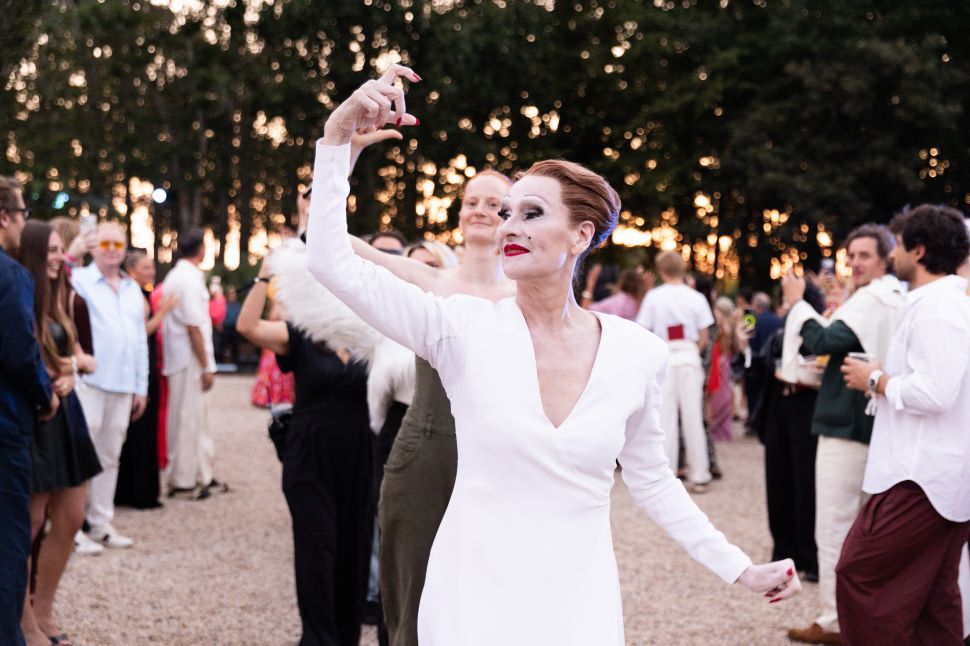
And absurdist it was. Tiki torches lit a path in the woods where a Lincoln Town Car, half covered in foliage, doors open, played a haunting oldies song. On the other side, a man sat inside a white billboard, legs dangling, lost on his phone. Beside him, the words “YOU CAN” were cut out, the setting sun glowing through the letters. The crowd’s attire ranged from women in gowns and stilettos, not an easy feat on such uneven terrain, to others in more sensible footwear.
A pebbled staircase surrounded by white and purple flowers led to a hut one ducked into. Inside, a spotlight shone on dirt that smelled like earth with a hint of manure while a man wrapped like a mummy phonetically sounded out words like “DREEM” as a mouth moved on a screen to eerie music. Moving on, a phone rang among the trees, and curious guests picked up to an emotional voice on the other end. A shirtless man in a cowboy hat chopped wood. Dancers on stilts in long white skirts arched backward and forward, perhaps weeping or in ecstasy. A man in black vinyl wrestled a spiky Styrofoam-type monster to the pulsing sound from Lou Reed Drones. It was an ocean of senses.
RoseLee Goldberg, Performa’s founder, told Observer, “Everywhere you look, Robert sets us up to have a view. Every step we take, you can be sure that he somehow thought of it.” Further on in the woods, Laurie Anderson, her circular amber frames matching her violin, performed A Hole in the Sky with Shane Weeks and members of the Shinnecock Nation. Mikhail Baryshnikov slipped into the crowd.
Other longtime Wilson collaborators, legends themselves, performed as well. Lucinda Childs and Christopher Knowles read excerpts from his plays; French actress Isabelle Huppert returned to lines from works she had performed with him across three decades; and Madeline Hollander presented Parallel Diagonals, inspired by the 45-degree angles in Wilson’s Einstein on the Beach.
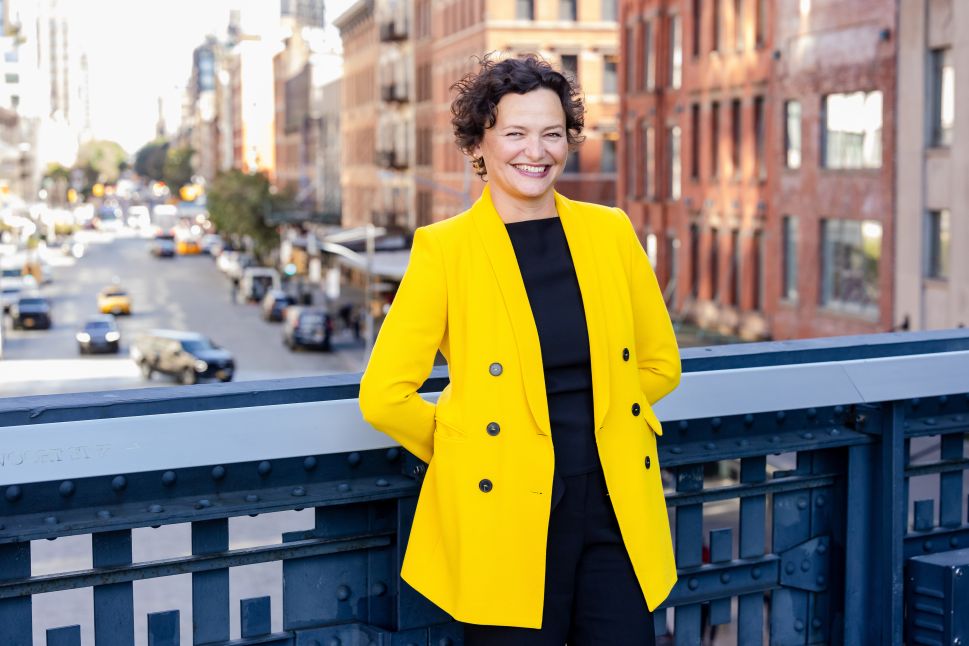
Notable attendees included fashion designer Cynthia Rowley, gallerist Arne Glimcher, sculptor Arlene Shechet, director Susan Stroman, news anchor Rosanna Scotto and Sailor Brinkley-Cook.
At the end of the dirt path, the woods opened into a square where guests sipped LALO margaritas and even a “Limitless” lager, and grazed on a smorgasbord of chilled watermelon and feta, burrata, sweet corn orecchiette and more. Bites by BITE were a delight to the tongue.
Dancer Katherine Crockett dazzled in a strapless nude-colored gown flecked with sequins. She told Observer that Wilson had directed her in multiple productions and changed her life. “He sparked my imagination. When I’d walk on stage, he’d say, ‘Remember, you’ve been walking for a thousand years.’” She mused on his wisdom. “If you think you’re going in the right direction, change directions.”
And she recalled the time he spoke at a gala: “An artist only needs three things—encouragement, encouragement, encouragement and the funds to make their art come true.” Asked what he might think about this particular evening, she thought he’d be excited about the young and acclaimed artists who’d come together to honor him and that he was a part of their becoming. “It’s extraordinary what I’ve seen walking through, and what we have yet to come.”
As guests grazed, a performer wheeled by, collecting trash in return for garbage-scented ice cream. A nearby guest winced. “It really does taste like trash, and I can’t get rid of the aftertaste.”
The crowd then turned to Julie Shanahan, who led an audience-participated dance drawn from Pina Bausch’s The Nelken Line, demonstrating the arm and hand movements for each season. Participating guests formed a joyous procession, winding through the crowd to Louis Armstrong’s “West End Blues.”
As the chain dispersed, many continued on toward a simultaneous staging of part one and part two of Wilson’s I Was Sitting on My Patio This Guy Appeared I Thought I Was Hallucinating. On the way, Observer caught up with Evelyn Duggan, a former summer intern now on staff. She wore a strapless jumpsuit, her strawberry hair pulled back and a delicate smattering of freckles across her face.
Asked by another guest if Wilson had been scary, she demurred, “He had a large presence, but I don’t think he was scary. He was demanding, very genuine, very detail-oriented, but also very funny and honest.” She added that he set the center up well with the intention of longevity. “He wanted this to be a place where artists could connect, not just with him, but with each other and then build this network for the world.” As for the festival’s theme: “Bob had a way with time. It wasn’t a linear thing. How can we stretch it to find more moments within it?” And then she disappeared into the crowd.
It was a double-sided stage: on one side, Christopher Nell in a black suit; on the other, Julie Shanahan in a white gown. Guests could move between the two. Nell called out from the stage: “There’s so little time, we’re wasting it. That’s fine with most elephants.”
As the night chilled and some guests drifted indoors, Observer spoke with Elka Rifkin, a former Watermill Center director who’d come back this year to volunteer and support Charles Chemin, the new artistic director. “The night has been remarkable,” she said. “It’s what Watermill has been, but I feel it’s on the cusp of what Watermill will become.”
Then the sound of two hundred cymbals by EYE reverberated across the grounds, and everyone poured back into the square. It came in waves, building, softening, crescendoing again. A blueberry crumble of sorts with mint was served to a rapt audience. It was transcendent. Then DJ King Shabazz closed out the night.
Had Wilson left enough of a roadmap for the Watermill Center to thrive without him? “A lot of people use the word legacy when they look at Watermill,” Elise Herget, the managing director, told Observer. “I think it’s more than that. I think it’s a continuation of something Bob created—not only a space for him to make work, but one he always intended as a framework for other artists to work within.” She paused. “I’m here all the time. I live and breathe this place right now, and it’s amazing. And through that, I can kind of feel like his presence has never left. It’s in every choice of line, every blade of grass that was planted over the past thirty years.”
After all, in Bob’s world, time was never linear but limitless.