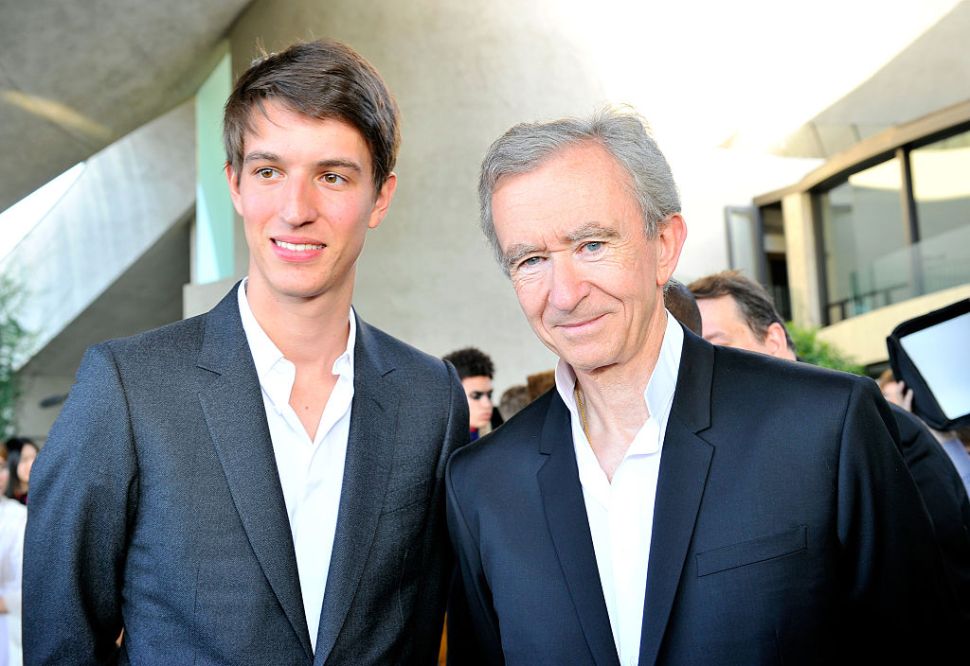
Alexandre Arnault (L) and Chairman and Chief Executive Officer Bernard Arnault attend the Louis Vuitton Cruise 2016 Resort Collection shown at a private residence on May 6, 2015 in Palm Springs, California. ” width=”970″ height=”667″ data-caption=’Barnard Arnault (R) and his Alexandre Arnault, who currently serves as deputy CEO of Moët Hennessy, LVMH’s wine-and-spirits division. <span class=”lazyload media-credit”>Donato Sardella/Getty Images for Louis Vuitton</span>’>
While the conglomerate behind Louis Vuitton, Tiffany & Co. and Hennessy appears to be emerging from the broader luxury-sector slump, uncertainty still surrounds its future leadership. At 77, LVMH CEO Bernard Arnault has yet to indicate which of his five children will eventually lead the 75-brand empire. Despite Arnault insisting there is no discord within his family, questions persist over the future of the industry’s second richest family (behind Hermès), with a net worth of $147 billion.
LVMH’s 12th-largest shareholder, asset manager DWS Group, said the succession plan remains “uncertain and opaque,” according to a translated report from French publication Le Monde published in July. The conglomerate, which generated €80.8 billion ($96.5 billion) in revenue in 2025, has publicly pushed back on claims of family strife. In a letter posted on X and signed by Arnault, the company said anyone waiting for the family to fracture would be “waiting a long time.”
LVMH’s latest earnings may give Arnault more reason to delay a transition. Revenue rose 3 percent to €19.3 billion ($22.2 billion) in the latest quarter, marking the company’s strongest performance since early 2024. Dior’s creative reset under Jonathan Anderson, Sephora’s growth and strong jewelry sales at Tiffany and Bvlgari all helped bolster results, even as demand in China remained weak and the wine-and-spirits division faced continued pressure.
Arnault is already known for his slow-burn leadership style, with gradual grooming—rather than an abrupt transition—at the center of his approach. “Luxury is one of the few sectors that thinks in generations rather than quarters,” Arnault said in the letter.
The aging CEO has also made clear that he does not plan to step down soon. LVMH shareholders in April approved a change to the company’s bylaws raising the CEO age cap from 80 to 85, allowing Arnault to theoretically remain in the role for nearly eight more years. The measure followed an earlier 2022 change that raised the maximum age from 75 to 80.
Arnault himself won control of LVMH through a financial takeover carried out throughout the 1980s. But the family has since closed the door on a similar outside maneuver. In 2022, it finalized the creation of its holding company, Agache, which owns 50.2 percent of LVMH shares and controls 66.4 percent of voting rights. That majority stake protects the group from a hostile takeover.
Agache operates as a joint-stock partnership, with each of Arnault’s five children holding a 20 percent stake. Decisions within the holding company require the support of at least three of the five heirs.
All five children hold senior roles across LVMH divisions. The eldest two are from Arnault’s first marriage to Anne Dewavrin, which lasted from 1973 to 1990. He shares his remaining three children with his second and current wife, Hélène Mercier-Arnault.
The LVMH heirs are:
Delphine Arnault, 51, became CEO of Christian Dior Couture in 2023. She has served on LVMH’s executive committee since 2019 and its board of directors since 2003.
Antoine Arnault, 49, heads Christian Dior SE, another LVMH holding company. He is also LVMH’s director of image and environment, joined the executive committee in February and has served on the board since 2006.
Alexandre Arnault, 34, is deputy CEO of Moët Hennessy, LVMH’s wine-and-spirits division, under Jean-Jacques Guiony. He joined the board in April after shareholders approved his appointment at the annual meeting.
Frédéric Arnault, 31, leads Italian luxury label Loro Piana and also joined the board in April.
Jean Arnault, 27, oversees LVMH’s watches division.
At the April annual meeting, Arnault gave each of his heirs an opportunity to speak publicly for the first time, reinforcing his effort to raise their profiles with shareholders.
What LVMH’s succession could look like
As the oldest child and the one with the most established leadership record, Delphine Arnault could emerge as a future CEO. But a shared leadership model—potentially involving Delphine and Antoine Arnault—also remains possible.
Another, less likely possibility is an external successor. Fewer than a third of global family businesses survive into the second generation. An outside executive could preserve operational continuity while helping avoid internal conflict.
L’Oréal offers one potential model. Leadership there passed from Liliane Bettencourt to her daughter, Françoise Bettencourt-Meyers, and her grandsons, including Jean-Victor Meyers. Their roles, however, were largely limited to controlling ownership through the family holding company, Téthys, and board stewardship, while non-family executives managed the business. That transition unfolded in the early 2010s, after a French court declared Bettencourt, then 88, mentally unfit because of dementia.
LVMH could pursue a similar arrangement. But Arnault’s decision to place his children in increasingly visible corporate roles suggests he is preparing a more deliberate, if gradual, family handover.
A closer parallel to LVMH’s multibrand luxury model may be Kering, the world’s fifth largest public luxury house. In 2005, founder François Pinault handed operational control of the conglomerate, then known as PPR, to his son, François-Henri Pinault. Over the following decade, François-Henri reshaped the company by divesting non-luxury retail businesses and turning it into a pure-play luxury group centered on brands such as Gucci and Yves Saint Laurent.
His siblings, Dominique and Laurence Pinault, are shareholders in the family holding company Groupe Artémis, which owns a majority stake in Kering, but they are otherwise removed from the group’s core business.
Prada’s founders, Miuccia Prada and Patrizio Bertelli, are also still transitioning leadership to their eldest son, Lorenzo Bertelli. He holds a majority stake in Ludo, the family holding company that controls roughly 80 percent of Prada. Lorenzo, a competitive rally car driver, joined the family business in 2017 and now serves as chief marketing officer, head of corporate social responsibility and Versace’s executive chairman, following Prada’s 2025 acquisition. Prada CEO Andrea Guerra is serving as transitional leadership until Lorenzo is ready to take the helm.
Despite the range of potential models, the outcome of LVMH’s succession remains difficult to read. The group’s resilience amid market turbulence underscores the strength of its family-led structure, but the eventual handover may prove even more consequential for the future of luxury.