
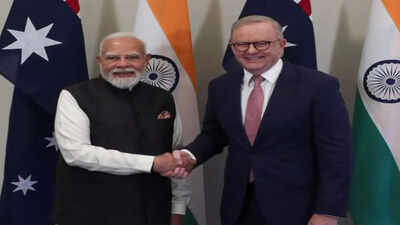
Defence and security, critical technology, supply chain resilience and energy security cooperation – including finalisation of administrative arrangements for long-term supply of uranium to India – topped the agenda of the 3rd India-Australia annual summit in Melbourne. PM Narendra Modi and his counterpart Anthony Albanese also agreed to fast track ongoing talks for a balanced and ambitious comprehensive economic cooperation agreement and a bilateral investment treaty. Invoking a cricketing analogy, Modi said India-Australia bilateral agenda was as focused as a one-day match, decisions fast like T20 and partnership long and deep like a test match. Among the 18 outcomes that were announced, there was a joint declaration on defence and security cooperation for interoperability of forces and defense industrial collaboration, and a maritime security collaboration roadmap. India and Australia also launched a Partnership for Cyber, Critical Technologies, Supply Chains (PACTS) to support national and regional security, promote collaboration to make critical supply chains more resilient, and strengthen collaboration in critical technologies, cyber security, and digital resilience. In his media statement, Modi said PACTS will facilitate critical minerals cooperation vital for strategic security and clean energy transition and that both sides will work together on a critical mineral corridor. Among the major takeaways was also the long-pending operationalisation of the 2014 India-Australia Civil Nuclear Agreement for uranium supply to India. “Today, we signed a significant agreement in the field of nuclear energy. This will pave the way for the supply of uranium from Australia to India and give fresh momentum to our clean energy objectives,” said the PM, who described India and Australia at a business event earlier as natural and trusted partners in times of global uncertainties.While reiterating support for India’s Nuclear Suppliers Group (NSG) membership bid, a joint statement said the agreement will enable long-term Australian uranium exports to India for exclusively peaceful purposes and under IAEA safeguards. India and Australia had concluded fuel supply arrangements as early as in 2015 but it was yet to be operationalised because of a lack of agreement on the issue of safeguards. Calling the agreement a shot in the arm for India’s clean energy goals, foreign secretary Vikram Misri said it was important to have reporting procedures and protocols that would satisfy both sides about the supply, handling and accounting of material. “As a result of very intense discussions over a period of almost 2 years, both sides were able to conclude these issues to their mutual satisfaction,” said Misri. Government officials had said last week they were expecting the discussion to conclude during the visit. Modi welcomed the opening of Australian university campuses in India saying it had added a new chapter to the knowledge partnership and that both sides will work to enhance the exchange of students, professionals, and tourists between the two countries. Amid concerns over the reported delay in processing of student visas, Albanese stressed in the meeting Indian students in Australia are welcomed and valued members of Australian classrooms, campuses and communities. “India and Australia are vibrant democracies, multicultural societies and 2 significant ocean powers. These shared characteristics and our common worldview inspire us to move forward continuously with deep mutual trust,” said Modi in his statement. Misri later said there was an assurance from Australia that there would be no reduction of opportunities for genuine Indian students. The leaders also called for urgent reform of the UNSC – with Australia reiterating its support for India’s candidacy for a permanent seat in the Council – and unequivocally condemned terrorism in all its forms and manifestations. Condemning the “horrific attacks” perpetrated at Pahalgam and Bondi Beach, the leaders in the joint statement emphasised the importance of all countries combatting the threat of terrorism in a comprehensive and sustained manner, and called for action against globally proscribed terrorists and terror entities, including those listed by the United Nations Security Council 1267 Sanctions Committee. Albanese also said after the meeting that Australia values India as a top-tier security partner and the defence declaration reflects a shared commitment to a peaceful, stable and prosperous Indo-Pacific region. “We will boost strategic coordination, increase the complexity of our defence exercises and further build interoperability between our defence forces. We undertake to consult on defence-related developments in the Indo-Pacific that affect our shared interests,” said the Australian PM.