
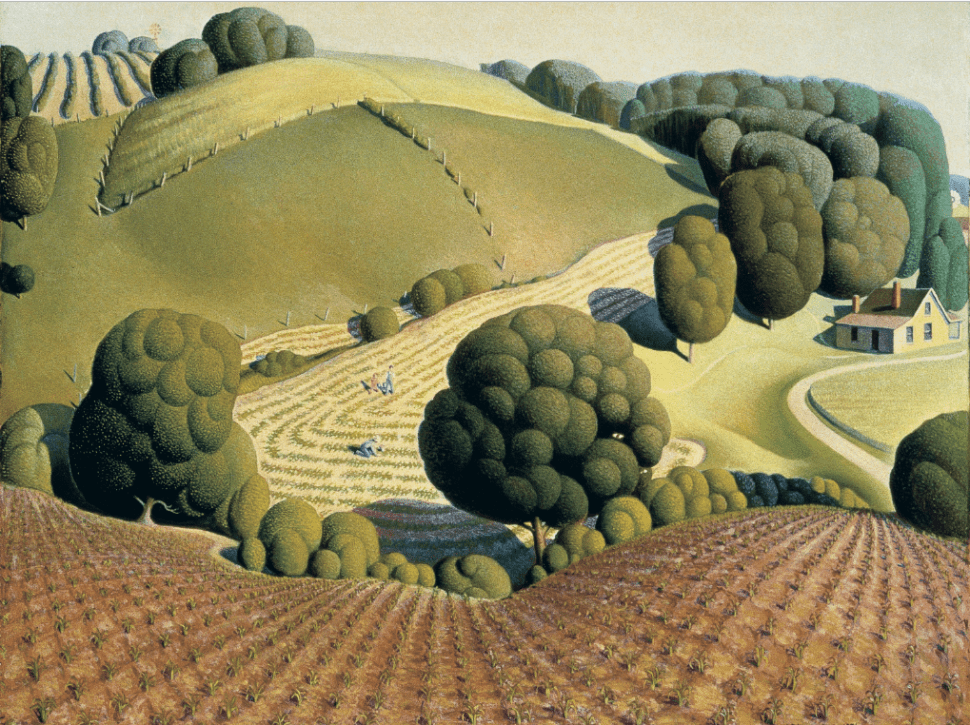
At the interwar peak of Grant Wood’s career as a painter, the Iowa native stood his models, including himself, as rigid as pitchforks and as tall as corn stalks, having been taken with the posturing and psychological depth imbued in the fastidiousness of Northern Renaissance portraiture—Wood’s American Gothic wouldn’t look so out of place beside a Jan van Eyck. The midwestern modernism of American regionalism, in Wood’s prime, has more in common with depictions of fields and tillermen dating back several centuries prior, than with the darkness lurking among genetically modified crops and used syringes that dot post-Manifest Destiny expanses of Big Ag farmland and the impoverished communities that live amongst it today. And there’s no better contrast between what was and what is, than the inclusion of Pennsyltucky artist Samantha Joy Groff’s Harvest Lady (2026) in “Pasture to Present: Grant Wood’s Corn Room and New Visions of Rural America,” currently on view at Sioux City Art Center, in Sioux City, Iowa. If the look on the face of Grant Wood, in his included 1932 self-portrait, is fraught in its representation of himself as an avatar for rural America and how they’re together perceived by a curious and encroaching modern world, Groff’s portraits draw from a society who contort to hide from passersby even when no one deigns to look up from their phones to acknowledge their surroundings unless they spy fodder for cynical content.
In “Pasture to Present,” curator Christopher Atkins surveys western American art working off much the same map Saul Steinberg illustrated for his most famous New Yorker cover, View of the World from 9th Avenue, from 1976, which depicts all the world west of the Hudson River as a backwoods with its share of lumps. The poster itself wouldn’t be out of place in the show. Nearly all the contemporary works here highlight the fraught state of public and private grass, dirt, snow and sands, though less is made of who occupies them, an ongoing rejection of otherness that even shows as ambitious as this struggle to explore.
“Pasture to Present: Grant Wood’s Corn Room and New Visions of Rural America“
Artists: Various
Venue: Sioux City Art Center
Address: 225 Nebraska St, Sioux City
Through: December 6, 2026
There’s Wisconsin artist Tom Uttech’s Mamakadjidgan (2011-12) which depicts layers of postage stamp perfect birds, their generations of seasonal crossings navigating a bucolic landscape—a reminder not all migration patterns through the wild have to be so politically fraught. Minnesota artist Lamar Peterson’s No Time For Weeds (2023) painted in the aftermath of the George Floyd era protests, shows a black man tentatively at ease in his own flourishing garden. It’s also tiered so high, he appears six feet under and pushing up daisies, hidden from the outside noise and in the one place where he can wield a spade without courting danger to himself, and even then the stigma of the tool’s more malicious meaning invades his safe space. When Peterson’s series was first on display at Fredericks & Freiser in 2023, the accompanying text highlighted the politics on display; here it’s erased.
Groff’s works pack in the meaning so it’s unavoidable, even if her subjects appear shrunken. The 32-year-old Yale MFA graduate and art instructor at Kutztown University was born in the Mennonite community of Franconia, only an hour northwest of Philadelphia. She grew up in and out of the faith, but never abandoned the region or its people. Her landscapes are laden with sacred imagery and Christian mysticism. She sometimes casts her outcast figures in the divine light of oncoming headlights—suggesting greater mercy than the disgruntled property owners or drug dealers likely pulling up. One of her grandest pictures, the pieta Fentanyl Jesus (2024) featured three models, including an addict, whose failing bodies, like their once youthful beauty, seem unlikely to last to their Jesus year; if they’re to be saved by more than God, their circumstances require as much urgent attention as a Taylor Farms recall.
“The girl being cradled in the back, I’ve painted her before, and she’s missing half of her teeth and she’s so great to paint because she has meth mouth and she rocks it and it’s hot,” Groff said. “She’s not afraid to be ugly in a painting, and in my work you have to be okay with that.” That model is in the arms of a former addict from the neighborhood, who grew up 10 minutes from Groff, and now works in the harm reduction community.
Groff’s penchant for headlight yellow hues, representing sickness from the inside in Fentanyl Jesus, and from the outside in Late Harvest, further engage with the exhibition’s centerpiece, Wood’s Corn Room murals, hazy in a golden light that evoke the ebb and flow of dust and abundance and how the land endures in between. The murals have their own pride of place separate from contemporary comparisons, immersing viewers in both an environment similar to how they were first displayed in the dining room of the former Martin Hotel in Sioux City, while at the same time evoking the calm of Claude Monet’s Waterlilies or the Rothko chapel.
Wood received the Martin Hotel commission in 1926. Nebraska businessman Eugene Eppley hired the artist to paint a series of murals for hotels across Iowa. By the 1950s, the murals at the Martin had been painted and papered over, rediscovered in the 1970s, gifted to the art center in 2007 following a sale, and restored to their current state following a $75,000 conservation effort last year. The mural was in a fragile state given Wood’s subtractive process in creating the corn stalks by wiping away paint to define its forms.
Groff peels back abundance to let the outside in. His model in Late Harvest might take shelter in the field, but the abundance rising up around her doesn’t extend as far as it once did. The yellows here skew green in the subject’s pallor; it’s a sickness not limited to herself, but inescapable in the air and soil.
“Even as this person might be sitting in a cornfield, things don’t seem at peace,” Groff said. She was informed by a strange green light entering a Grant Wood work she once saw, that reminded her of a doomsday feeling she felt while driving by a power plant near where this corn was growing. “Even if the nuclear power it produces is quote-unquote safe, there’s impending doom cooked into the environment where I live.”
Groff isn’t entirely alone in harvesting the weighty emotions rural Americans carry. One artist not in the show, and who pioneered Groff’s oeuvre of feminist Pennsyltucky regionalism, is Rebecca Morgan, whose upcoming show, “Painting in the Apocalypse,” opens at the Asya Geisberg gallery in Tribeca on September 9. Morgan’s often self-deprecating portraiture channels on the canvas a philosophy Groff puts forth in her social media, including her Instagram handle, @redneckhotwife.
“I’m a deeply private person, I’m not outwardly expressive emotionally, but when I was accepted to Yale I was being told I have to have a website, I should get on social media, and to be the person, the artist I am, out loud, feels really vulnerable. So I made myself public and used this identity to beat people to the punch in assuming the worst of me. And going to graduate school in 2020, post-Trump and pre-Trump, it was so unpopular to be a working-class white lady from my area—you just got shit for looking the way you look.”
Morgan’s work regularly tackles the anxiety of the rural woman coping with being seen, and what it feels like to receive the attention you demand, in pursuit of a successful modern life and part of popular culture. Her paintings long explored class issues with dark humor and satire, and her latest show tackles influencer tradwives who profit off performative provincialism, and buries the airs of the first family who for all their big city posturing, global influence and an equally extensive real estate empire, can’t help but engage with their surroundings like the Beverly Hillbillies of the oligarchy.