
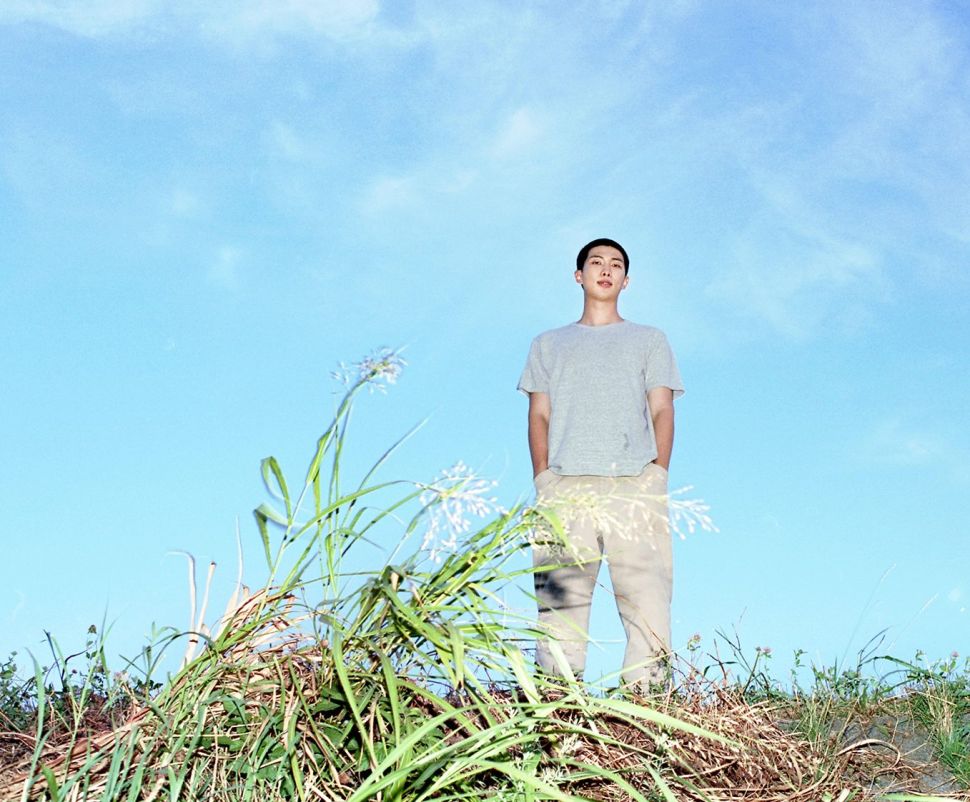
Known to most of the world as RM, frontman of the K-pop mega-group BTS, Kim Namjoon shows another, more personal side in his latest creative endeavor as co-curator, alongside América Castillo and Hyoeun Kim, on the San Francisco Museum of Modern Art’s “RM x SFMOMA: Between You and Me.” In it, nearly 150 works from his personal art collection are featured in conversation with pieces from the museum’s permanent collection.
“We wanted to do more than simply show RM’s collection. We wanted the two collections to speak to each other. So, as we brought them together, we looked for shared interests and questions among artists from different times and cultures,” Hyoeun Kim told Observer. “Sometimes we found connections in color and material, and sometimes it was the way artists approach similar ideas.”
While the artworks span centuries and cultures, East and West predominate, including seminal figures in modern and contemporary Korean art, such as Chang Ucchin, Kim Yun Shin, Kwon Okyon, Park Rehyun, To Sang-Bong and Yun Hyong-keun, in conversation with work from SFMOMA’s own collection by artists like Donald Judd, Yves Klein, Agnes Martin, Henri Matisse, Georgia O’Keeffe and Mark Rothko.
“RM x SFMOMA: Between You and Me“
Artists: Various
Venue: SFMOMA
Address: 151 3rd St, San Francisco, CA
Through: February 7, 2027
“There aren’t many things that show a person more honestly than a collection they’ve built over a long period of time spending their money, their life, their effort, and even giving the walls of their own home. I guess this exhibition is a pretty long introduction to myself,” RM said, reflecting on the impact of the show, which is divided into eight sections:
Blue Water
RM explains that since blue is the color of water and we all came from water, an appropriate place to start is with 26-I-70 #141 and 15-VII-70 #181, both painted in 1970 by Kim Whanki, who often employed the color and is the first Korean artist with whom RM became familiar. Roni Horn’s Untitled (“But the boomerang that returns is not the same one I threw.”) is a glass cylinder, as crystalline as water, that sits on the floor. “It looks like ice. It looks like water. It looks like weather. It looks like rain,” is how RM describes it in the audio tour.
Friendscape
Paintings and carvings of landscapes and animals predominate here, nowhere more so than in To Sang-Bong’s painting of a palace garden, as well as Kim Chong Hak’s winter landscape with a pair of ducks swimming in a stream. Occidental entries include the museum’s Petunia, painted by Georgia O’Keeffe in 1925.
Home
Included here is Son Sangki’s Artificial City-Irony from 1987—a view of a well-to-do living room. “When I see this painting, I always feel like, ‘Am I being a boring rich person?’ It makes me really uncomfortable, and I like it,” RM says. The section also includes furniture and earthenware by a variety of Korean artists as well as Philip Guston’s Untitled Red and Black Book from 1969. From SFMOMA’s collection is Richard Diebenkorn’s 1969 painting, Untitled (Interior with Mirror), as well as a 1907 painting of flowers by Matisse.
Photo Buddha
Featured here is Nam June Paik’s 1978 ink drawing of Buddha on TV from the museum’s collection, and RM’s matching 1994 sculpture of Buddha watching TV called Enlightenment Compressed. “Maybe he likes watching TV,” the singer ponders. “Maybe we are his TV. It’s Nam June Paik asking about technology and religion. It’s funny to see the Buddha looking at the TV, like we are looking at our phones every day.”
People
“What always catches me for the longest is the self-portrait of an artist,” notes RM. “We sometimes forget, especially when we get overwhelmed by the aura of a name like Picasso or Matisse, they are just people.” Alberto Giacometti’s evocative 1962 Bust of Annette from the museum’s collection departs from his signature elongated bronzes. RM contributes Park Soo Keun’s folksy oil-on-Masonite image of a girl with a baby bundled on her back.
Passion
Included here are paintings and artists who inspire RM toward better work and a spiritually healthy existence. From his own collection are abstract works by Son Sangki and Hyun-Sook Song, as well as the museum’s The Window (1932), by Rufino Tamayo, and a Ruth Asawa hanging sculpture from the early 1950s. “I don’t know if it helped me be a better musician. But it helped me be a better person,” he says of the works in this section. “When I just look back on their lives and their passion, their will, their devotion to a single thing, they’re telling me there is no free lunch.”
I don’t know why, but I like it
“These are the pieces, they just called me,” he explains. “Sometimes, at some point, you just forget all those reasons and you just can’t explain.” From his own collection, Maracas, Yoshitomo Nara’s drawing of a girl holding a maraca, is likable enough, as is his animation cel of Pikachu.
Yun Hyong-keun, Blue-Umber ’79-C6: A minimalist Dansaekhwa painting on raw linen featuring two wide vertical bands of deep umber-black framing an unpainted natural tan center” width=”970″ height=”1427″ data-caption=’Yun Hyong-keun, <em>Blue-Umber ’79-C6</em>, 1979. <span class=”lazyload media-credit”>From the collection of RM; © Yun Seong-ryeol, courtesy PKM Gallery</span>’>
Umber I
This section draws its name from Yun Hyong-keun’s 1990 oil on linen titled Burnt Umber & Ultramarine. “I even made an album cover of my own with his painting,” RM recalls. He flew halfway around the world to the 2019 Venice Biennale to see an exhibition of Yun’s work. “When I first got there, a young girl was exiting, crying. So I was like, ‘Why is she crying?’ And then once I got into it, I understood it. I didn’t cry, but it was a sublime experience. That was the point I started to really admire the Korean artists.”
It’s no surprise that an art show associated with RM would draw fans who might not otherwise visit a museum, but “RM x SFMOMA: Between You and Me” isn’t about K-pop. And while Korean art is a vital component of the show, at its heart is a shared human experience, no matter your place of origin. “There are three curators, and I’m the one that’s not Korean,” laughs Castillo. “And even though I’m not Korean, and I don’t have the same sensibilities culturally, I kept reflecting back on my culture and how we’re all human.”