
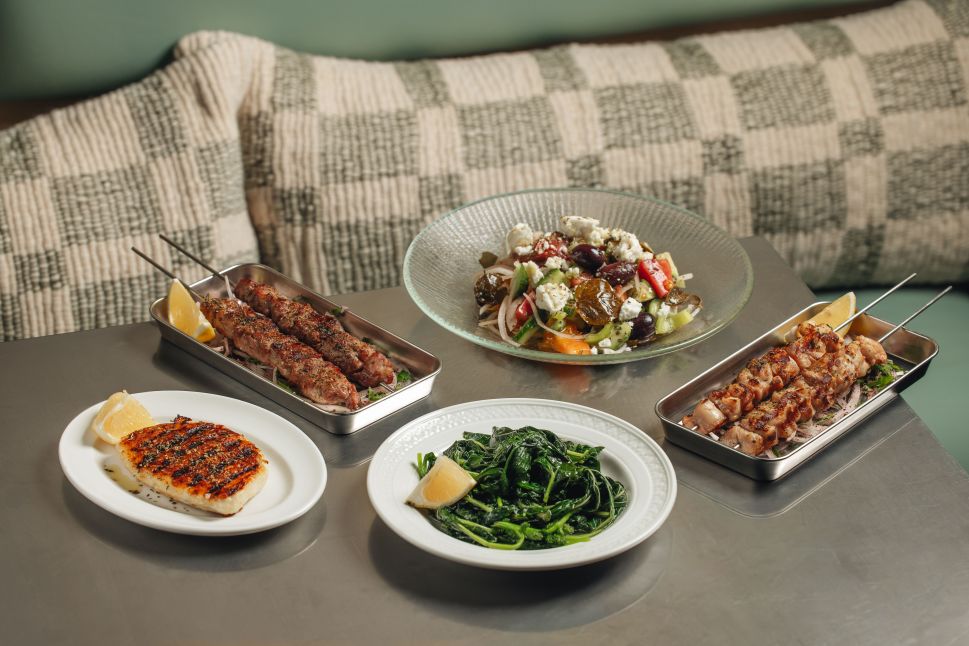
Souvlaki, tzatziki, saganaki—these are just a few of the dishes that have landed on London’s menus over the past year, evidence of an influx of modern, elevated Greek restaurants arriving in the British capital. While London has always had a plethora of dining options, including both casual and more high-end Greek restaurants, in recent months, there has been an unexpected and unprecedented surge of new openings. It’s making a case for more than just a trend, with chefs and restaurateurs showcasing the scope of the regional cuisine in refined, sometimes experimental ways, in the hope that these restaurants will become permanent fixtures.
“The last real trend was cooking with fire, and before that it was Asian food,” says Louis Korovilas, head chef at Clio, a stylish, contemporary Greek restaurant on Chiltern Street in Marylebone, which opened in April. “It’s Greece’s time in the sun.” Korovilas opines that in the past, people have viewed Greek food as “the ugly duckling of Mediterranean food.” Now, however, he’s noticing people looking at Greek cuisine through a “different lens.”
To be clear, there have been Greek restaurants in London for decades. Elysée opened as a French eatery in 1936, but after it was purchased by George, Michael and Ulysses Karageorgis in 1962, it was transformed into a memorable Greek spot. It’s evolved to keep up with the times, now embracing a modern, upscale vibe suited to Mayfair, but has always attracted well-to-do diners, including figures like Prince Philip and Muhammad Ali.
More casual restaurants, like Halepi and Andy’s Taverna, have also been around since the 1960s. The 2010s brought in a few more, including Mazi, in Notting Hill, in 2012. But for many years, the number of Greek restaurants paled in comparison to the plethora of Italian, Indian and Lebanese eateries around London. When Christina Mouratoglou co-founded Mazi with her husband and business partner, Adrien Carré, she says the “Greek food scene didn’t exist at all.” While that is not entirely true, it’s fair to say that that type of elevated offering was certainly rare.
“I didn’t have a restaurant background before, but I was always into food and obsessed with food,” says Mouratoglou, who grew up in Thessaloniki. “I wanted to show people what really good Greek food is. And what it is and what it’s not, because there were a lot of misconceptions at the time.”
She describes the Greek restaurant scene in London at the time as “very basic.” “It was mainly Cypriot-focused because there were a lot of Cypriot immigrants that came here in the ‘60s,” Mouratoglou says, referencing the vast number of people from Cyprus who moved to the U.K. before the country gained independence from Britain in 1960. “They had their cuisine, which is very different to mainland Greek cuisine.”
Mazi opened in 2012, and within a few years, Mouratoglou began to notice similar eateries, including Marylebone’s Opso (2014) and St. James’s Estiatorio Milos (2015). “But it’s only been the last couple of years that we’ve really seen a lot more,” she declares of the growing Greek restaurant scene in London.
The number of new Greek openings is substantial, even by London standards, where several new restaurants debut every week. In 2024, Oma and Agora made a splash in Borough Market. Last year saw the arrival of Pyro, Myrtos and Lagana. This year, the city welcomed Clio, Zylia and Fenix Mayfair, in addition to Taverna Ermou, an established import from Athens. For Mouratoglou, the reason is twofold: Some of the restaurants simply represent people jumping on what they see as a trend because that is what sells, but others are sincere, playing on a newfound love for Greece itself.
“There are a lot of people who recently have traveled to Greece and fallen in love with it,” Mouratoglou says. “They genuinely fell in love with the country and the food. Traditionally, people in England would mostly visit Spain, Italy and France, but now Greece has overtaken all of these summer destinations.”
The statistics agree: In 2022, 4.5 million Brits visited Greece, up from less than three million in 2021. In 2025, British tourists spent a notably high amount per visit to Greece, second only to American visitors, according to a study from the Institute of the Greek Tourism Confederation. And, anecdotally, it seems like everyone in London has spent time in Athens or on one of the islands this year.
Nick Molyviatis, co-founder of Zylia, which combines Greek and Cypriot inspirations and dishes, agrees that this development in London comes down to awareness. People are more comfortable eating food they know or have previously tried. Now, because more diners have visited Greece, there’s more openness to experiencing the broader palate of the cuisine. These more contemporary Greek restaurants avoid clichés such as classical columns and statues and blue-and-white decor, and emphasize the convivial nature of Greek dining.
“It’s less of a gimmick and more about the food,” Molyviatis says. “There is a very big difference in the cuisine between the islands and the mountains and the fields. Most people know about how the south of Spain and the north of Spain are very different, and hopefully in a few years people will have this understanding about Greek and Cypriot food.”
Korovilas has noticed that both diners and chefs are becoming more aware of the broader scope of Greek food. He recalls a short stint at culinary school when he was getting started as a chef, and a teacher turning her nose up when he said he was Greek. “She said, ‘Yeah, we don’t do that here,’” he remembers. “Greek food has always been a dirty word [in the culinary world] because people associated it with souvlaki and [fries]. Now people are starting to realize that it’s much more than that.”
Korovilas points out that there was a time when Italian food in London consisted of basic dishes like spaghetti Bolognese and chicken Parmesan. It’s evolved dramatically since, but it’s also become an oversaturated market. “So now everyone’s trying to do the lesser-known stuff,” Korovilas says.
Each of the new restaurants has a slightly different focus. Zylia, which opened in May, showcases Molyviatis’ Athenian heritage alongside his co-founder Barry Karacostas’ roots in Cyprus. They compromised over which version of a dish would appear on the menu. The tzatziki, a yogurt-and-cucumber dip, for instance, is Karacostas’ rendition.
“We had a mutual understanding of the fact that we wanted the ingredients to shine,” Molyviatis says. “Greek food is very simple in nature, so there is nowhere to hide. We decided we were going to do things that made sense to us and how we grew up.”
At Clio, Korovilas, whose family is from the Peloponnese mountain region of Greece, wants to showcase dishes that Londoners might not be as familiar with. One of his signature dishes is rabbit stifado, a classic stew featuring braised rabbit.
“We’re trying to get away from fried calamari and all those seaside classics that we all love,” he says. “I love them, too, but I’m looking at ingredient-led dishes. We don’t want to import all of our vegetables—we want to use what’s in season up here.”
He estimates that Clio uses 50 percent Greek ingredients and 50 percent local products from the U.K. Some things, like thyme, are inimitable. Korovilas gets his from the Greek mountains. “It reminds me of when I’m driving through Greece,” he says. “When we’re developing a dish, I’m looking for those smells and feelings. I’m chasing that authenticity.”
In that vein of authenticity, the chef imports his olive oil from Greece, where his uncle makes it in the hills of Kalamata. It’s produced on a small scale, so Clio has exclusivity to it in London. “We’ll probably stamp it with our name at some point,” Korovilas says. “At the moment, it comes in a blank barrel. But it’s fantastic.”
Mouratoglou’s latest restaurant, Maza, focuses on dishes and flavors from Athens. She grew up in Thessaloniki, but spent a lot of time with her family in the country’s capital.
“Maza was inspired by my upbringing in the ‘80s and the food I remember eating as a small kid,” Mouratoglou says. “Not to try to be too modern, not try to be intrusive, taking something simple and using good cooking techniques, good seasoning, good ingredients.”
The chicken souvlaki, an immediate favorite among diners, is a careful recreation of a version she remembers from a hole-in-the-wall spot in Thessaloniki. The meatballs are dubbed “Grandmama’s meatballs.” Other dishes are more modern in their approach. It was important to Mouratoglou that nothing was fussy or overdone.
“I wanted to be pure,” she says. “So the octopus is octopus with capers, lemon, olive and oregano. That’s how you would get it in a taverna in a village in Greece. We just use better techniques. It’s more elevated than what you would get in a small town on the sea.”
At Pyro, chef Yiannis Mexis, who grew up between Mykonos and Athens, is toying with less traditional versions of classic dishes. He calls the food Greek-inspired, which explains why his take on spanakopita is served as a Portuguese pastel de nata.
“At the end of the day, you’re not in Greece, you’re not in Mykonos where I grew up, you are in London,” Mexis explains. “The guests coming here to eat are accustomed to different palates and textures and flavors and standards. So you need to deliver to that. And I don’t want to showcase just one region. I want to showcase Greece as a whole, and I want to do it in a refined, tasteful way.”
Pyro’s menu features the expected dishes, but each is elevated in a unique way. The pita is made with potato sourdough and grilled on an open flame. A delicious raw sea bream crudo arrives inside the whole fish, laced with green olives and caper leaves. There’s the usual suckling pig, lamb and beef options for the main course, but other options are more surprising, like Silver Hill Farm duck served with figs.
“We’re using the dried figs from Kymi, a town in Greece that produces figs,” Mexis says. “In Greece, we have a fava dip, and we also have a stew that is made with duck in the northern area of Greece. This dish uses all of that influence from Greece, but it’s devised in a way by someone who lives in the U.K. If you know the connection, it’s very Greek-inspired.”
Previously, very few companies imported Greek ingredients into the U.K. These days, chefs have more options. Zylia uses Lygias Dairy Products for halloumi and Kostarelos for six-month barrel-aged feta. The restaurant also imports dried mint, oregano and olive oil. Molyviatis says getting the best products has gotten easier.
“The more restaurants that open, the more it raises awareness,” he says. “And the more that open, the more supplies start to be available to us. Ten years ago, there was hardly any [Greek] product available, but right now there’s more product, and there’s competition between suppliers, so it brings more things in, and that makes it more interesting.”
The same holds true for Greek wine. Maza’s wine list is 100 percent Greek, and many of the cocktails are made with Greek spirits, like mastiha.
“Suppliers always thank us for creating a market that didn’t exist before,” Mouratoglou said. “We have wines from all over the country, from small producers, from big producers, from big names, from small names. The evolution over the last 15 years is incredible, and if a lot of these wines had a French label, they could be sold three or four times more [money].”
At Pyro, 65 percent of the wine list is Greek. “The wines there are equal to some of the best wines in the world,” Mexis says. “Now, you have a lot more people like me who want to celebrate the producers and winemakers from Greece. It’s down to the chefs and the suppliers and the restaurateurs to play their roles in helping to create a new narrative around Greek gastronomy and Greek culture.”
Whether these elevated takes on Greek cuisine are here to stay in London or are merely another of the city’s frequent culinary trends remains to be seen. The explosion of modern, hip restaurants is undeniably exciting for diners, especially since none of the menus is quite the same. It represents the possibility of discovery, especially if you’re trying to recapture the magic of a recent trip to Greece. As many chefs point out, it’s also exciting to see restaurants that don’t capitalize on clichés.
“The new wave of Greek restaurants is about avoiding gimmicks,” Molyviatis says. “No more olive branches on the menus or yelling ‘Opa!’ It’s about the food. Hopefully, more restaurants will open. One of my old bosses, years ago, said, ‘If Italians can do a restaurant on every corner, why can’t Greeks?’ And it’s true.”