
Since the nation’s founding, Americans have gone west in search of dreams. For some, that dream was gold. For others, work—any sort would do. Later, it was stardom. The blinding rays of the sun weren’t bright enough; they needed movie lights. But if America represented the dream, California was its fever. Millions went looking for opportunity. Plenty got work, but most lost out on the big time. In Of Mice and Men, Crooks, the bitter stable-hand, deflates Lennie’s fantasy of owning some land with George and raising chickens, “Nobody never gets to heaven, and nobody gets no land.”
The Great Depression should have ended the dream. But while 15 million Americans were unemployed, Fred Astaire danced with Ginger Rogers, wearing a top hat and tails and singing about the loveliness of getting caught in the rain. A town called Hollywood had turned the dream into a factory and then industry. By the 1970s, however, people were waking up. James Dean and Marilyn Monroe were dead, television kept people indoors, and Charles Manson got his followers to kill a pregnant Sharon Tate in 1969. How could a dream survive that?
There are two themes that come up time and time again in Californian novels: heat and disappointment. They’re there in Joan Didion’s prose and Raymond Chandler’s pulp, as well as contemporary works by Miranda July and Tommy Orange. (The dream now is Silicon Valley. Dreams so often morph into nightmares.) It’s no surprise then that there have been so many novels set in California. But the state, with “air you can kiss” as Kerouac wrote, is rarely just a backdrop; rather, the Golden State is almost always a character, or a metaphor, or at the very least a noticeable presence, overbearing or passively observing protagonists looking for something better and rarely finding it. Here are some key novels about the dreams and realities of California.
Books that explore the California dream
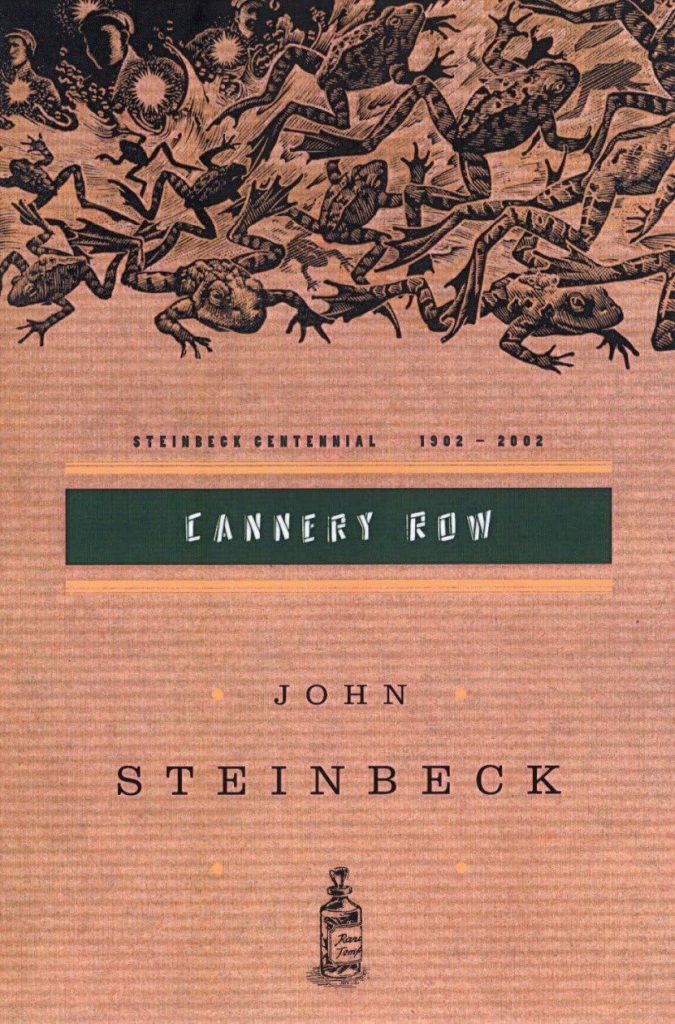
‘Cannery Row’ by John Steinbeck
John Steinbeck is the novelist of early California. His canonical works, namely Of Mice and Men and the epics East of Eden and The Grapes of Wrath, all contain characters searching for something better in the midst of hardships. But Steinbeck’s 1945 novel Cannery Row—a short, ambiguous, often hilarious, quietly tragic book—best evokes a sense of place and the way space can reflect the contradictions of human nature. The opening line of the book suggests these multitudes: “Cannery Row in Monterey in California is a poem, a stink, a grating noise, a quality of light, a tone, a habit, a nostalgia, a dream.”
There is no plot as such. Rather, the book follows a cast of misfits and outsiders trying to live in Cannery Row: Doc, the lovable marine biologist; Mack, a mischievous schemer; Henri, the painter who loves boats but is afraid of the ocean. It’s a funny book—”Two generations of Americans knew more about the Ford coil than the clitoris”—but also, this being Steinbeck, one filled with pathos, a story “where men hungering for love destroy everything lovable about them” and where death is always entwined with living.
Read also: Sweet Thursday, The Pastures of Heaven, East of Eden, The Grapes of Wrath, Of Mice and Men, The Red Pony
‘Cannery Row’ by John Steinbeck.
Courtesy Penguin Books
‘Ask The Dust’ by John Fante
Robert Towne, who wrote the greatest movie ever made about Los Angeles (Chinatown), called John Fante’s Ask the Dust the greatest novel ever written about that same city. Fante’s roman à clef about a wannabe writer did not set the world aflame when it was published in 1939. It was only once Charles Bukowski and a few others in the late ’70s started advocating for it that the book got a critical reappraisal and found wide readership. Set during the Great Depression, the novel follows Arturo Bandini (Fante’s alter ego), renting a room in a boarding house in downtown LA, living off oranges and trying to write. Bandini sees the contrasts that define Los Angeles—the decadence and the poverty living side-by-side. “Ah, Los Angeles! Dust and fog of your lonely streets, I am no longer lonely. Just you wait, all of you ghosts of this room, just you wait, because it will happen, as sure as there’s a God in heaven.” One can see Steinbeck’s Crooks shaking his head and smirking.
‘Ask The Dust’ by John Fante.
Courtesy Ecco
‘Play It As It Lays’ by Joan Didion
“I was raised to believe that what came in on the next roll would always be better than what went out on the last.” Didion’s California is different from Steinbeck’s. In her novels and her non-fiction (The White Album, Slouching Towards Bethlehem) she dissects what California, and Los Angeles in particular, had become during and on the other side of the ’60s. She writes of an L.A. that’s become void of meaning. In Play It As It Lays, Maria drives on the freeway. She drives fast, across the many lines of L.A.’s infamous lanes, searching for what? She’s a moderately successful actress, with a husband, a lover and a daughter in a sanatorium. She drinks Coca-Cola, quite a lot of it. Didion’s California is populated by people with “bodies gleaming, unlined, as if they had an arrangement with mortality” and who say things like “beaucoup fantastic” at parties. Her book is maybe the best ever written to capture loneliness and apathy that describes a California losing its sense of itself. A character BZ asks Maria at one point what matters. “Nothing,” she replies.
‘Play It As It Lays’ by Joan Didion.
Courtesy Farrar, Straus and Giroux
‘Less Than Zero’ by Bret Easton Ellis
People are afraid to merge on freeways in Los Angeles, the narrator tells us in the first line of Bret Easton Ellis’ debut novel. He could be talking to Joan Didion’s fast-wheeling Maria. He’s not. He’s talking to Blair, his ex-girlfriend picking him up at LAX. The narrator is Clay, a college student coming home to L.A. for winter break and the prototypical Ellis character: rich, spoiled, arrogant, devoid of purpose. Did I mention he’s from Los Angeles?
Ellis has set several of his novels in L.A., but none have made quite the same impact as Less Than Zero when it was published in 1985. He became a central figure in Gen X literature, writing about the disaffection and moral void that comes from having too much money and not enough love. “I don’t want to care. If I care about things, it’ll just be worse, it’ll just be another thing to worry about. It’s less painful if I don’t care.” If Didion’s Maria led to Clay, where has Clay led to?
‘Less Than Zero’ by Bret Easton Ellis.
Courtesy Vintage
‘The Joy Luck Club’ by Amy Tan
“Unlike my mother, I did not believe I could be anything I wanted to be. I could only be me.” Amy Tan’s 1989 novel follows four Chinese immigrant mothers and their four American-born daughters as their expectations of life in America meet reality. The mothers start a Mahjong club in San Francisco, and the novel follows a structure similar to a Mahjong game: the book is divided into four parts, each containing four subsections told by different narrators. It asks us to consider different perspectives on America, the meaning of assimilation, and, in a way distinct from the narratives focused on the single (often white) individual, takes a wider view of what America means.
‘The Joy Luck Club’ by Amy Tan.
Courtesy Penguin Books
‘Big Sur’ by Jack Kerouac
Jack Kerouac inspired generations of people to hit the road and find meaning through wanderings and writing. He helped create the mythology of the open road and the American West, though his novels, typed in rapid bursts, contain the corrective to their own philosophies. Kerouac wrote Big Sur over 10 days in 1961. On The Road had made Kerouac a celebrity – hardly the ‘beat’ he once was – and the attention did not suit him at all. The novel is a fictionalized account of Kerouac’s trips to Big Sur trying to escape attention and expectations fame had brought him in San Francisco. It’s not a brilliant novel, but it is worth reading for representing the decline that comes after fame. Beyond its location, it feels like a Californian story. We strive for so much, but rarely do we find what we want. There’s no further West to go once you hit the shore. “Something good will come out of all things yet—And it will be golden and eternal just like that—There’s no need to say another word.”
‘Big Sur’ by Jack Kerouac.
Courtesy Warbler Classics
‘There, There’ by Tommy Orange
Tommy Orange wrote a powerful, emotionally complex novel with There, There. Published in 2018, the book is about a group of Native Americans in Oakland. There is a lot of pain in There, There—alcoholism, unemployment, depression, fetal alcohol syndrome, as well as themes of historical trauma. It’s also a novel about how to define one’s sense of self, particularly when a community has for so long been defined by others. Or, as the novel puts it, “Kevin Costner saving us, John Wayne slaying us [and] an Italian guy named Iron Eyes Cody playing our parts in movies.” Orange said in an interview, “There’s a monolithic version of what a Native is supposed to be. Writing a polyphonic, multigenerational novel is resisting this one idea of what being Native is supposed to look like.” In doing so, Orange has written a novel that adds new complexity to the literary image of California. (Coincidentally, he’s called On The Road the book he considers the most overrated.)
‘There, There’ by Tommy Orange.
Courtesy Vintage
‘All Fours’ by Miranda July
When Maria is unsure what to do with herself in Play It As It Lays, she thinks about going to New York. “It was something people did when they did not know what else to do,” Didion writes, “they went to New York for a few days.” But she doesn’t go to New York. Perhaps Miranda July had this moment in mind when she wrote All Fours, her sensational 2024 novel about autonomy and freedom. A successful, perimenopausal artist has a husband and child at home. She tells them she’s going to New York for a few days. But she spots a motel a few miles away from her house and stays there instead. She doesn’t cross the country; she doesn’t go to New York. Instead, she embarks on a sexual affair with a much younger man and wonders how she fits into the world of monogamy and domesticity. Like all of July’s work on screen and on the page, All Fours is hilarious and devastating in its obscure tenderness. How much is life spent dreaming and how much happiness can we realistically expect for ourselves? Those seem like very Californian questions.
‘All Fours’ by Miranda July.
Riverhead Books