
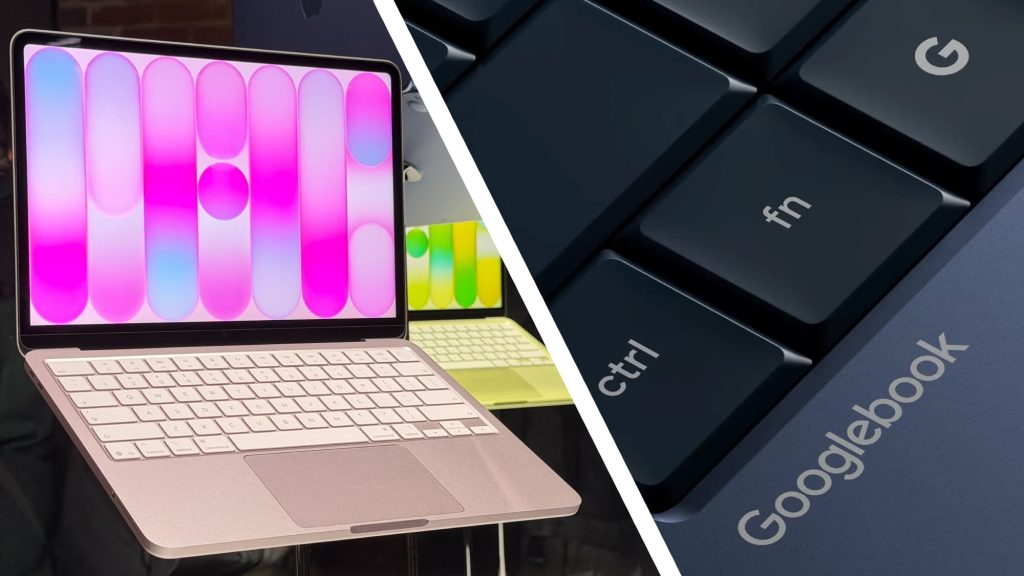
While OpenAI continues to sit pat on whatever device it is planning to build with Jony Ive, it is embarking on a journey that Google began years ago with the launch of the Android and Chrome OS operating systems followed by its own Pixel devices.
Long before anyone had heard of ChatGPT, Google CEO Sundar Pichai made clear that AI was a primary driver behind Google’s device push. Now, the company’s journey is about to take a turn with the launch of Googlebooks.
While Googlebooks and Chromebooks will coexist for a number of years, it’s clear that the former will eventually replace the latter. But are Googlebooks actually new “books” or really just new “chapters” that represent an evolution of the Chromebook. That depends on where the comparison lies.
Latest Videos FromTechRadar
Chromebooks have done an excellent job of retaining attributes such as ease of management, security, and affordability. On the other hand, the AI-first mission of the Googlebook represents a dramatic contrast from the cloud-first mission of the Chromebook, and the two platforms carry significant enough differences to justify the new naming.
Foremost, the Googlebooks’ new technical foundation of Android should greatly improve the performance and integration of Android apps versus today’s Chromebooks.
You may like
A crash landing from the cloud
Indeed, that serves as a reminder that the original philosophy of the Chromebook as a minimalist web app appliance disappeared a long time ago. And while it is still tough to beat the Chromebook when it comes to computing on a tight budget (Microsoft’s most recent attempt, the education-focused Surface Laptop SE, had the company’s quickest market retreat since Windows RT), Google and its partners have sought to climb the pricing ladder with Chromebook Pluses.
These devices, which have embraced higher quality materials and earlier access to Google’s AI innovations (albeit mostly cloud-based ones), have sold well enough to signal to Google that the market is ready for Windows alternatives that shift away from competing so heavily on price.
While it’s not a perfect parallel for what Apple was able to do in bringing kids who grew up with the Apple II to the Mac, Google has an opportunity to provide a more capable alternative to a generation of kids who grew up with Chromebooks, particularly at a time when AI stands to transform the PC experience from being a tool to being an agent.
(Image credit: Future)
And so the more important question becomes not how Googlebooks will diverge from Chromebooks, but how their new functionality will stack up to Windows, which will also of course continue to evolve.
In this sense, Google’s timing is excellent because it does not need to rely on Android versions of apps catching up to Windows versions; the company has never had much luck getting developers to optimize for Android platforms beyond the phone. Rather, it can compete on a new breed of AI-focused functionality.
But despite Microsoft pulling back from cramming CoPilot into every corner of its desktop operating system, it is still in the early days of integrating AI into that platform as well.
At Build, for example, Microsoft showed not only how it is bringing OpenClaw-pioneered workflows into Windows, but how it is expanding the supporting processor family to include the bold and powerful RTX Spark architecture from MediaTek and Nvidia.
That should put some distance between Windows and Android-based PCs at the top of the market, but the real test will come down to how well Microsoft can scale such AI down versus how well Google scales its desktop AI up.